The surge in global AI stocks over the past day can only be described as insane.
Global memory giant SK Hynix surged 12%, Micron Technology rose 11%, SanDisk gained 12%, while Samsung, affected by the strike, saw a slightly smaller increase of 5%. Meanwhile, demand for CPUs is also growing rapidly, with Intel soaring 13% and AMD jumping 16% in pre-market trading today, a complete breakout.
The reason this surge occurred in the last two days is that the Q1 earnings reports related to AI from various major companies generally exceeded expectations. For example, SK Hynix, a leading storage manufacturer, reported a Q1 profit of 175 billion (I've converted the unit to RMB), with a full-year forecast of 1-1.3 trillion. These figures are astounding; a company earning over 1 trillion a year with a profit margin exceeding 70% is insane.
SK Hynix distributes bonuses to its employees at a fixed rate of 10% of net profit. Last year, the average bonus per employee was over 600,000 yuan, and this year it is expected to be over 3 million yuan, which is a conservative estimate.
As I mentioned last night, the storage industry has high barriers to entry and high technological barriers. Currently, the three giants (SK Hynix, Samsung, and Micron) monopolize 90-95% of the market share. China's Changxin Memory has a market share of about 3%, which already makes it the fourth largest in the world. It will be difficult to catch up within 5 years. So for this cycle, we can only watch helplessly as the Koreans and Americans make a killing. They comfortably control the supply and raise prices, winning big.
The Changxin Memory Technologies Co., Ltd. (CMT), which I mentioned above, is not yet listed on the A-share market; it's going through the IPO process on the STAR Market. Once it's listed, it will take off directly. Other domestic storage-related companies include those specializing in design, those supplying chips for storage, and those making automotive-grade DRAM. They've managed to get involved but haven't directly benefited from the AI boom, and their profits can't compare to the three major international companies. However, domestic capital can't flow overseas, so it can only buy similar A-share listed companies, which have seen significant gains this year.
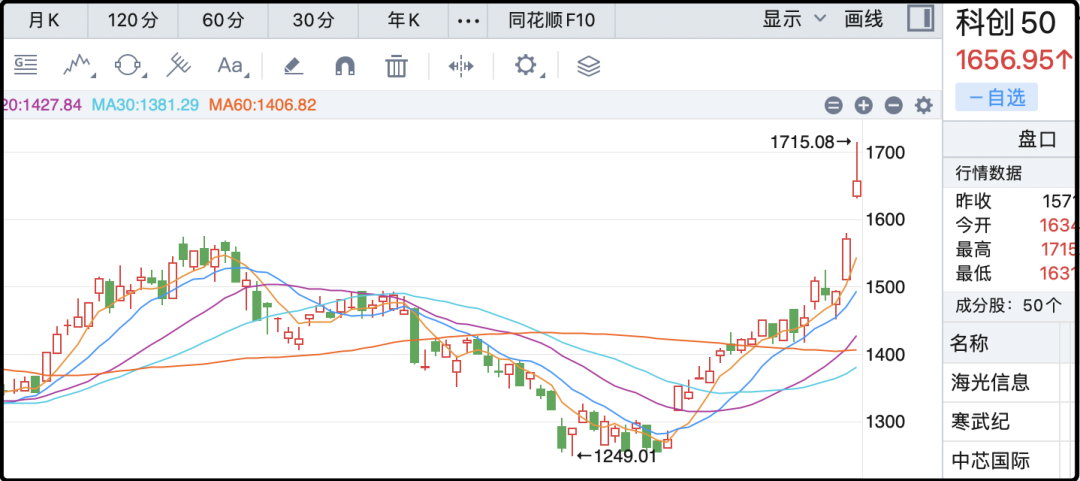
Leaving aside individual stocks, just look at how the STAR Market 50 Index rose by as much as 9% today. That shows how extreme the FOMO sentiment in the market is. People are envious of those who have it and laugh at those who don't. Funds that missed out are scrambling to buy in. At this point, nobody listens to talk about risks.
On the other side of the seesaw, Lao Deng Asset Management suffered a severe siphon effect, with the CSI Liquor Index falling another 1.6% today, bringing its year-to-date decline to 14%. Wuliangye, which experienced a financial crisis over the weekend, opened at -7%, attracting some bargain hunters, but ultimately closed at -5%.
Everyone was pessimistic about you, and you just didn't live up to expectations. The first-quarter reports of the consumer sector were collectively disappointing, those betting on a turnaround all lost their enthusiasm, and under this extreme pressure, more and more investors' mentality began to become unbalanced. In the past few days, the back-end has been flooded with questions about whether to cut your losses on Harden and chase AI.
I can't give you an answer to this question. You all know my situation. I haven't taken a clear side; I've just heavily invested in the CSI 500 and slowly rolled over contracts. The CSI 500 has risen 15% this year, and with the discount of nearly 19%, I'm already satisfied. Last year, I mentioned investing in broad-based indices at least five times. Buffett also gave this advice to investors. He told retail investors to buy the S&P 500. If you can't buy the S&P 500, buy the CSI 500. You won't lose out or be cheated.
As long as AI is still in a boom cycle, funds will continue to be siphoned off, and traditional industries will be continuously suppressed. Even if performance recovers, stock prices will be difficult to rise. Therefore, many people are discussing where this round of AI will rise to and whether it has already reached the top of the cycle.
I can't see too far ahead, but judging from the performance of related companies in the first quarter, they are still expanding rapidly. We should try to avoid making contrarian trades, otherwise it's like picking up coins in front of a road roller.
1. News broke this afternoon that the US and Iran may reach a ceasefire memorandum of understanding within 48 hours. The core of this memorandum is Iran's commitment to suspend uranium enrichment, the US lifting billions of dollars in sanctions on Iranian assets, gradually restoring navigation through the Strait of Hormuz, and the US gradually lifting its maritime blockade against Iran. Although this document is in the form of a memorandum, its legal binding force is weak. However, once signed, both sides will have 30 days to move towards a further ceasefire agreement, thus it has positive significance.
Following this news, Brent crude oil prices fell by 6-7%, showing some cooling, but still remained above $100. The impact of the US-Iran situation on the stock market is diminishing. Unless a full-scale war breaks out again (which is highly unlikely, <20%), other fluctuations will not significantly affect the market.
2. Wuliangye Group plans to increase its stake in the company by 3 to 5 billion yuan. I suspect some readers will be confused. Wuliangye Group is not the listed company Wuliangye, but the parent company and major shareholder of the listed company, holding 20% of the shares. If we include the Yibin State-owned Assets Supervision and Administration Commission, which is acting in concert, the total shareholding would be 55%.
When a listed company buys shares itself, it's called a share buyback; when a major shareholder buys shares, it's called an increase in holdings. The two are different. The 8-10 billion yuan buyback a few days ago was a repurchase, while this 3-5 billion yuan increase in holdings is an increase in holdings. Of course, the purpose is the same: to stabilize the stock price and prevent Wuliangye's share price from plummeting to the point of losing public trust, even though their actions this time have already damaged their credibility.
3. ST Wingtech hit its daily limit down, which wasn't unexpected. Wingtech's convertible bonds also crashed today, falling below 80 yuan at their lowest point. This bond matures next July with a redemption price of 108 yuan, yielding an annualized return of nearly 30%. On April 20th, I said it wasn't worth risking a 10% return unless the annualized return was above 25%, making a small position worthwhile. Is there a possibility of Wingtech defaulting? Of course, there is that risk; otherwise, how could a 30% annualized return allow you to effortlessly make money? In short, think carefully before acting, and don't gamble with chips you can't afford to lose.
I'm quite emotional today. Samsung and SK Hynix of South Korea may both have net profits exceeding 1 trillion won (RMB) this year. Considering South Korea's population is only 50 million, although this money can't be evenly distributed among the people, this windfall will still greatly enrich South Korean society. I'm wondering why Chinese companies have never had such good fortune. We monopolized electric vehicles, but only made a meager profit; we monopolized photovoltaics, but suffered huge losses while providing relief to others.
When will we no longer have to struggle to make money, no longer have to fight amongst ourselves, and finally be able to fleece the world's leeks? Let's do it!
That's all for tonight, launch.
Original Article: View Chinese Version