My buddies called me out for drinks tonight, and I got completely drunk. I'm too tired to go to sleep now. This was something I wrote in advance this afternoon. Sorry, I'm so sleepy, I'm going to sleep.
Last night, a childhood photo of Hu Ge appeared on the show "Dedication of Love." Some people said it didn't look like him and couldn't recognize him, but that might be due to the angle. This photo is definitely Hu Ge. I'll post another photo of him at the same age from another angle; you'll see the resemblance then.
Some people commented asking why they've always heard of the CP Group being huge, but don't seem to have much contact with it in daily life. I checked the data, and CP Group's annual revenue in China is in the 200 billion RMB range, with 80,000 employees—definitely a super-large company. However, their main business is agricultural and livestock feed, focusing on B2B business, so they don't have much contact with ordinary consumers (C2C). But many people should have heard of their supermarket brand, formerly known as Lotus Supermarket, which was later renamed CP Lotus.
The Charoen Pokphand Group is known as CP Group in Thailand. Its founder was Xie Yichu, a patriotic overseas Chinese. Xie Yichu was from Chaoshan and went to Southeast Asia in the 1920s to make a living. People from Chaoshan have a strong sense of national identity. He had four children named Zhengmin, Damin, Zhongmin, and Guomin, which together form the name "Chengda China." Xie Yichu donated money during the War of Resistance against Japan and actively returned to invest in China after the founding of the People's Republic. He has a long history of charitable donations, and many schools in China have buildings commemorating his success, making him a government-recognized role model for overseas Chinese.
Charoen Pokphand Group was once the largest shareholder of Ping An Insurance, but it later reduced its holdings and is now the third largest shareholder. Overall, Charoen Pokphand Group's presence in Chinese society has indeed declined since 2010, because their industries are all traditional industries and they have no connection with emerging industries such as the Internet, new energy, and AI. However, they are definitely considered "one of our own" among foreign companies, brothers who have supported each other through thick and thin since they started from humble beginnings.
Speaking of the variety show "Zhengda Variety Show," the one that impressed me the most was "The World Is Truly Amazing." A young female host traveled the world, introducing some exotic customs and cultures. That was more than 30 years ago in China, which was still somewhat backward and closed off. I'm not afraid to admit that my understanding of foreign countries at that time came almost entirely from watching "Zhengda Variety Show."
Deepseek has released version V4. The last update was version V3.2 released last December (Tencent Yuanbao is currently using this version). Everyone is concerned about what upgrades are included.
In short, the text throughput is significantly improved, increasing from the previous limit of 100,000 characters to 750,000 characters. Reasoning capabilities are also enhanced, and computational costs are reduced by one-third compared to the previous V3.2 version. DeepSeek was already renowned for its low cost, and now it's even cheaper with an additional discount.
You might find this hard to believe, but compared to top-tier US models like Claude and ChatGPT, the cost difference is over 50 times. Why is DeepSeek's cost advantage so significant?
To give a simple example, the American model always holds a general meeting to solve problems, with everyone (modules) in attendance. While this results in stronger and more comprehensive problem-solving capabilities, the manpower costs of holding these meetings are high. Deepseek, on the other hand, selects specific individuals (modules) to hold smaller meetings. Although the solutions may sometimes be slightly less satisfactory, it minimizes costs to the extreme.
In traditional industries, a cost difference of 5% or even 50 times can wipe out a company, let alone 50 times. But AI is still in its early stages, and humanity is actively exploring the limits of AI models; cost isn't the most important factor.
The American model has a first-mover advantage, maintaining a lead of about 5-10%. They are willing to invest heavily in this 5-10% advantage regardless of cost. I guess they have realized that even if they try to compete on cost, they will definitely not be able to beat China, so they might as well blindly forge ahead and create differentiation.
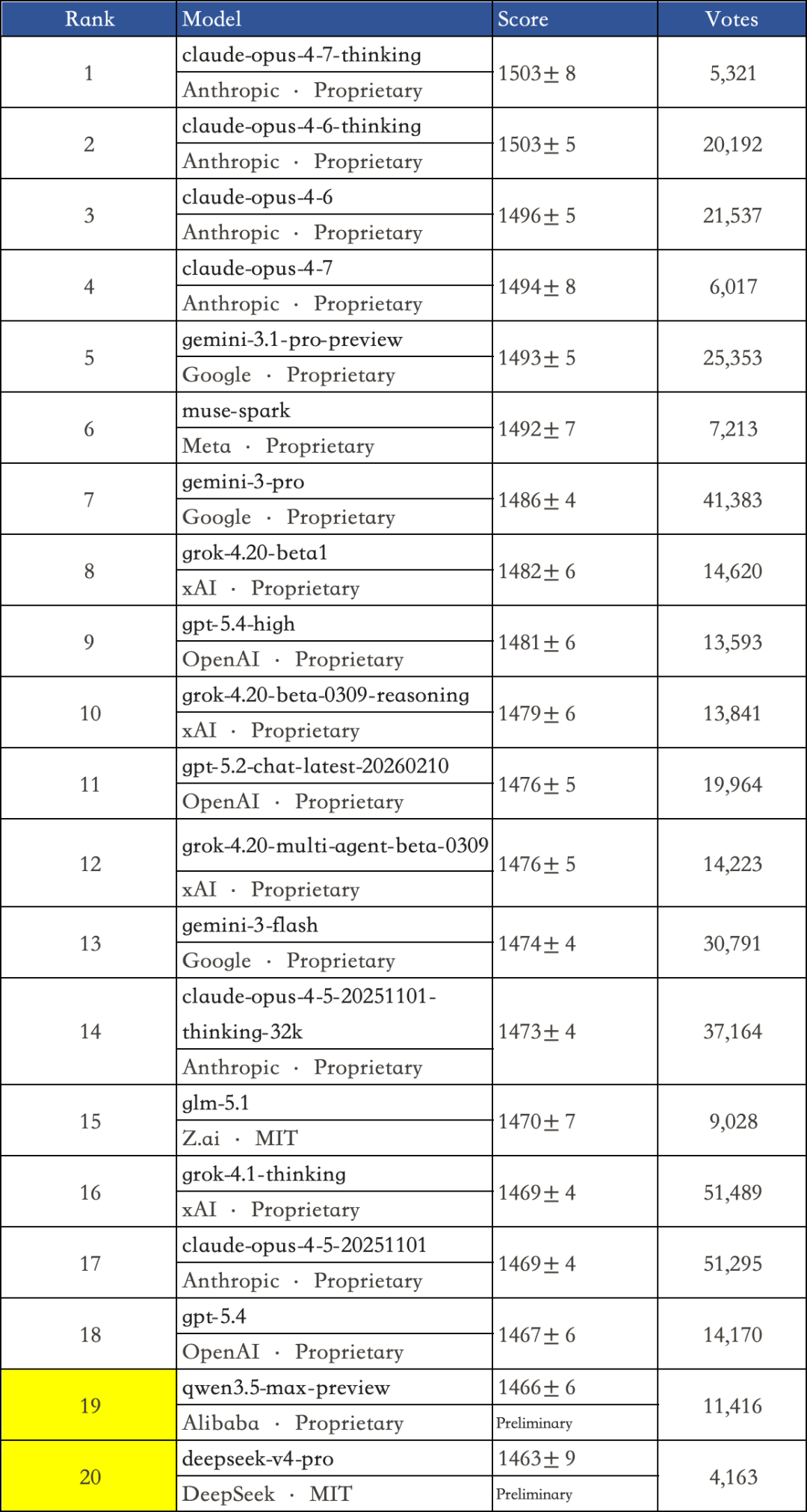
Another important point about DeepSeek is that it breaks free from Nvidia's chip dominance and can be fully compatible with Huawei and Cambricon's chips. Independent models + independent hardware = AI autonomy, eliminating concerns about being held back by technology.  I checked the latest ELO rankings, which is a blind test ranking of AI models, where human users subjectively score and compare them based on anonymous responses. Currently (on the 25th), v4 is ranked 20th, ahead of another domestic model, Qianwen 3.5-max.
P.S.: The ELO leaderboard includes over 340 global models, with the top 20 considered top-tier. Also, both Qianwen 3.5 and ds V4 are in Preliminary status, indicating they were recently launched and the sample size for scoring is still insufficient; there may be room for improvement in their scores later.
Yesterday, Kweichow Moutai released its first-quarter financial report, and all liquor shareholders waited anxiously for the results to be announced.
Revenue was 53.9 billion yuan, up 6.5% year-on-year; non-GAAP profit was 27.24 billion yuan, up 1.45% year-on-year, with a growth rate of only 1%.
The company reported operating cash flow of 43.2 billion yuan in the first quarter, a year-on-year increase of 205%, which sounds impressive. However, it was actually due to two large sums of money being returned upon maturity of wealth management products, and had nothing to do with selling alcohol.
Another significant change in the first-quarter report is that Moutai's direct sales reached 29.5 billion yuan, accounting for 55% of its total sales, exceeding half for the first time. The company cut 255 distributors in the first quarter, continuing its market share decline, somewhat resembling the discarding of a used product. However, there's little that can be done; the industry's overall economic climate is dire, and it can no longer support such a large interest group.
How was this quarterly report? Not ideal. The consensus among institutions was that the first quarter's profit would be around 29 billion, but the actual profit was about 7% lower. Fortunately, it didn't continue to decline. I think it's a slight negative, not a major disaster. Let's see how the market reacts next Monday.
I checked the latest ELO rankings, which is a blind test ranking of AI models, where human users subjectively score and compare them based on anonymous responses. Currently (on the 25th), v4 is ranked 20th, ahead of another domestic model, Qianwen 3.5-max.
P.S.: The ELO leaderboard includes over 340 global models, with the top 20 considered top-tier. Also, both Qianwen 3.5 and ds V4 are in Preliminary status, indicating they were recently launched and the sample size for scoring is still insufficient; there may be room for improvement in their scores later.
Yesterday, Kweichow Moutai released its first-quarter financial report, and all liquor shareholders waited anxiously for the results to be announced.
Revenue was 53.9 billion yuan, up 6.5% year-on-year; non-GAAP profit was 27.24 billion yuan, up 1.45% year-on-year, with a growth rate of only 1%.
The company reported operating cash flow of 43.2 billion yuan in the first quarter, a year-on-year increase of 205%, which sounds impressive. However, it was actually due to two large sums of money being returned upon maturity of wealth management products, and had nothing to do with selling alcohol.
Another significant change in the first-quarter report is that Moutai's direct sales reached 29.5 billion yuan, accounting for 55% of its total sales, exceeding half for the first time. The company cut 255 distributors in the first quarter, continuing its market share decline, somewhat resembling the discarding of a used product. However, there's little that can be done; the industry's overall economic climate is dire, and it can no longer support such a large interest group.
How was this quarterly report? Not ideal. The consensus among institutions was that the first quarter's profit would be around 29 billion, but the actual profit was about 7% lower. Fortunately, it didn't continue to decline. I think it's a slight negative, not a major disaster. Let's see how the market reacts next Monday.
Original Article: View Chinese Version