Tonight I plan to spend some time explaining the pork cycle, because I think it's currently at a historical turning point and will be a hot investment area in the future.
First, let's clarify the commonly used prices. The most important one is the price of live pigs at slaughter. The latest price is about 8.7 yuan/kg. When I mentioned this price before, many readers got anxious because they thought the price in supermarkets was much higher. That's because live pigs go through slaughtering, processing, wholesale, and retail. Each step adds a little cost. By the time they are sold in supermarkets, the price is about 20-24 yuan/kg.
Well-known listed companies, such as Muyuan Foods, New Hope Group, and Wens Foodstuff Group, raise pigs and sell them at the ex-farm price, which is currently less than 9 yuan. Their breeding costs are generally in the range of 11.5-13 yuan.
That's right, everyone is currently suffering deep losses. Every animal they raise loses money, with an average loss of 200-400 yuan per animal.
The root of all this can be traced back to the African swine fever outbreak from 2018 to 2020. Because many pigs died, pork prices skyrocketed, with the price of live pigs reaching as high as 40 yuan per kilogram. Do the math yourself: the cost is only a dozen yuan, with a profit margin of over 100%. Raising a single pig could generate a profit of 2,000 to 2,500 yuan, so the entire industry frantically expanded its production capacity.
One memorable thing from that time was that one of my neighbors, who mainly raised pigs, sold his house to buy more sows. Looking back now, both house prices and pig prices were at historical highs at the time.
The reasonable number of breeding sows in the Chinese market is about 37-38 million. In 2021, the number peaked at over 45 million, but has gradually declined in recent years, returning to just over 39 million.
Some readers may be wondering why pork is still in oversupply and prices are falling. The answer lies in two other key figures that have changed. One is psyll (piglets born per sow per year). Previously, with less advanced techniques, sows could produce 17-18 piglets a year. In recent years, with improved techniques, this has increased to 27-29 piglets, a 40-50% increase in production capacity.
As an aside, pig farming techniques are more advanced in Europe, where the average number of pigs per sow (PSY) is generally over 30, sometimes even approaching 40.
Another figure is the weight of a single pig. In 2018, the average weight was 110kg per pig. Now, with better fattening technology, they can generally be raised to 125-130kg, an increase of 15-20kg.
Therefore, with the number of sows remaining the same, the number of piglets born increased by 40-50%, and the weight of each pig increased by 15-20%. The supply was too large, and the Chinese people could not consume it all, so the price was driven down.
Currently, the price of live pigs at slaughter is the second lowest in nearly 20 years, approaching the level of 2006. However, considering inflation and currency devaluation over the past 20 years, the actual price of pork is already at a historical low, which is quite dire. The highest alert level set by the state for the pig-to-grain ratio is 5:1, which would trigger strategic stockpiling, but the latest pig-to-grain ratio has fallen to 3.66:1.
Seeing this, you will surely realize that pork prices cannot remain this low indefinitely, as this does not conform to price patterns, and the subsequent elimination of outdated production capacity in the industry will definitely lead to a recovery.
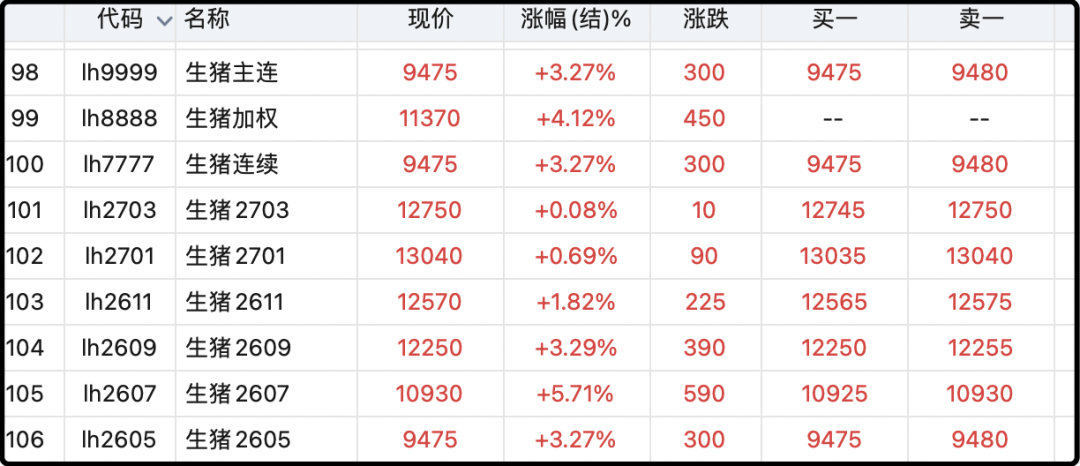
Yes, that's what pigs think too. I checked the hog futures price yesterday. The main contract for May was 9475, which means 9475 yuan per ton of pork, or 9.47 yuan per kilogram. That's about 10% more expensive than the spot price I mentioned above.
That's not even the worst part. The July contract is 10930, and the September contract is 12250, with an average monthly premium of 7%. This means that the market expects pork prices to rise by 25-30% in the next four months, and the premium has already priced it in advance. After considering all factors, I determined that the risk-reward ratio for bottom fishing was not high enough, so I gave up.
Since futures are not suitable, how about buying stocks in the pig farming sector? I actually took a look at it quietly a few days ago. During the bull market in A-shares over the past year and a half, pig farming actually declined slightly against the trend, but the overall decline was far less than the decline in pork prices. The investors in the sector are quite resilient. They must know that we are currently at a cyclical trough. Not many people are really willing to cut their losses at this point. They all want to grit their teeth and get through it.
Simply put, the pit wasn't dug deep enough or severe enough, resulting in a smaller-than-expected rebound. The risk-reward ratio is better than futures, but not good enough to tempt me to jump on the bandwagon.
That's all for the pork topic. You should be able to understand most of the content. If you have any questions about the futures section, you can use AI assistance.
1. Today, the Associated Press, citing anonymous officials, reported that the US and Iran have agreed in principle to extend the ceasefire, but this is not recognized by either side, which remains committed to the April 22nd cutoff line. The US military is still blockading the Gulf, preventing Iranian ships from leaving, although neutral countries are allowing passage; more than 20 merchant ships have passed through in the past 24 hours. Iran has collected tens of millions in transit fees, but its own oil cannot be sold.
2. Duan Yongping's put option positions have been disclosed. If they are triggered, the total size will be HK$6.7 billion. He himself said that he placed the order by mistake; he originally intended to sell HK$3.4 billion worth of put options, but due to a lack of understanding of the rules, he ended up with double the amount. HK$6.7 billion is a fairly heavy position for him, not just for fun.
These put options have a strike price of HK$150, and a significant portion of them expire on April 29th, with a premium of HK$3.50. I hadn't paid attention to individual stock options before, but calculating it this way, the 14-day premium is 2.18%, which translates to an annualized return of 57%, higher than I expected.
When the price of the two-yuan coin was around $2,000, I also aggressively sold put options (1,800-1,900), and the annualized interest rate was 20-30%, which is not as high as the premium income of Pop Mart.
3. CATL announced a first-quarter profit of 20.738 billion yuan, a year-on-year increase of 48.5%, with revenue increasing by 52%. This performance is phenomenal. A 40-50% growth rate despite its large scale makes it seem like it's raking in all the money from upstream and downstream industries. The electric vehicle industry is so competitive it's practically cannibalizing each other. Even the rats in CATL's granary are getting fat and need to lose weight.
Therefore, the ChiNext board is quite strong, with the largest weighted stocks being either lithium batteries or optical modules, hitting the mark perfectly.
That's all for tonight, time to go.
Original Article: View Chinese Version