The temporary ceasefire agreement took effect at 8 a.m. Beijing time on Wednesday, and it is already at risk of collapse after only one day.
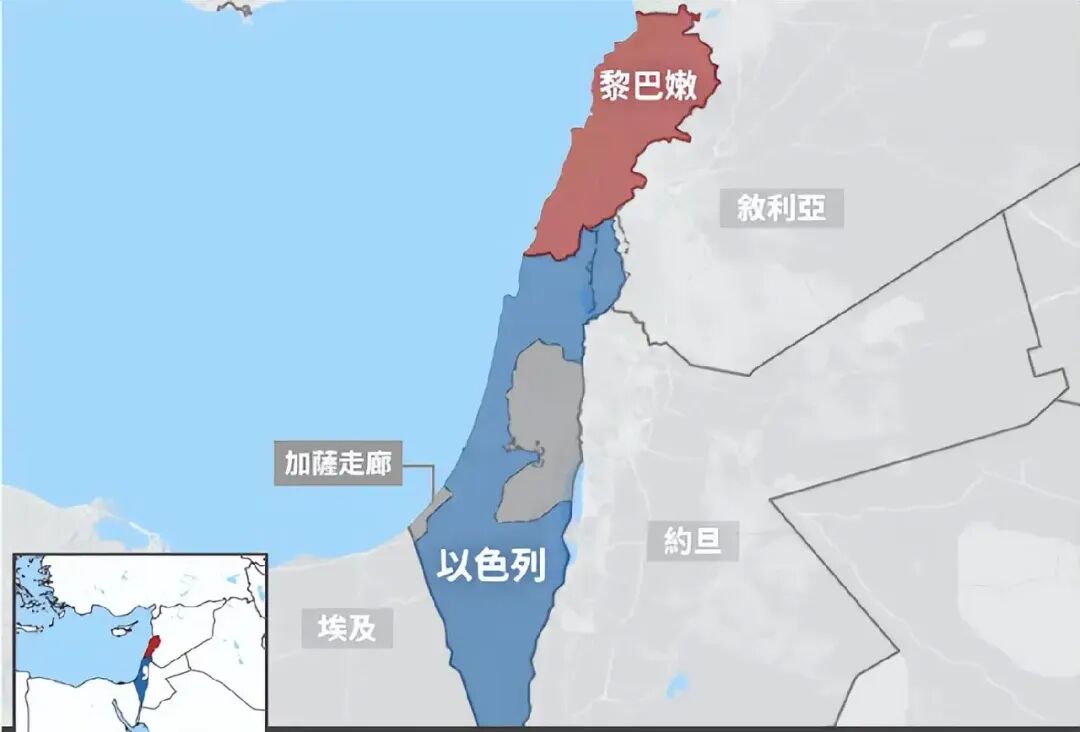
First, Israel continued its fierce attack on Hezbollah, launching its most intense single-day strike since the start of the war. Initially, it was claimed that Qassem was killed, but this was later corrected to say that it was Qassem's (private secretary's) nephew. Hezbollah has been hostile to Israel since its founding in 1982, engaging in 44 years of conflict. They are also the core force of the Iranian-led "Arc of Resistance," with Iran providing its allies with $2-3 billion in aid annually, roughly half of which goes to Hezbollah.
Iran was furious at Israel's actions, claiming they violated the ceasefire agreement. However, the United States insisted that the war in Lebanon was a separate war unrelated to the current ceasefire agreement, and that they had no obligation to restrain Israel.
Then, even before negotiations began, serious disagreements arose between the two sides on core issues. The White House accused the media of spreading false and erroneous reports about the so-called "Ten Points to Iran," claiming they were fabricated and incorrect, and that the negotiating terms they received from Iran were a different version that could still serve as a basis for negotiations.
Actually, I said yesterday that it was impossible. The conditions Iran offered made it seem like they had already won a complete victory, but in reality, they were surrounded and bombed for a month, their planes couldn't take to the skies, and their ships couldn't leave the sea. If you take the "Ten Iran Terms" to domestic AI (information technology), they'll also say it's impossible.
There are two possibilities: one is that Pakistan is deceiving both sides, trying to persuade Iran and the United States to cease fire, which has a 20% probability; the other is that Iran is giving the United States a negotiable version, while simultaneously promoting a completely victorious version domestically to stabilize the high-pressure situation at home, which has a 75% probability; and there is a 5% probability that Trump is planning to sell out the country and is holding back a big one.
Both sides are giving conflicting accounts on uranium enrichment today. Iran says it won't hand it over, claiming it's a legitimate civilian right, while the US says it must hand it over, or it will come and get it itself.
This is the second crack.
In retaliation, Iran announced the re-closure of the Strait of Hormuz. Interestingly, the White House stated, "This is a case of what they're saying publicly is different privately." In other words, Iran's public statements and private communications are inconsistent. The US has observed an increase in traffic through the Strait of Hormuz in recent days, so it does not believe that Iran is violating the agreement.
Judging from the reactions of the capital market and oil prices, there is some anxiety about the collapse of the ceasefire agreement. Oil prices rebounded by 4% today, which is about one-third of yesterday's drop, but at least as of the time of writing, the ceasefire negotiations are still moving forward in a shaky manner.
Oh, by the way, I saw a report today that Israel attacked Iranian territory after the ceasefire agreement took effect. That news is inaccurate; Israel has not acknowledged it. You can ask Doubao and Yuanbao, and they both say yes, but chatgpt, gemini, and grok all say no. So, did they actually fight? I tend to think no, because if they had, the A-shares market wouldn't tolerate it.
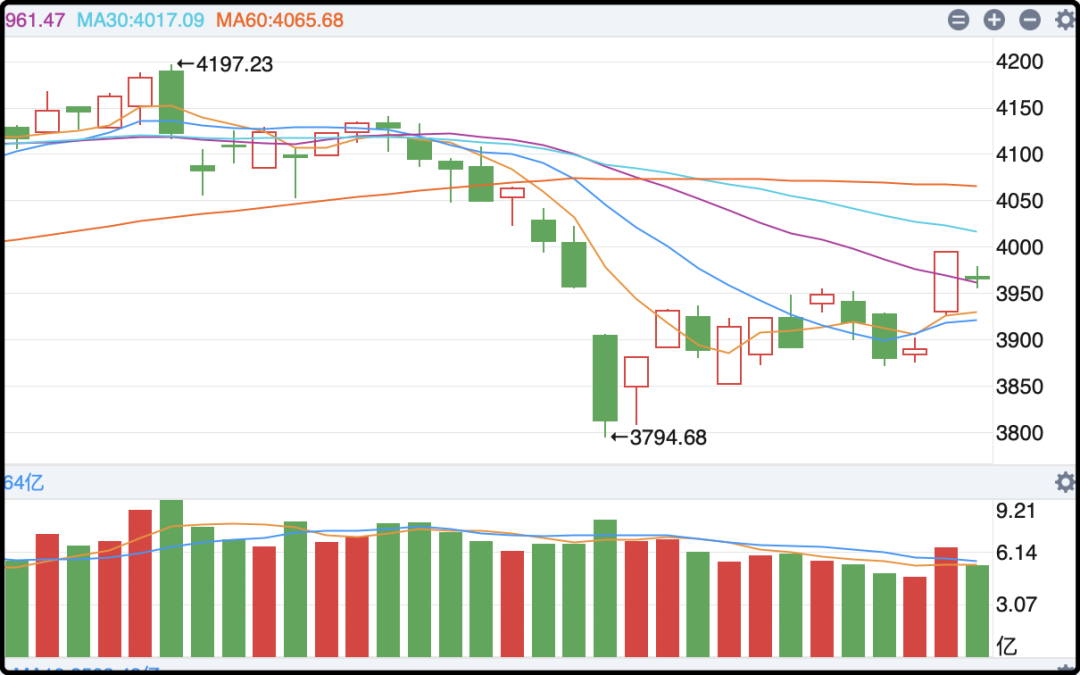
Global stock markets saw a slight pullback today, and the A-share market was no exception, with a turnover of 2.13 trillion yuan and a median decline of 1.55%. This roughly wiped out one-third of yesterday's gains, similar to what I mentioned earlier regarding oil prices. This reflects a rational pricing of potential risks after yesterday's broad-based rally, as the market returns to calm.
The ceasefire negotiations are visibly difficult. I don't know what Iran's real bottom line is, because every time they make a public statement, they make a grand declaration of victory, and the conditions they offer seem like a joke. Trump said the real negotiating conditions are completely different, but this time the big mouth has kept his mouth shut and hasn't told anyone what his version is.
I asked AIs both in China and abroad what the most likely outcome of this negotiation would be. They generally felt that the probability of reaching a perfect peace agreement was very low, only 10-15%. The most likely outcome was an extension of the ceasefire agreement, with a probability of 50-60% as the tug-of-war continued. If you subtract the two probabilities from 100%, what's left is a renewed war.
This is the risk of your holdings in the near future. Of course, the A-share market as a whole is in a downward trend, so good news will be weakened and bad news will be amplified. So unless there are any surprises, the probability of filling the gap in the next 1-2 weeks is quite high. This is for reference only, and you bear the risk yourself.
1. Goldman Sachs' latest analysis suggests that Brent crude oil prices will reach $90 and WTI crude oil prices will reach $87 in the second quarter, both about 5% lower than the current prices. Therefore, Goldman Sachs' assessment of the situation in Iran is relatively optimistic.
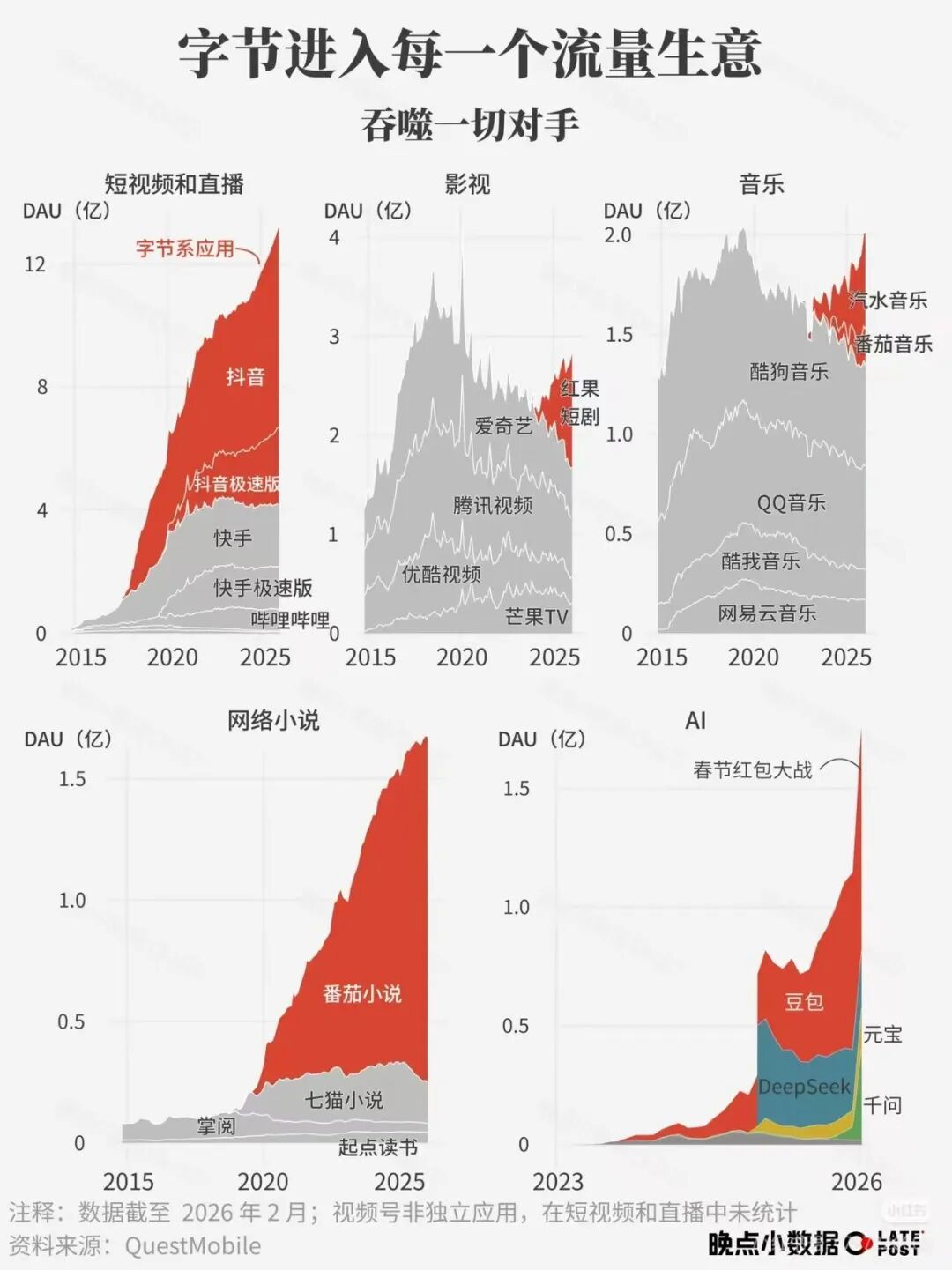
2. Today I saw an article on the self-media platform "LatePost" that basically said ByteDance is leveraging its traffic advantage to make rapid progress in multiple business lines, impacting the landscape of several industries. One particular trend chart really stuck with me, so I'm sharing it here:
In fields such as short videos, live streaming, short dramas, music, online novels, and AI, ByteDance quickly captures a large market share whenever it starts to exert its strength. There is also an e-commerce sector in the picture that is not included in the statistics. In 2020, ByteDance's market share in e-commerce was 12%, which has soared to 24% by 2025, second only to Taobao Group with 31%. Judging from the growth trend, it has the opportunity to reach the top around 2030.
So there was a hot topic on the internet before that the slump in the Chinese internet sector was partly due to ByteDance's suppression, and I think there's some truth to that. ByteDance is a very good company, and their biggest drawback right now is that I haven't been able to buy their stock yet. They're quietly making a fortune without sharing it with the public, which only makes more and more people envious and jealous.
3. CITIC Securities reported a first-quarter profit of 10.2 billion yuan, a year-on-year increase of 54%, which is excellent performance. However, its stock price fell by 15% in the first quarter. Investors holding securities stocks have been among the most disappointed groups in the past two years. No matter how much a listed company earns, it cannot be reflected in the stock price. The PE and PB ratios are getting lower and lower, but they are just numbers. Share buybacks are impossible, and dividends are not generous. Let's continue to fool them.
4. In March, global gold ETFs saw outflows of $12 billion, with North America selling $14 billion and Asia buying $1.9 billion. Other regions saw little change in inflows or outflows.
That's all for tonight, time to get to work.
Original Article: View Chinese Version