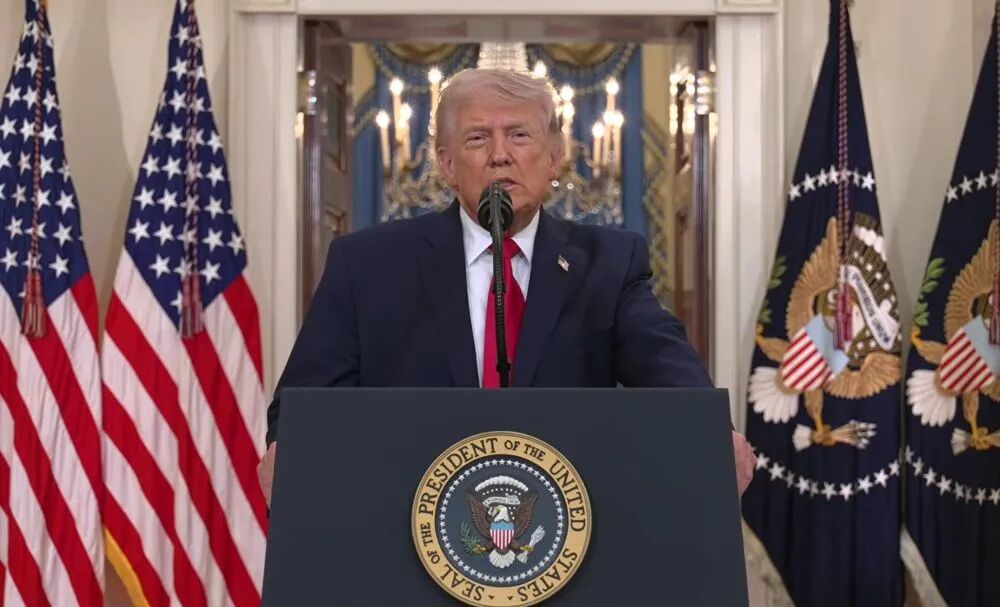
At 9 p.m. Eastern Time on Wednesday, which is 9 a.m. Beijing Time on Thursday, Trump delivered his latest national televised address, reversing the situation once again and significantly impacting the capital markets.
I suspect this old guy did it on purpose. The US stock market had already closed for 5 hours, but the A-share market was about to open in a dozen minutes. Damn it, this is targeted bombing.
His speech mainly consisted of boasting to the American people, claiming that Iran had been crippled, with its military, nuclear, and missile facilities severely destroyed, and that the United States had achieved an overwhelming victory. He also stated that although the Strait of Hormuz was blocked by Iran, the United States did not need the strait, and that those countries that relied on it should resolve their own problems.
The key point is that the strikes against Iran will be intensified in the next 2-3 weeks, starting with the destruction of power plants across the country. If Iran does not compromise, energy facilities may also be attacked.
Before he even finished speaking, oil prices surged 8%, reaching a recent high of $108. Gold, which had already rebounded to $4800 yesterday, was hammered back down to $4600. Japanese and South Korean stock markets, which had been relatively stable after opening this morning, were also devastated by Trump's remarks.
As for A-shares, they opened lower and continued to decline throughout the day, with a median decline of -1.86%. Yesterday's rebound wasn't enough to push the market down further.
This is the current state of the stock market. The US and Iran are hurting each other militarily and pulling each other back and forth politically, causing international oil prices to fluctuate wildly. The stock market changes faster than turning the pages of a book, and short-term fluctuations are unpredictable.
Because there is too much conflicting information, no one can guess what the real bottom line of the United States and Iran is. In fact, I think there is no irreconcilable contradiction between the two sides, and they can make an exchange by taking a step back.
The United States demands a permanent ban on nuclear weapons in exchange for Iran retaining its mainstream civilian nuclear industry.
The United States demands a halt to its support for proxy wars in exchange for Iran retaining its missile self-defense capabilities.
The United States is demanding that the Strait of Hormuz be opened in exchange for Iran gradually lifting economic sanctions.
The United States demands that Iran retain its hegemony in the Middle East in exchange for not being attacked again.
Look at these sets of exchange equations I've listed. It's clear that negotiations are possible, but both sides are too arrogant, each believing they have the upper hand. So they want to escalate the pain of war to force the other to back down. Humans are inherently warlike and cruel. Let them fight! Next week, the US military will bomb Iran's power plants, Iran will bomb the surrounding water plants, and the entire Middle East will be back to the days of relying on firewood and water carriers.
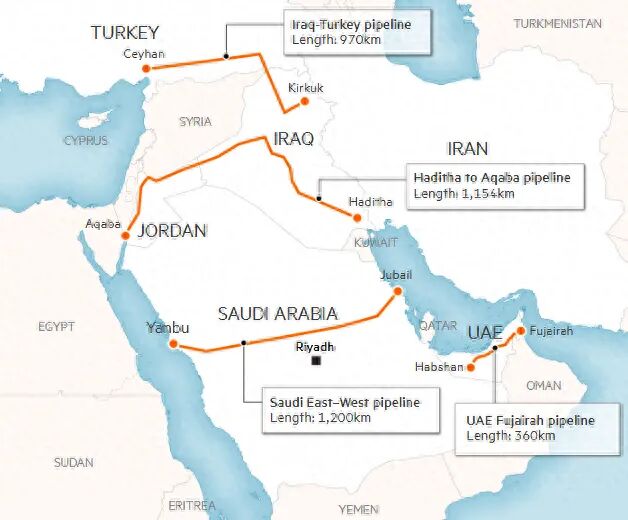
Reports indicate that Gulf states are considering new pipelines to bypass the Strait of Hormuz for oil transportation. The news broke around lunchtime, causing CNPC Engineering to surge to its daily limit and CNOOC Engineering to rise by 4%.
Even if pipelines are built, they cannot solve the short-term problem; it will take at least 3-5 years. At this stage, what these countries can do is expand the capacity of existing pipelines. Saudi Arabia and the UAE are already doing this, with about 40% of their oil being transported via pipelines. However, there is still a gap of more than 10 million barrels that is stuck.
I estimate that the countries in the Persian Gulf have figured it out. Even if Iran says it will open the Strait of Hormuz, it's unreliable. If a war breaks out, they'll close the port again and suppress oil prices. It's better to spend money to build pipelines to bypass the strait, which would require an investment of about $200-400 billion. This is indeed a huge, essential order.
China has the West-to-East Gas Pipeline, while the princes have the East-to-West Gas Pipeline; if you can't afford to offend them, you can only hide.
1. This Friday, the central government will purchase frozen pork from its reserves because the pig-to-corn ratio has fallen to 4:1, triggering a level-one warning. At this point, the government will initiate pork stockpiling. The pig-to-corn ratio is calculated by dividing the national farm-gate price of live pigs by the national wholesale price of corn. Corn accounts for about 70% of pig feed costs. A pig-to-corn ratio below 6:1 is considered the break-even point for the entire industry; the current ratio of 4:1 indicates that the entire industry is generally operating at a loss. Stockpiling events like this may boost stock prices in the short term, but with pork prices hovering at low levels, a stock price recovery will be difficult. The consumer sector has been truly miserable in recent years.  2. The latest opinion poll released yesterday shows that Trump's approval rating for managing the economy is 31%, a record low; his approval rating for handling inflation is 28%, down 7% from January; and 65% of the public believes the economy is deteriorating, up 10% from January. Currently, US oil prices have exceeded $4 per gallon, which is approximately 7.3 yuan per liter, and 86% of Americans are worried about inflation.
The previous protests involving millions of people weren't necessarily anti-war; after all, nobody seemed to care about the swift capture of Maduro. What they were truly opposed to was rising prices. This is the core of the Iranian game: they don't have the ability to defeat the US military, but they do have the ability to hurt the wallets of ordinary Americans.
3. The wholesale price of a case of Moutai has risen to 1730 yuan, and iMoutai has tightened its purchase rules again, limiting each person to one purchase per day. All these signs indicate that the liquor industry, at least the high-end liquor sector, is showing signs of recovery; however, there is still no consensus on the price of liquor stocks.
4. Artemis 2 has been successfully launched and will then conduct a 10-day lunar orbit mission. It will not land on the moon, but will instead use the moon's gravity assist to return to Earth. This mission marks humanity's return to the moon and lays the foundation for the subsequent Artemis 3 manned lunar landing. This should have been a major event for commercial spaceflight, but the hype surrounding this sector has died down, and funds are flowing out. Even SpaceX's imminent IPO hasn't generated much buzz. Those still holding onto their funds in the commercial spaceflight sector need to seriously reassess the situation.
That's all for tonight. I was supposed to announce the winners of the trip for parents, but something unexpected happened. Out of the 20 notified winners, 2-3 people voluntarily withdrew. The reason was that their parents were unwell, didn't have time, or didn't want to stay overnight. So I'll have to find other readers to make up the difference, and confirmation will be delayed by 1-2 days.
Finally, thank you to the 90,000 readers who sent me payment last night. (bows deeply)
2. The latest opinion poll released yesterday shows that Trump's approval rating for managing the economy is 31%, a record low; his approval rating for handling inflation is 28%, down 7% from January; and 65% of the public believes the economy is deteriorating, up 10% from January. Currently, US oil prices have exceeded $4 per gallon, which is approximately 7.3 yuan per liter, and 86% of Americans are worried about inflation.
The previous protests involving millions of people weren't necessarily anti-war; after all, nobody seemed to care about the swift capture of Maduro. What they were truly opposed to was rising prices. This is the core of the Iranian game: they don't have the ability to defeat the US military, but they do have the ability to hurt the wallets of ordinary Americans.
3. The wholesale price of a case of Moutai has risen to 1730 yuan, and iMoutai has tightened its purchase rules again, limiting each person to one purchase per day. All these signs indicate that the liquor industry, at least the high-end liquor sector, is showing signs of recovery; however, there is still no consensus on the price of liquor stocks.
4. Artemis 2 has been successfully launched and will then conduct a 10-day lunar orbit mission. It will not land on the moon, but will instead use the moon's gravity assist to return to Earth. This mission marks humanity's return to the moon and lays the foundation for the subsequent Artemis 3 manned lunar landing. This should have been a major event for commercial spaceflight, but the hype surrounding this sector has died down, and funds are flowing out. Even SpaceX's imminent IPO hasn't generated much buzz. Those still holding onto their funds in the commercial spaceflight sector need to seriously reassess the situation.
That's all for tonight. I was supposed to announce the winners of the trip for parents, but something unexpected happened. Out of the 20 notified winners, 2-3 people voluntarily withdrew. The reason was that their parents were unwell, didn't have time, or didn't want to stay overnight. So I'll have to find other readers to make up the difference, and confirmation will be delayed by 1-2 days.
Finally, thank you to the 90,000 readers who sent me payment last night. (bows deeply)
Original Article: View Chinese Version