The event I posted at 5:30 pm today already has 130,000 messages in the backend. In addition to signing up for the event, many readers also took the opportunity to share their family situations and their feelings for their parents, which moved me deeply.
Some readers said that 20 spots were too few, and the chances of winning seemed slim. Indeed, it's very few; the probability is probably one in ten thousand. This is the first time we've done a similar event, and my assistant told me to focus on controlling the number of participants to ensure a successful event, and we can continue to organize more later.
Even if I doubled the money, the number of readers I could win would still be far from enough. I started this event simply to give everyone a little encouragement, to help them complete things they've been planning to do but have repeatedly put off, and to avoid leaving regrets in life.  The most unexpected news I heard today is that Moutai has actually raised its price, marking the first increase in eight years.
The ex-factory price of 53-degree Feitian Moutai has been adjusted from 1,169 yuan to 1,269 yuan, an increase of 8.55%; the official self-operated retail price has been adjusted from 1,499 yuan to 1,539 yuan, an increase of 2.67%.
To put it simply, the ex-factory price is the price that Moutai gives to its distributors. Previously, it was always 1169 yuan. A few years ago, when the market was booming, the market price of Moutai reached 2500-2700 yuan, a difference of up to 1500 yuan per bottle. For distributors, getting more Feitian Moutai is practically equivalent to receiving direct cash payments; this alone generates profits in the tens of billions of yuan.
So you see, three consecutive chairmen of Moutai have been imprisoned; two were sentenced to life imprisonment for embezzling nine-figure sums, and another is currently on trial—all because of corruption and rent-seeking in the distributor channel. One of Moutai's reform strategies in recent years has been to gradually reduce the influence of its distributor network and increase the proportion of direct sales to consumers, converting the money that distributors previously earned passively into company profits.
For example, look at this time: the official retail price increased by 2.67%, and the ex-factory price increased by 8.55%. With this adjustment, dealers will earn 6% less.
What truly surprised me was that Moutai chose to raise prices at a time when overall liquor consumption is sluggish. Even a small increase is still an increase, and a price hike indicates a market recovery and price stabilization. Following Moutai's price adjustment announcement, the secondary market price for liquor jumped by 100 yuan tonight.
The CSI Liquor Index has fallen 10.6% this year, marking its sixth consecutive year of decline. However, liquor consumption in January and February increased by 19% year-on-year, the fastest growth rate among all commodity categories. I now suspect that the stock price at this level is being unfairly punished, or that the price reaction is lagging. I think the liquor sector offers good value at the current level, somewhat like the photovoltaic and lithium battery sectors a couple of years ago. Those with positions should hold on until now and not give up easily.
Today, A-shares opened sharply lower due to the weekend situation in Iran, but miraculously recovered before lunch break, with my CSI 500 index even turning slightly positive. Actually, the Asia-Pacific region was generally bad today; Nikkei, South Korean, Hong Kong, Taiwan, and India all saw significant declines. A-shares do have a somewhat unpredictable nature; you might often criticize them as hopeless, but when other sectors collapse, this lump of mud occasionally manages to stand up.
The market is currently in a rather delicate position. The upward trend has been broken, and it has now reached the platform built between September and December last year. After the bulls found support, they put up a daily-level resistance, and the market is temporarily stuck at this position.
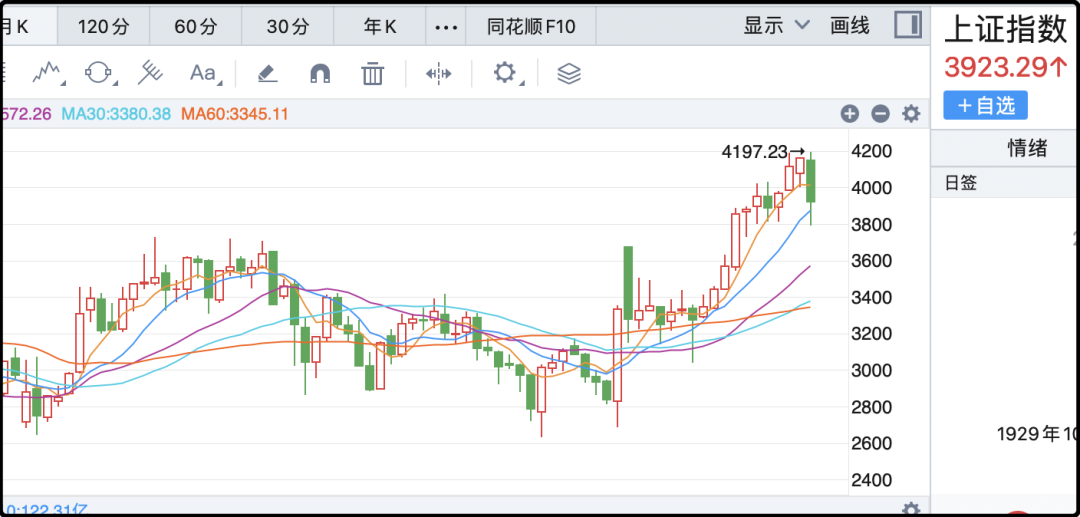
Many people are discussing whether this bull market is completely over, but I think it's too early to draw that conclusion, at least at this stage. Looking at the Shanghai Composite Index's monthly chart, March showed a typical pullback, and the chart pattern hasn't reached a point of no return. As a market rally that has been anticipated for 10 years, I think the current performance is below expectations for a bull market 3.0.
I haven't considered reducing my IC holdings. I sold my last lot at 7770, and now that it's back to that level, I don't plan to sell again. As for bottom fishing above 7000 points, I'm not thinking about that. I'll see how things go below 7000 points. The current level is neither high nor low, so it's kind of a dilemma. Fortunately, the current annualized discount is 9%, so I'm happy to wait and see.
1. Today, the power sector fell sharply by 4%, ranking first in the decline list. This was mainly due to the release of a new policy (draft for comments) on coal-fired power capacity pricing. Regardless of whether thermal power plants generate electricity, there are daily operation and maintenance costs. Therefore, the government stipulates that thermal power plants will receive a minimum wage as long as they can provide power at any time, regardless of whether they generate electricity or not.
New policies have been introduced, providing only a "minimum wage" to compliant and efficient coal-fired power plants, while older thermal power plants will be phased out. That's why you see small-scale thermal power companies' stock prices plummeting today, but companies like Yangtze Power are largely unaffected. China will definitely undergo a large-scale transition to green energy in the future, and the gradual elimination of outdated thermal power capacity is an inevitable trend.
2. Midea Group plans to repurchase A-shares worth 6.5-13 billion yuan. This amount is very large, but what I don't understand is that the purpose is not cancellation, but employee stock ownership plan or equity incentive. Does the latter require such a large scale? To be honest, I don't understand it. I will have to look into it more carefully later.
3. SF Holding has adjusted its share repurchase plan, increasing the repurchase amount to 3-6 billion yuan, double the previous 1.5-3 billion yuan. The intended use of the repurchased shares has also been changed to share cancellation, which is correct. However, SF simultaneously announced plans to use 38 billion yuan of its own funds to purchase low-risk bank wealth management products. Clearly, SF believes that buying its own company's stock is definitely not a low-risk investment; it's extremely risky.
The most unexpected news I heard today is that Moutai has actually raised its price, marking the first increase in eight years.
The ex-factory price of 53-degree Feitian Moutai has been adjusted from 1,169 yuan to 1,269 yuan, an increase of 8.55%; the official self-operated retail price has been adjusted from 1,499 yuan to 1,539 yuan, an increase of 2.67%.
To put it simply, the ex-factory price is the price that Moutai gives to its distributors. Previously, it was always 1169 yuan. A few years ago, when the market was booming, the market price of Moutai reached 2500-2700 yuan, a difference of up to 1500 yuan per bottle. For distributors, getting more Feitian Moutai is practically equivalent to receiving direct cash payments; this alone generates profits in the tens of billions of yuan.
So you see, three consecutive chairmen of Moutai have been imprisoned; two were sentenced to life imprisonment for embezzling nine-figure sums, and another is currently on trial—all because of corruption and rent-seeking in the distributor channel. One of Moutai's reform strategies in recent years has been to gradually reduce the influence of its distributor network and increase the proportion of direct sales to consumers, converting the money that distributors previously earned passively into company profits.
For example, look at this time: the official retail price increased by 2.67%, and the ex-factory price increased by 8.55%. With this adjustment, dealers will earn 6% less.
What truly surprised me was that Moutai chose to raise prices at a time when overall liquor consumption is sluggish. Even a small increase is still an increase, and a price hike indicates a market recovery and price stabilization. Following Moutai's price adjustment announcement, the secondary market price for liquor jumped by 100 yuan tonight.
The CSI Liquor Index has fallen 10.6% this year, marking its sixth consecutive year of decline. However, liquor consumption in January and February increased by 19% year-on-year, the fastest growth rate among all commodity categories. I now suspect that the stock price at this level is being unfairly punished, or that the price reaction is lagging. I think the liquor sector offers good value at the current level, somewhat like the photovoltaic and lithium battery sectors a couple of years ago. Those with positions should hold on until now and not give up easily.
Today, A-shares opened sharply lower due to the weekend situation in Iran, but miraculously recovered before lunch break, with my CSI 500 index even turning slightly positive. Actually, the Asia-Pacific region was generally bad today; Nikkei, South Korean, Hong Kong, Taiwan, and India all saw significant declines. A-shares do have a somewhat unpredictable nature; you might often criticize them as hopeless, but when other sectors collapse, this lump of mud occasionally manages to stand up.
The market is currently in a rather delicate position. The upward trend has been broken, and it has now reached the platform built between September and December last year. After the bulls found support, they put up a daily-level resistance, and the market is temporarily stuck at this position.
Many people are discussing whether this bull market is completely over, but I think it's too early to draw that conclusion, at least at this stage. Looking at the Shanghai Composite Index's monthly chart, March showed a typical pullback, and the chart pattern hasn't reached a point of no return. As a market rally that has been anticipated for 10 years, I think the current performance is below expectations for a bull market 3.0.
I haven't considered reducing my IC holdings. I sold my last lot at 7770, and now that it's back to that level, I don't plan to sell again. As for bottom fishing above 7000 points, I'm not thinking about that. I'll see how things go below 7000 points. The current level is neither high nor low, so it's kind of a dilemma. Fortunately, the current annualized discount is 9%, so I'm happy to wait and see.
1. Today, the power sector fell sharply by 4%, ranking first in the decline list. This was mainly due to the release of a new policy (draft for comments) on coal-fired power capacity pricing. Regardless of whether thermal power plants generate electricity, there are daily operation and maintenance costs. Therefore, the government stipulates that thermal power plants will receive a minimum wage as long as they can provide power at any time, regardless of whether they generate electricity or not.
New policies have been introduced, providing only a "minimum wage" to compliant and efficient coal-fired power plants, while older thermal power plants will be phased out. That's why you see small-scale thermal power companies' stock prices plummeting today, but companies like Yangtze Power are largely unaffected. China will definitely undergo a large-scale transition to green energy in the future, and the gradual elimination of outdated thermal power capacity is an inevitable trend.
2. Midea Group plans to repurchase A-shares worth 6.5-13 billion yuan. This amount is very large, but what I don't understand is that the purpose is not cancellation, but employee stock ownership plan or equity incentive. Does the latter require such a large scale? To be honest, I don't understand it. I will have to look into it more carefully later.
3. SF Holding has adjusted its share repurchase plan, increasing the repurchase amount to 3-6 billion yuan, double the previous 1.5-3 billion yuan. The intended use of the repurchased shares has also been changed to share cancellation, which is correct. However, SF simultaneously announced plans to use 38 billion yuan of its own funds to purchase low-risk bank wealth management products. Clearly, SF believes that buying its own company's stock is definitely not a low-risk investment; it's extremely risky.  4. The massive protests involving millions of people in the United States are putting pressure on the Trump administration. Democratic societies are at a disadvantage in strategic warfare, and those in power often face obstacles in policy implementation. It's not that the Iranian people are inherently good at enduring hardship or enjoy suffering; they simply have no other choice. Trump frequently makes incoherent statements in the media to appease domestic opposition. He likely genuinely wants to withdraw as soon as possible, but the conditions Iran is offering are unacceptable to the US, making the situation difficult.
5. Iranian officials announced plans to charge fees for the Strait of Hormuz, which is bad news for several Gulf states, including Iraq, Kuwait, Qatar, and the UAE. Saudi Arabia is also significantly affected, but it has a Plan B—oil pipelines that bypass the Strait of Hormuz—so its situation is slightly better. As for the United States and Israel, they do not rely on trade routes through the Strait of Hormuz.
4. The massive protests involving millions of people in the United States are putting pressure on the Trump administration. Democratic societies are at a disadvantage in strategic warfare, and those in power often face obstacles in policy implementation. It's not that the Iranian people are inherently good at enduring hardship or enjoy suffering; they simply have no other choice. Trump frequently makes incoherent statements in the media to appease domestic opposition. He likely genuinely wants to withdraw as soon as possible, but the conditions Iran is offering are unacceptable to the US, making the situation difficult.
5. Iranian officials announced plans to charge fees for the Strait of Hormuz, which is bad news for several Gulf states, including Iraq, Kuwait, Qatar, and the UAE. Saudi Arabia is also significantly affected, but it has a Plan B—oil pipelines that bypass the Strait of Hormuz—so its situation is slightly better. As for the United States and Israel, they do not rely on trade routes through the Strait of Hormuz.
Original Article: View Chinese Version