Many readers have left messages in the comments section asking a question: AI often has hallucinations and gives wrong answers. How can this be avoided?
I'll give you the answer first: it can't be avoided, it can only be overcome.
Many people think that Chinese AI models are not good enough or that their computing power is not advanced enough, which is why they make mistakes. But I'm telling you that's not true. Mainstream foreign models like ChatGPT, Gemini, Claude, and Grok also often produce some very absurd illusions.
The most memorable time for me was last year when Yang Zhenning passed away. I was searching for information about him on Gemini when I unexpectedly came across a piece of gossip that said Yang's first wife, Du Zhili, committed suicide in 1964, and he then married his sister-in-law as his second wife. I was stunned for a moment, wondering why I had never heard of this before, so I asked her about it several times.
AI meticulously provided me with details, including the reason for the wife's suicide, her entanglement with Lao Yang, and even the name and information of her younger sister, which broadened my horizons. At lunch, I shared this gossip with my wife, leaving her completely astonished.
I might have shared this gossip with you all that night, but I was still worried, so I went to cross-verify it with other AIs, and found that it was completely untrue. Old Yang had two wives. He married Du Zhili in 1950, and the two were together for half a century. Du Zhili passed away in 2003, and he later married Weng Fan.
As for the suicide and the second wife's younger sister, it was all an AI hallucination. It's unbelievable because when I kept asking questions, it kept making things up, managing to make the story coherent. Thinking about it now, it's still a bit scary. If this had been posted on a public account, it would have caused a huge mess. Damn it.
I'm a heavy user of large AI models, using them frequently both domestically and internationally. Every model has produced serious errors, so achieving 100% absolute avoidance is impossible. My approach is cross-validation: I copy and paste the answer from model A into model B for verification, and if there are discrepancies, I then use model C for further evaluation.
It's unlikely that two or three models will exhibit the same illusion, so you're unlikely to encounter any pitfalls. However, doing so would severely impact efficiency, so I only perform cross-validation on important and sensitive information, not on every single piece of information.
That being said, the information you normally consume from Douyin, Weibo, Zhihu, Baidu, Xiaohongshu, WeChat groups, and even public accounts contains far more misinformation, nonsense, and deception than AI. Since you can tolerate all of that, why don't you understand why AI occasionally seems to have hallucinations?
This is somewhat similar to self-driving cars. Every accident involving a car is amplified and discussed, with various criticisms accusing the technology of killing people and being unsafe. Even though human drivers are generally less reliable and have a higher accident rate, people subconsciously accept that being hit and killed by a human driver is just bad luck. Do you think this way too?
Since we've come this far, let me share some thoughts I had while researching Lao Yang's materials.
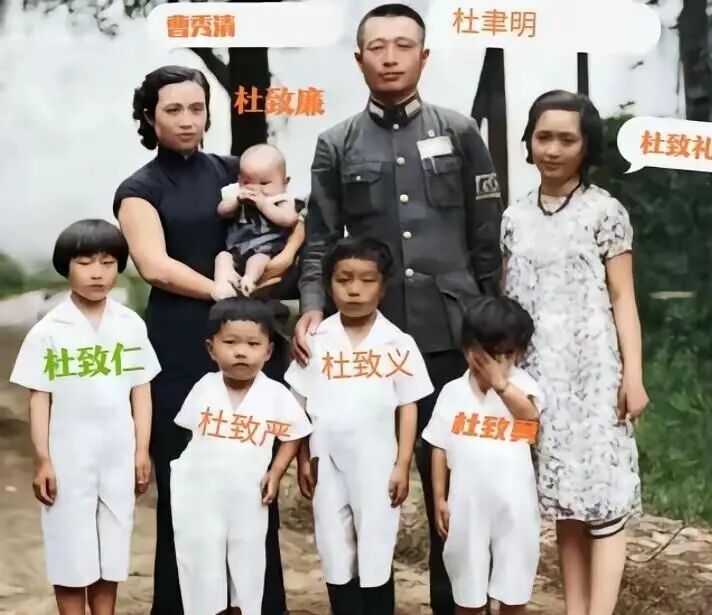
You've probably heard of Yang's first wife, Du Zhili, the daughter of Du Yuming, a high-ranking Kuomintang general. He was captured during the Huaihai Campaign in 1949, holding the rank of lieutenant general. After his capture, he maintained a tough stance and spent many years in the Gongdelin Prison for reform.
His wife, Cao Xiuqing, along with their six children, were transported to Taiwan by Chiang Kai-shek, where they were not treated well. After the Kuomintang retreated to the island, they were preoccupied with their own problems, and families like the Du family, descendants of surrendered generals, experienced the harsh realities of life. It took a lot of connections to finally get Cao Xiuqing a job as a mail clerk, earning a meager salary to support her family.
The eldest son, Tu Chih-jen, was quite promising and was admitted to Princeton University, a prestigious American university. However, when he was a junior, the banks in Taiwan stopped providing loans, and he was unable to raise the $3,000 tuition fee. Ultimately, he could not bear the pressure and committed suicide. This happened in 1956.
Based on historical inflation rates, $3,000 in 1956 is roughly equivalent to $40,000 today.
This is a tragic story; the son of a former army lieutenant general was driven to suicide by $3,000 in tuition fees. Cao Xiuqing approached the Bank of Taiwan, but they refused to lend him money. He also approached Chiang Kai-shek, who only agreed to give him $1,000.
In my previous article, I mentioned that Yang Zhenning married Du Zhili in 1950, so he was already Du Zhiren's brother-in-law at that time. However, he was not famous yet, had just bought a house, and was also burdened with a mortgage. He was unable to help with the $3,000. Old Yang later said that this matter had always been a regret in his life.
Then, a turning point came quickly. In 1957, Yang Zhenning won the Nobel Prize, becoming the first Chinese person to receive it, and his fame spread worldwide. Suddenly, his father-in-law in mainland China and his mother-in-law in Taiwan were… different.
Chiang Kai-shek immediately contacted Cao Xiuqing, hoping she could go to the United States to persuade Yang Zhenning to return to Taiwan. However, Cao Xiuqing went to the United States in 1958 and severed ties with the Kuomintang government, never returning to Taiwan until her death. Du Yuming was among the first batch of people granted amnesty on the mainland, and was later assigned to the CPPCC (Chinese People's Political Consultative Conference), becoming a key target for united front work.
In 1963, Cao Xiuqing returned to mainland China from the United States and reunited with Du Yuming. The two lived in Beijing until their deaths in the early 1980s. Even during the turbulent decade, the couple remained safe and sound because in the 1970s, when Yang Zhenning, as a Nobel laureate, visited mainland China several times, Premier Zhou Enlai specifically requested protection for Du Yuming and his wife.
Actually, the most tragic part of the story I wrote above was the situation of Cao Xiuqing's four children (two boys and two girls) left behind in Taiwan after she went to the United States. With their father "surrendered" and their mother "defecting and never returning," they not only had no relatives or friends in Taiwan, but their political status was also extremely sensitive. The four children depended on each other for survival and were also monitored and suppressed.
A family of seven or eight was separated across mainland China, Taiwan, and Hong Kong, and hadn't seen each other for decades. In those days, there were no cell phones or telephones, and even communication was sensitive and difficult. I was deeply saddened when I read about this past event.
Let's stop here for tonight.
Original Article: View Chinese Version