
-
Completely cease acts of aggression and assassination
-
Establish effective mechanisms to ensure that war never happens again.
-
Clarify and guarantee war loss compensation
-
A total ceasefire has been declared on all fronts and by all resistance organizations.
-
Recognize Iran's legitimate sovereignty over the Strait of Hormuz
The latest version of the ceasefire conditions has removed the withdrawal of US troops from the Persian Gulf and the trial and transfer of anti-Iranian media personnel, indicating that Iran is gradually becoming more pragmatic. As for the five new conditions, let me interpret them.
1 is the easiest to achieve; it only requires a word from both sides.
2. It's unrealistic. If the US attacks again in six months, no one can stop or restrain it. The practical mechanism that Iran talks about doesn't actually exist.
3. Getting the US to pay reparations is difficult; the US has never paid war reparations in its history. Iran could try to be the first. Trump's idea is to unfreeze previously sanctioned Iranian assets as compensation.
4. The ceasefire on all fronts was actually intended to help its allies. Israel was launching an offensive against Hezbollah in Lebanon, and the two sides were vastly different in strength. Israel wanted to create a 30-kilometer "safety buffer zone".
5. Iran wants to collect transit fees in the Strait of Hormuz, and this is already in effect. Legislation is needed to solidify this and ensure long-term, regular revenue generation. Rumors suggest the fee is $150,000-$200,000 per ship.
These are Iran's demands, which seem contradictory to the US's proposal yesterday. However, a cross-referencing reveals that there is no core conflict. Neither side is currently mentally prepared for negotiations. Given Iran's high aspirations, it will likely take some time to work things out.
All three parties involved on the battlefield were busy: Iran launched an anti-ship missile at a US aircraft carrier, but it missed by 15 kilometers and the US military did not intercept it; the US military increased its Marine Corps troops in the Middle East, possibly in preparation for an attack on Kharg Island; and Israel, fearing a US ceasefire, rushed to bomb Iranian military targets.
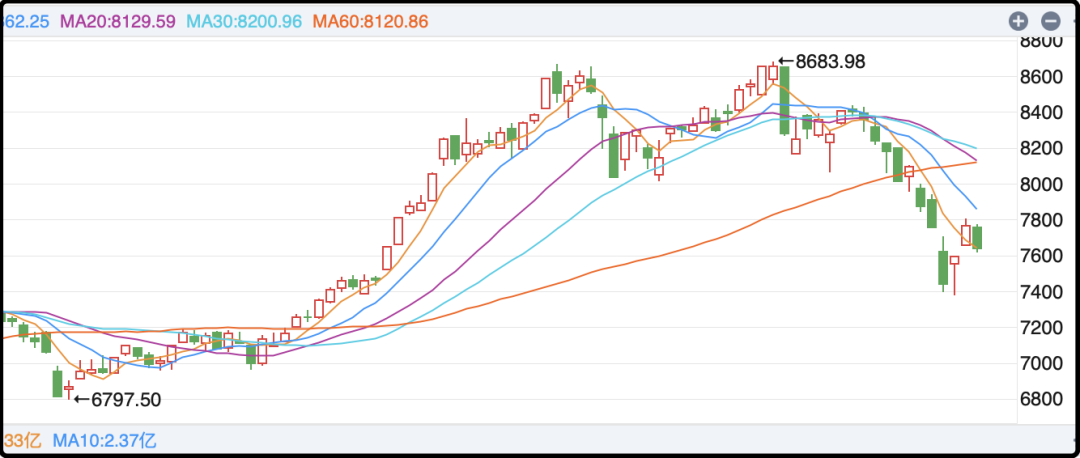
That's roughly the situation. The situation is unclear, and Brent crude oil prices have rebounded to $102, leading to a surge in the oil and gas sector today, but the overall stock market is down. The Shanghai Composite Index filled yesterday's gap today, while the CSI 500 is still a little short. Market sentiment is currently low, with today's trading volume falling below 2 trillion yuan, indicating that most funds are adopting a wait-and-see attitude. Given the uncertainty surrounding the situation in Iran, it's difficult to see a reversal and upward trend.
…
Another major event occurred in the tech world today : Google's DeepMind team released a compression algorithm called TurboQuant, which improves memory utilization efficiency by up to 6 times, thus significantly reducing the memory hardware requirements of AI. As a result, the stock prices of storage giants such as Micron and Western Digital fell immediately after the news, and the A-share storage chip sector also dropped by 3% today.
I've roughly understood its algorithm logic: when storing data for AI, it identifies highly similar data and replaces them with each other. This is similar to the photo organizing function on our phones. Sometimes you take several photos of the same scene, and after repeated comparisons, you keep the best one and delete the rest. TurboQuant does something similar.
The code has been released as open source on GitHub, and the community has responded enthusiastically, spontaneously promoting the application of this technology. It is expected to be fully integrated into various AI models within 1-2 months.
Some say that with this technology, the memory shortage will disappear and memory prices will drop rapidly. I don't think so. I remember when DeepSeek was first released, its main selling point was that it could produce high-quality models with less than 10% training cost. At that time, many people were saying that the demand for GPUs would plummet and GPU prices would also drop.
This ghost story was all the rage for a while, causing Nvidia's stock price to plummet by 16% in a single day (January 27th), but it all recovered later. This was because people discovered that after training costs came down, the demand for developing and using large models surged, and overall, Nvidia's graphics cards were still in short supply.
The same logic applies to this memory shortage; the new algorithm will improve memory utilization efficiency, but it won't change the short-term reality of memory scarcity. Therefore, I believe the pullback in this sector will be limited, and a deep decline is unlikely.
…
1. Trump posted today that his planned visit to China, which was postponed due to Iran's military action, has now been rescheduled and is scheduled to take place in Beijing on May 14-15.
2. Ping An's non-GAAP profit is projected to reach 143.7 billion yuan in 2025, a 22% increase, with a planned cash dividend of 48.9 billion yuan, marking 14 consecutive years of growth. However, Ping An's stock price recently fell from 74 to 56, a short-term pullback of 25%. Previously, foreign institutions were bullish on Ping An, leading to a surge in its stock price, but all of that has been wiped out. Good performance is useless, and a 4.5% dividend yield is also irrelevant; the A-share market doesn't care about these things.
3. Pop Mart plummeted 22% yesterday and fell another 10% today. The faster it rose last year, the faster it will fall this year. Kuaishou also crashed 14% today, falling back into the quagmire of below 50. I am truly utterly disappointed with Hong Kong stocks. If they continue to fall like this and then recover in a few years, I'll have to pay a heavy tax. I will probably be more cautious about buying Chinese concept stocks in the future, and if I were to increase my holdings, I would prioritize stocks owned by Li Ka-shing.
4. The Financial Times reported that Manus' two founders are currently under investigation in Beijing and restricted from leaving the country, but are free within China. Let me remind you, they're the AI agent company that was sold to Meta for over $2 billion. At that time, Lobster AI hadn't yet emerged, and Meta's offer was quite high. Now Manus's value is much lower than before, and if they ultimately can't sell, Zuckerberg might be quite happy.
That's all for tonight.
Original Article: View Chinese Version