I expected a drop on Monday, but I didn't expect it to be this severe. It started declining at 10 AM and continued downwards with almost no significant rebound. Even after suffering such heavy bombing, Iran knew to retaliate with missiles, but the A-shares offered absolutely no resistance, collapsing completely. No wonder it's been the worst-performing stock market in the world's major markets for the past 15 years; that familiar feeling is back.
Today's drop has turned the CSI 500 index from positive to negative for the year, with a cumulative decline of 0.33%. I had a floating profit of over 500 points at the beginning of March, which I've now wiped out. To make myself feel a little better, let's just pretend yesterday was the end of the New Year's holiday, and the market hadn't risen before then, damn it.
War is cruel, but most of the time the pain of war is confined to a certain area, such as the Russia-Ukraine war, the Israeli-Palestinian conflict, and the bloody conflicts in the remote corners of Africa, where the impact can only spill over to a limited extent. Logically, the intensity of Iran's recent conflict was not high, but because it affected the Strait of Hormuz and dozens of oil fields of varying sizes in the Persian Gulf, it drove up oil prices, ultimately making everyone in the world feel the pain of war.
In a few hours, domestic oil prices will see a surge, costing around 100 yuan more to fill up a tank. As a result, long queues have been forming at gas stations since yesterday. Some people say they don't need gasoline because they drive electric cars, but the increased costs of everyday chemicals, including those used in delivery and logistics, will ultimately be passed on to you at the retail level.
We feel distressed, and so do ordinary Americans. Their per capita energy consumption is much higher than ours, and with the surge in oil prices, their monthly fuel costs have increased by $150-200 alone. This is already shaking Trump's base of supporters. To say that the Iranians' current resistance is the right approach is an understatement; otherwise, few would care if their country were bombed back to the days of oil lamps. Now, by sharing the suffering with the world, others will find it unbearable and push for a ceasefire.
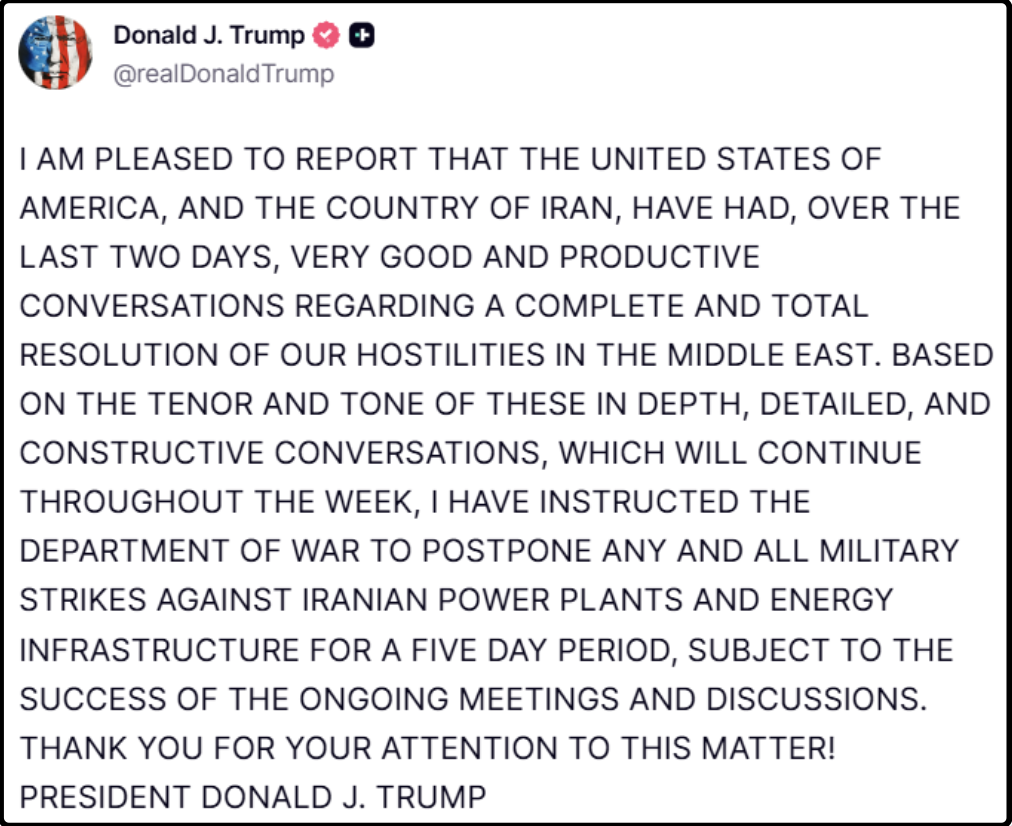
As I was writing this, I heard Trump post on social media that he had talked with Iran, and the talks went well. He said they canceled the 48-hour bombing ultimatum he issued on Sunday and were willing to postpone military action for five days.
In the official WeChat account, after clicking on an image, long-press to access a translation function that can translate the English text in the image.
Following this news, oil prices plummeted by 10%, US stock futures rebounded sharply, and Bitcoin and Ethereum also instantly rebounded by 5%. Although Iran subsequently denied having any contact or negotiations with the US, the market maintained its gains after repeated fluctuations, indicating that capital markets believe Trump's stance is more important.
According to US media outlet Axios, citing internal sources, Turkey, Egypt, and Pakistan have been frequently acting as intermediaries over the past two days, relaying messages between the US envoy and Iranian Foreign Minister Araqchi to mediate between the two countries. "The discussions involved ending the war and resolving all outstanding issues."
I believe there is genuine contact between the two sides, but the confrontation is escalating. Neither side has reached its limit in terms of enduring the pain of war, so neither is willing to show weakness. Actually, the US side might be easier to coordinate. Trump said a few days ago that Iran must surrender unconditionally, but he can immediately change his mind and discuss specific conditions; he doesn't care about these things. On the other hand, most of Iran's influential figures are dead, and those rising from below rely on demonstrating toughness to gain support. At this point, publicly declaring negotiations with the US would be political suicide.
Regardless, the ultimatum originally scheduled for Tuesday has been temporarily postponed, giving the capital market a 2-3 day buffer period. Currently, overseas markets are still rebounding, and they should be able to recover some losses tomorrow, unless the A-share market has other plans.
1. US traders have increased their bets on a Federal Reserve rate hike this year. Previously expecting one or two rate cuts, they've now abandoned that idea and instead believe a 25 basis point rate hike before the end of the year. This demonstrates the power of rising oil prices; the dollar has been forcefully pulled back from an easing cycle to a tightening cycle, which is bad news for gold, silver, and commodities. However, this information came before Trump's post.
2. Israeli sources revealed that US officials are pushing forward with the plan to seize Kharg Island, having already deployed 4,500 Marines from elsewhere. This information comes before Trump's post, suggesting that an attack is unlikely in the next five days. Given the complete suppression of Iranian air and naval power, the success rate of a US-Israeli island attack is severely reduced. However, the island is only 25 kilometers from the Iranian mainland, well within range of enemy fire, and defending it would be extremely costly. It's estimated that this is merely a last resort after negotiations have completely broken down, used for maximum pressure.
3. Zijin Mining acquired Chifeng Gold. A few months ago, this would have been interpreted as good news, but things have changed drastically in the past thirty days. Gold prices have plummeted, market sentiment has cooled, and the news is no longer considered positive. Chifeng Gold hit its daily limit down today, and Zijin Mining couldn't save it, executing the 600 million yuan share buyback mentioned yesterday.
I went to see the movie "The Rescue Plan" today. I guess you guys haven't heard of this movie. Nowadays, American blockbusters basically don't have much buzz in China. There's no promotion or hype, and Maoyan's box office prediction is less than 100 million yuan.
Let me briefly explain the background of the story. The sun has been infected by an alligator, and its temperature is gradually decreasing. In the future, there will be a food shortage, and half of humanity will die. Faced with this crisis, scientists discovered a star (12 light-years away) whose temperature did not decrease after being infected. They guessed that there was a cure there, so they used the alligator as an energy source to build a spaceship that could reach 92% of the speed of light and sent a scientific team to investigate.
The journey would take over a decade, but according to the time dilation principle of relativity, time inside the spacecraft would be approximately four years. To conserve resources, the astronauts were forced into hibernation, a risky endeavor where they might never wake up.
The story in the movie starts here, and I won't spoil the rest. If I had to summarize it, it would be about 45% *The Martian*, 20% *Interstellar*, 20% *Arrival*, and 15% *Gravity*. If you really like all four of these movies, then this is definitely a hard science fiction masterpiece with a score of 8 or higher, and it's worth watching.
Original Article: View Chinese Version