To update yesterday's content, Larijani's death was officially confirmed by Iranian officials this morning. This means Israel can not only carry out beheadings, but also confirm deaths before Iran does. Although Khalifa Haftar was Iran's new leader, Larijani handled the main daily military and political affairs, so Israel called him the "de facto leader," but that's no longer the case.
The successive assassinations were undoubtedly due in part to Israel's superior intelligence and weaponry, but I believe Iran's somewhat lax attitude towards the security of its leaders was also a significant contributing factor. Khamenei wouldn't have died if he had remained in his bunker; he insisted on holding meetings on the surface. Even Larijani, who died today, was participating in public events in the square just days before. It gives the impression that they didn't make every effort to avoid death; dying was considered martyrdom.
Larijani's death will be followed by a successor, but this will not lead to Iranian concessions; in fact, the successor will likely be even more assertive. Because the successor lacks experience and prestige, they usually seek support by firmly upholding their predecessor's policies. Therefore, continuing the decapitation strikes will not help the ceasefire, but it's clear to everyone that Israel is the least willing to accept a ceasefire among the three warring parties.
They have been locked in a feud with Iran for nearly 50 years. Now that Iran's nuclear weapons development is close to 80%, Israel cannot sit idly by and hopes to resolve the crisis once and for all. If you put yourself in their shoes, you can understand their logic.
Yesterday's comments also touched on quantitative trading, and many readers left messages expressing their interest. Quantitative trading has been demonized in recent years, with a terrible reputation, and is perceived by retail investors as a tool to fleece them. Let me explain why.
Firstly, the total size is approximately 3 trillion yuan, with private equity accounting for 2.5 trillion yuan and public funds having 500 billion yuan in index enhancement.
The most mainstream quantitative model is the index enhancement model, which aims to track and outperform the index. The industry's main benchmarks are the CSI 500 and CSI 1000 indices. Quantitative models, by adjusting their holdings, consistently outperform the index by 10-20% annually (under ideal conditions). Approximately 60% of the 3 trillion yuan market capitalization consists of this type of index enhancement fund.
Seeing this, some people might ask, "What if the index drops by 30% in a bear market? Wouldn't these funds also lose money?" Yes, they would lose money, but by 10-20% less than others.
If you want to make consistent profits regardless of whether it's a bull or bear market, you need to hedge. Buy 100 million worth of stocks to outperform the index, and open 100 million worth of short futures positions to hedge. This way, regardless of whether it's a bull or bear market, you can earn 10-20% outperforming the index every year.
People often ask me why stock index futures have a long-term discount. Well, here's the reason: approximately 600-800 billion yuan of quantitative funds have been holding short positions for hedging, leading to an imbalance between buying and selling, which results in the long-term discount.
Index-enhanced models account for roughly three-quarters of quantitative trading. The remaining quarter includes arbitrage, high-frequency T+0 trading, active stock selection, and multi-strategy trading. Among these, high-frequency T+0 trading is the most exploitative for retail investors. Regulators have introduced policies to restrict it over the past few years, and its scale is now very small.
The 3 trillion yuan in quantitative funds, considered "smart money," have generally outperformed the market. This outperformance necessarily corresponds to over 3 trillion yuan in retail investor funds underperforming the market, systematically worsening the survival environment for retail investors in the A-share market. Retail investors have been right to criticize quantitative trading in recent years, but since quantitative trading is neither illegal nor irregular, what reason is there to shut it down? Just because retail investors can't compete with it?
Finally, let's talk about solutions. The best approach is to buy quantitative funds, or like me, use futures to generate returns. If you can't beat them, join in and earn excess returns. The downside is that there's a barrier to entry; those with little money can't get on board. The middle approach is to buy index ETFs or engage in low-frequency value investing to prevent them from profiting at your expense. The worst approach is to keep criticizing, intensify the criticism, and create a public outcry. If regulators can't handle it, they might continue to crack down on quantitative funds, leaving those who make money in quantitative investing with a mess in their faces.  Trading volume in the A-share market remained sluggish today, at only 2.04 trillion yuan, but individual stocks rebounded, with the median increase of 0.91%, mainly due to the overall recovery of the technology sector. Communications rose 5.6%, optical modules 3.7%, components 3.4%, and semiconductors 2.9%, driven by a new narrative surrounding AI.
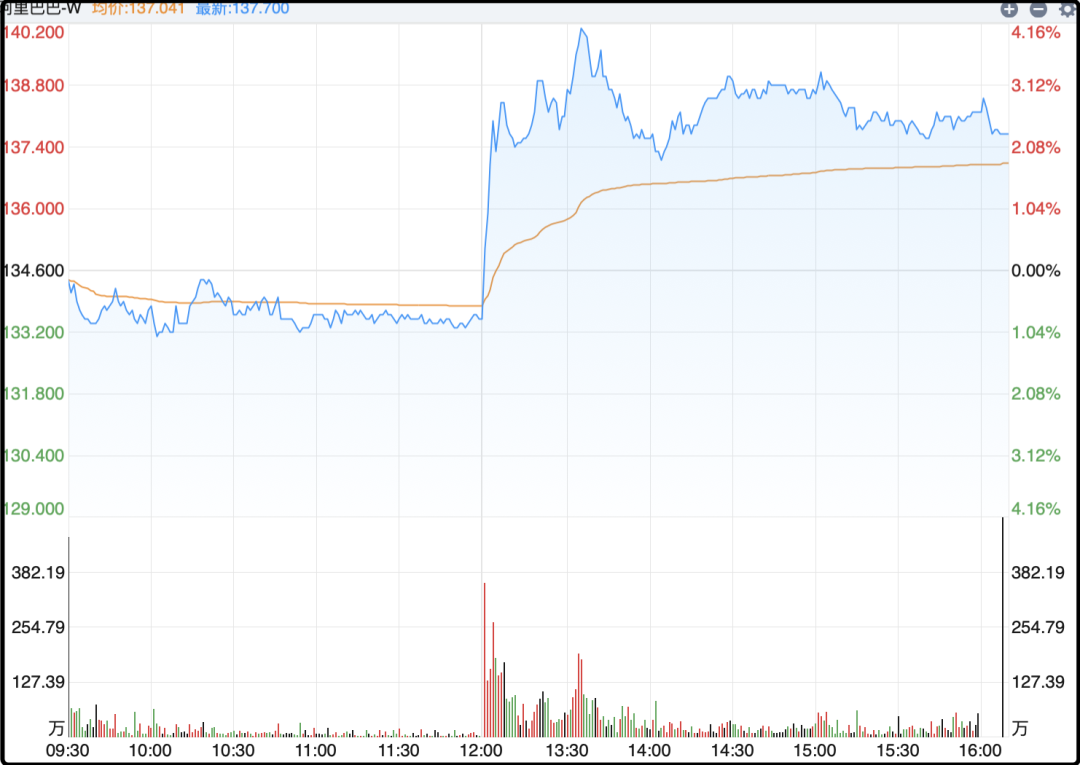
Alibaba announced a 5-34% price increase for its AI computing power and storage products due to a "surge in token usage." There's been a recent craze for AI-powered lobster farming, but the lobsters aren't raised for nothing; every action and thought they make consumes tokens. Remember the word "token"—in the future, it will be a fundamental resource on par with oil, electricity, and data.
Alibaba's stock price soared immediately after the announcement, followed by news that Baidu would raise prices for its computing power, storage, and other products by 5-30%, confirming the AI narrative. In the afternoon, A-share technology stocks rose across the board, ensuring that the index stabilized before reaching a key psychological level.
The biggest concern about AI is that it generates a lot of hype but doesn't generate revenue or achieve commercial viability. However, the recent development of lobster AI is changing this situation. AI agents can now perform actual tasks, and computing power can be converted into labor. As a result, the demand for computing power has increased, while the demand for labor has decreased.
The massive (20%) layoffs at Meta in other countries have attracted attention, and there have been frequent reports in China recently, some true and some false, but the feeling that an AI unemployment wave is coming is becoming more and more real.
Speaking of which, while I was scrolling through short videos these past few days, I saw an ad for a short drama called "The Unrivaled Hero," the kind where the male protagonist travels back in time and marries three wives at the beginning. Nothing new, but what surprised me was that while I was scrolling, I actually came across an animated version of the short drama called "The Iron Bond of the Sinful Wife," with the exact same plot. It was made entirely with AI, and although it was very rough and had bugs, it was still watchable.
I think everyone should seriously consider their job and social value, and whether they will be replaced within three to five years.
1. Israel recently attacked a major Iranian natural gas facility that processes 40% of Iran's natural gas. Israeli officials stated that the attack was coordinated with the United States. This was in retaliation for the Islamic Revolutionary Guard Corps' planned attacks on several Middle Eastern oil facilities, primarily located in Saudi Arabia, the UAE, and Qatar, which had been warned to evacuate in advance. The attacks are expected to occur within the next few hours.
Goodness, oil prices are going to go up again tomorrow. While the Gulf states haven't actively joined the attack on Iran, they've clearly sided with the US. They hope the US can completely resolve the Iran issue this time, avoiding a mess halfway through. At the very least, they want to eliminate Iran's ability to attack neighboring countries.
2. Tencent's latest financial report shows full-year revenue of RMB 751.8 billion (+14%), net profit of RMB 259.6 billion (+17%), and gross margin rising to 56%, with AI becoming the core engine. The gaming business performed strongly, with domestic game revenue reaching RMB 164.2 billion (+18%) and international game revenue reaching RMB 77.4 billion (+33%). Video account advertising drove marketing service revenue to RMB 145 billion (+19%). Tencent Cloud achieved large-scale profitability, with enterprise service revenue increasing by 22% in Q4 . Full-year R&D expenditure reached RMB 85.75 billion, and capital expenditure reached RMB 79.2 billion, both record highs.
Speaking of which, I'm spending more and more time on WeChat Video Channels now. I used to think that the content on WeChat Video Channels was significantly inferior to that on Douyin, but recently that gap has been narrowing considerably. I feel that WeChat Video Channels has reached about 80% of the content quality of Douyin. You guys can give it a try.
Trading volume in the A-share market remained sluggish today, at only 2.04 trillion yuan, but individual stocks rebounded, with the median increase of 0.91%, mainly due to the overall recovery of the technology sector. Communications rose 5.6%, optical modules 3.7%, components 3.4%, and semiconductors 2.9%, driven by a new narrative surrounding AI.
Alibaba announced a 5-34% price increase for its AI computing power and storage products due to a "surge in token usage." There's been a recent craze for AI-powered lobster farming, but the lobsters aren't raised for nothing; every action and thought they make consumes tokens. Remember the word "token"—in the future, it will be a fundamental resource on par with oil, electricity, and data.
Alibaba's stock price soared immediately after the announcement, followed by news that Baidu would raise prices for its computing power, storage, and other products by 5-30%, confirming the AI narrative. In the afternoon, A-share technology stocks rose across the board, ensuring that the index stabilized before reaching a key psychological level.
The biggest concern about AI is that it generates a lot of hype but doesn't generate revenue or achieve commercial viability. However, the recent development of lobster AI is changing this situation. AI agents can now perform actual tasks, and computing power can be converted into labor. As a result, the demand for computing power has increased, while the demand for labor has decreased.
The massive (20%) layoffs at Meta in other countries have attracted attention, and there have been frequent reports in China recently, some true and some false, but the feeling that an AI unemployment wave is coming is becoming more and more real.
Speaking of which, while I was scrolling through short videos these past few days, I saw an ad for a short drama called "The Unrivaled Hero," the kind where the male protagonist travels back in time and marries three wives at the beginning. Nothing new, but what surprised me was that while I was scrolling, I actually came across an animated version of the short drama called "The Iron Bond of the Sinful Wife," with the exact same plot. It was made entirely with AI, and although it was very rough and had bugs, it was still watchable.
I think everyone should seriously consider their job and social value, and whether they will be replaced within three to five years.
1. Israel recently attacked a major Iranian natural gas facility that processes 40% of Iran's natural gas. Israeli officials stated that the attack was coordinated with the United States. This was in retaliation for the Islamic Revolutionary Guard Corps' planned attacks on several Middle Eastern oil facilities, primarily located in Saudi Arabia, the UAE, and Qatar, which had been warned to evacuate in advance. The attacks are expected to occur within the next few hours.
Goodness, oil prices are going to go up again tomorrow. While the Gulf states haven't actively joined the attack on Iran, they've clearly sided with the US. They hope the US can completely resolve the Iran issue this time, avoiding a mess halfway through. At the very least, they want to eliminate Iran's ability to attack neighboring countries.
2. Tencent's latest financial report shows full-year revenue of RMB 751.8 billion (+14%), net profit of RMB 259.6 billion (+17%), and gross margin rising to 56%, with AI becoming the core engine. The gaming business performed strongly, with domestic game revenue reaching RMB 164.2 billion (+18%) and international game revenue reaching RMB 77.4 billion (+33%). Video account advertising drove marketing service revenue to RMB 145 billion (+19%). Tencent Cloud achieved large-scale profitability, with enterprise service revenue increasing by 22% in Q4 . Full-year R&D expenditure reached RMB 85.75 billion, and capital expenditure reached RMB 79.2 billion, both record highs.
Speaking of which, I'm spending more and more time on WeChat Video Channels now. I used to think that the content on WeChat Video Channels was significantly inferior to that on Douyin, but recently that gap has been narrowing considerably. I feel that WeChat Video Channels has reached about 80% of the content quality of Douyin. You guys can give it a try.
Original Article: View Chinese Version