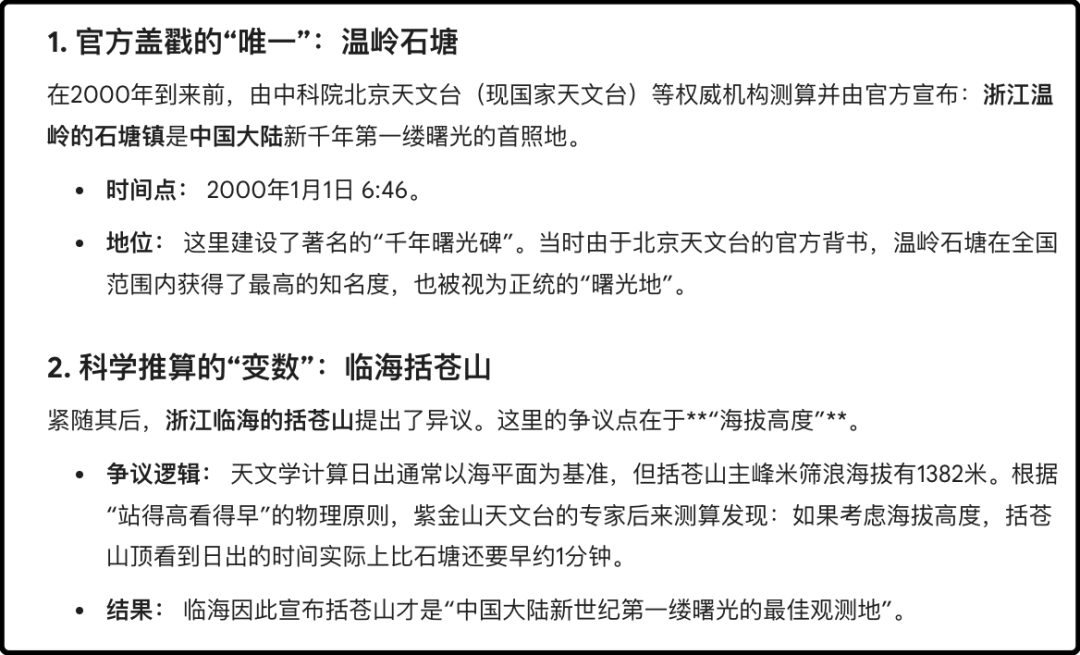
Yesterday, many people debated where the first rays of sunlight of the new century would shine. Looking at the map, it seems to be Heilongjiang, because they are the easternmost province. However, the Earth's rotation has an angle of inclination, and around New Year's Day (winter), the earliest areas to be illuminated by sunlight are the southeastern coastal areas, namely Taizhou in Zhejiang. As for whether it's Shitang in Wenling or Kuocang Mountain in Linhai, I asked on gemini, chatgpt, and Doubao, and the answer was consistent.
See that? "Schedule an appointment 1 minute earlier".
This one minute might not matter to you, but it was very important to me because that early morning, I was on the roof of the highest building on the summit of Kuocang Mountain. My friend and I climbed up there together; he sat on the roof to watch the sunrise, while I, being a bit cunning, stood up to watch. So, I truly was the first person in mainland China to see the dawn of the new century.  With 1.4 billion people in China, being number one in anything is no easy feat, something to brag about for a lifetime. I added some descriptions to let Doubao recreate that moment from my memory; he was so cool.
There was a little incident; my initial description didn't mention a windmill on the mountaintop, which the AI added automatically. Because 25 years had passed, I couldn't remember if there were windmills on the mountaintop back then, and the AI's response was:
"The first batch of wind turbines on the top of Kuocang Mountain were connected to the grid at full capacity on June 25, 1998 , which was also the time when the wind farm was officially put into operation. When you recall the dawn of the new century in 2000, these wind turbines were indeed already standing on the top of Kuocang Mountain, witnessing the cheers and grand occasion at that time."
Hmm…it seems like they've gotten smarter again.
With 1.4 billion people in China, being number one in anything is no easy feat, something to brag about for a lifetime. I added some descriptions to let Doubao recreate that moment from my memory; he was so cool.
There was a little incident; my initial description didn't mention a windmill on the mountaintop, which the AI added automatically. Because 25 years had passed, I couldn't remember if there were windmills on the mountaintop back then, and the AI's response was:
"The first batch of wind turbines on the top of Kuocang Mountain were connected to the grid at full capacity on June 25, 1998 , which was also the time when the wind farm was officially put into operation. When you recall the dawn of the new century in 2000, these wind turbines were indeed already standing on the top of Kuocang Mountain, witnessing the cheers and grand occasion at that time."
Hmm…it seems like they've gotten smarter again.  The biggest event this weekend was the surge in oil prices, which reached a high of $95 in Friday night trading and closed at $93 at 7 a.m. on Saturday. Oil prices saw their biggest weekly gain on record, with Brent crude rising 28% and WTI crude rising 35%.
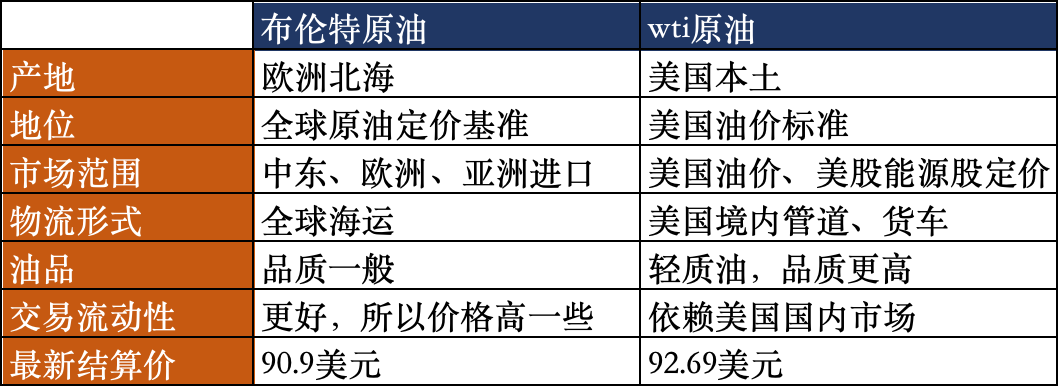
Here's a brief explanation of why there are two different oil prices.
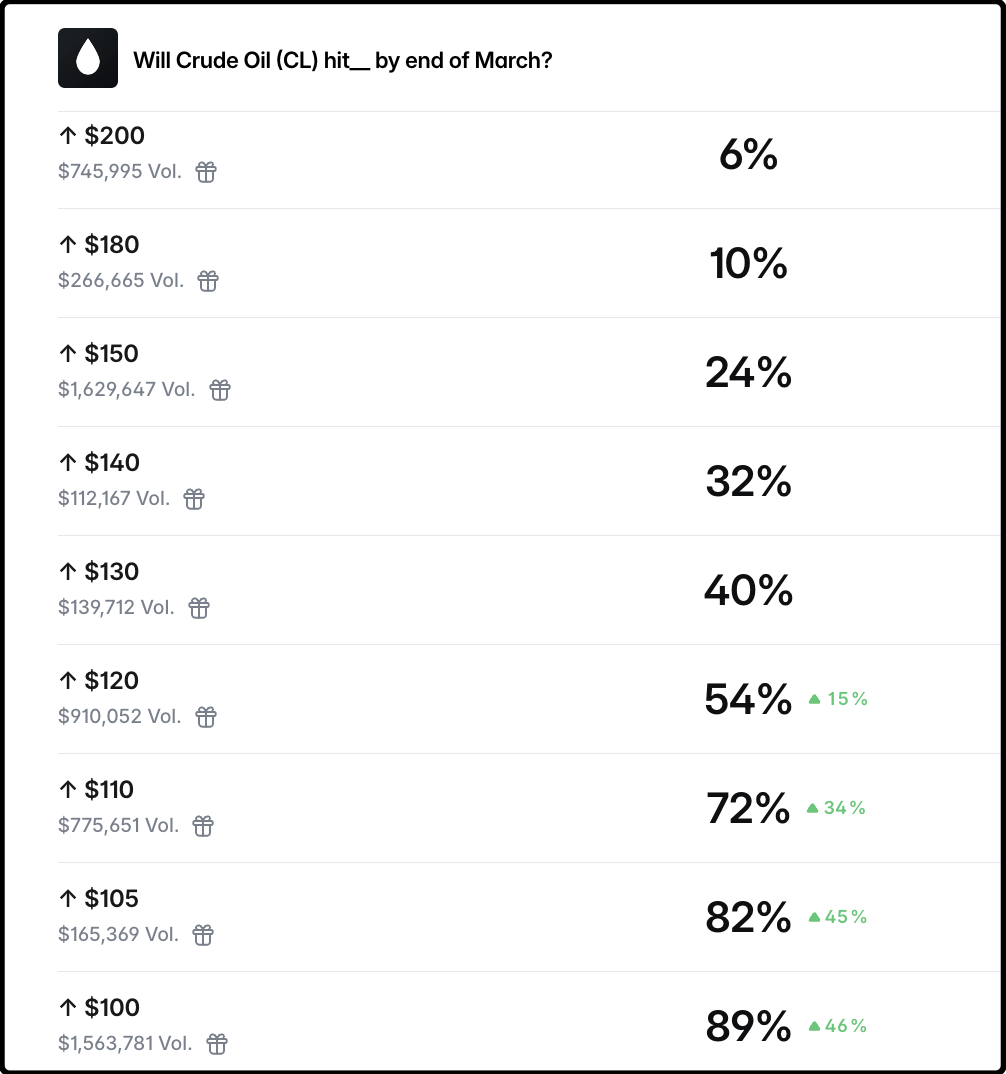
Internationally, the mainstream focus is still on Brent crude oil prices, so my analysis will assume this. Based on the current trend, breaking through $100 is highly probable, and it might happen within the first couple of days of next week. Last night I posted an on-chain betting pool's odds on the highest oil price that could be reached before the end of March, and when I checked again today, they had all increased.
Last night, the probability of $120 was 42%, but now it's 54%, an increase of nearly 30%, indicating that market sentiment has further intensified in the past 24 hours.
Goldman Sachs' initial prediction of $120 per barrel was considered outrageous by many, but as the situation has evolved, more and more people are beginning to believe this expectation. The reason for setting the price at $120 was that, according to analysis, the countries most closely linked to oil, including China and the US, could withstand oil prices below $120. Once the price exceeds $120, the global economic pain will intensify dramatically, and in the long run, no one can endure it, at which point there will be pressure to sit down and negotiate.
The US imports approximately 6 million barrels per day and exports about 11 million barrels, seemingly benefiting from rising oil prices. However, I made a mistake by viewing the US as a single entity. While soaring oil prices will make the energy industry incredibly wealthy, the cost of doubling oil prices will be borne by over 300 million ordinary Americans. The profits earned by the energy industry will not be used to subsidize ordinary citizens. Therefore, American society cannot sustain high oil prices for an extended period, unless Trump abandons all votes in the midterm elections.
In the current situation, Iran is indeed no match for the US-Israel coalition and is gradually losing its naval and air combat capabilities. However, deploying even a small force would be enough to deter the Strait of Hormuz. Because the strait is only 33 kilometers wide at its narrowest point, with a shipping channel less than 10 kilometers wide, Iran can use near-shore firepower, short-range missiles, drones, unmanned surface vessels, and mines to frighten merchant ships from daring to pass through, causing insurance companies to refuse coverage or incur unacceptable premiums.
Iran's strategic advantage in the Strait of Hormuz lies in its ability to cause enormous damage with minimal resources.
Therefore, without deploying ground troops, it will be difficult for the US and Israel to overthrow the Iranian regime through air strikes alone. As oil prices continue to rise, various pressures will eventually force both sides back to the negotiating table. At that point, Iran will no longer need to "unconditionally surrender" as Trump has suggested; it will have the leverage to negotiate, and the US and Israel will likely only be able to achieve partial results.
According to the latest institutional analysis and projections, oil prices may surge to $120 within two weeks, and then consolidate in the $120-$150 range (for several months?). When this will end depends on which side can't hold on any longer.
High oil prices will stimulate multiple sectors of the A-share market, with oil and gas, oil services, and coal chemicals directly benefiting. Indirect beneficiaries include natural gas, coal, chemicals, shipping, and even new energy and electric vehicles should receive some positive stimulus. This is all contingent on the situation in Iran dragging on long enough, more than two months.
1. Breaking news tonight: Iran has elected a new Supreme Leader, but they have not publicly announced the candidate. This is likely to prevent assassination attempts. If it were Khamenei's son, who was previously considered a frontrunner, Israel and the United States would launch a new round of assassinations. It's possible that the son would be killed right after the father, so not announcing the candidate is a way to protect the new leader.
I'm reminded of the on-chain casino where bets were placed before. So, how is this situation settled…?
2. The People's Bank of China has increased its gold holdings for the 16th consecutive month. In February, it increased its holdings from 74.19 million ounces to 74.22 million ounces. 30,000 ounces is worth about 1 billion RMB, which is similar to the monthly increase in previous months. The amount purchased in recent months has been around 1 billion RMB.
3. Another widely circulated story over the weekend was that a BlackRock fund had suspended redemptions, causing some panic. Indeed, a private credit fund with approximately $26 billion in assets under management had a 5% redemption cap in its terms and conditions. This quarter, redemption requests exceeded 9%, so redemptions were temporarily suspended. This is not a default; it was part of the product's initial design, with the excess amount queued for redemption in the next quarter.
I checked this product, and it mainly invests in corporate bonds with relatively high coupon rates of 10-12%. The product's annualized return over the past four years is 10.7%, which is quite high. Recently, it seems that some investors are rushing to sell due to concerns about the impact on the capital market and widespread bond defaults. Because bonds have poor liquidity, only 5% can be realized per quarter, which I think is fine and there's no need to cause panic.
That's all for now, launch.
The biggest event this weekend was the surge in oil prices, which reached a high of $95 in Friday night trading and closed at $93 at 7 a.m. on Saturday. Oil prices saw their biggest weekly gain on record, with Brent crude rising 28% and WTI crude rising 35%.
Here's a brief explanation of why there are two different oil prices.
Internationally, the mainstream focus is still on Brent crude oil prices, so my analysis will assume this. Based on the current trend, breaking through $100 is highly probable, and it might happen within the first couple of days of next week. Last night I posted an on-chain betting pool's odds on the highest oil price that could be reached before the end of March, and when I checked again today, they had all increased.
Last night, the probability of $120 was 42%, but now it's 54%, an increase of nearly 30%, indicating that market sentiment has further intensified in the past 24 hours.
Goldman Sachs' initial prediction of $120 per barrel was considered outrageous by many, but as the situation has evolved, more and more people are beginning to believe this expectation. The reason for setting the price at $120 was that, according to analysis, the countries most closely linked to oil, including China and the US, could withstand oil prices below $120. Once the price exceeds $120, the global economic pain will intensify dramatically, and in the long run, no one can endure it, at which point there will be pressure to sit down and negotiate.
The US imports approximately 6 million barrels per day and exports about 11 million barrels, seemingly benefiting from rising oil prices. However, I made a mistake by viewing the US as a single entity. While soaring oil prices will make the energy industry incredibly wealthy, the cost of doubling oil prices will be borne by over 300 million ordinary Americans. The profits earned by the energy industry will not be used to subsidize ordinary citizens. Therefore, American society cannot sustain high oil prices for an extended period, unless Trump abandons all votes in the midterm elections.
In the current situation, Iran is indeed no match for the US-Israel coalition and is gradually losing its naval and air combat capabilities. However, deploying even a small force would be enough to deter the Strait of Hormuz. Because the strait is only 33 kilometers wide at its narrowest point, with a shipping channel less than 10 kilometers wide, Iran can use near-shore firepower, short-range missiles, drones, unmanned surface vessels, and mines to frighten merchant ships from daring to pass through, causing insurance companies to refuse coverage or incur unacceptable premiums.
Iran's strategic advantage in the Strait of Hormuz lies in its ability to cause enormous damage with minimal resources.
Therefore, without deploying ground troops, it will be difficult for the US and Israel to overthrow the Iranian regime through air strikes alone. As oil prices continue to rise, various pressures will eventually force both sides back to the negotiating table. At that point, Iran will no longer need to "unconditionally surrender" as Trump has suggested; it will have the leverage to negotiate, and the US and Israel will likely only be able to achieve partial results.
According to the latest institutional analysis and projections, oil prices may surge to $120 within two weeks, and then consolidate in the $120-$150 range (for several months?). When this will end depends on which side can't hold on any longer.
High oil prices will stimulate multiple sectors of the A-share market, with oil and gas, oil services, and coal chemicals directly benefiting. Indirect beneficiaries include natural gas, coal, chemicals, shipping, and even new energy and electric vehicles should receive some positive stimulus. This is all contingent on the situation in Iran dragging on long enough, more than two months.
1. Breaking news tonight: Iran has elected a new Supreme Leader, but they have not publicly announced the candidate. This is likely to prevent assassination attempts. If it were Khamenei's son, who was previously considered a frontrunner, Israel and the United States would launch a new round of assassinations. It's possible that the son would be killed right after the father, so not announcing the candidate is a way to protect the new leader.
I'm reminded of the on-chain casino where bets were placed before. So, how is this situation settled…?
2. The People's Bank of China has increased its gold holdings for the 16th consecutive month. In February, it increased its holdings from 74.19 million ounces to 74.22 million ounces. 30,000 ounces is worth about 1 billion RMB, which is similar to the monthly increase in previous months. The amount purchased in recent months has been around 1 billion RMB.
3. Another widely circulated story over the weekend was that a BlackRock fund had suspended redemptions, causing some panic. Indeed, a private credit fund with approximately $26 billion in assets under management had a 5% redemption cap in its terms and conditions. This quarter, redemption requests exceeded 9%, so redemptions were temporarily suspended. This is not a default; it was part of the product's initial design, with the excess amount queued for redemption in the next quarter.
I checked this product, and it mainly invests in corporate bonds with relatively high coupon rates of 10-12%. The product's annualized return over the past four years is 10.7%, which is quite high. Recently, it seems that some investors are rushing to sell due to concerns about the impact on the capital market and widespread bond defaults. Because bonds have poor liquidity, only 5% can be realized per quarter, which I think is fine and there's no need to cause panic.
That's all for now, launch.
Original Article: View Chinese Version