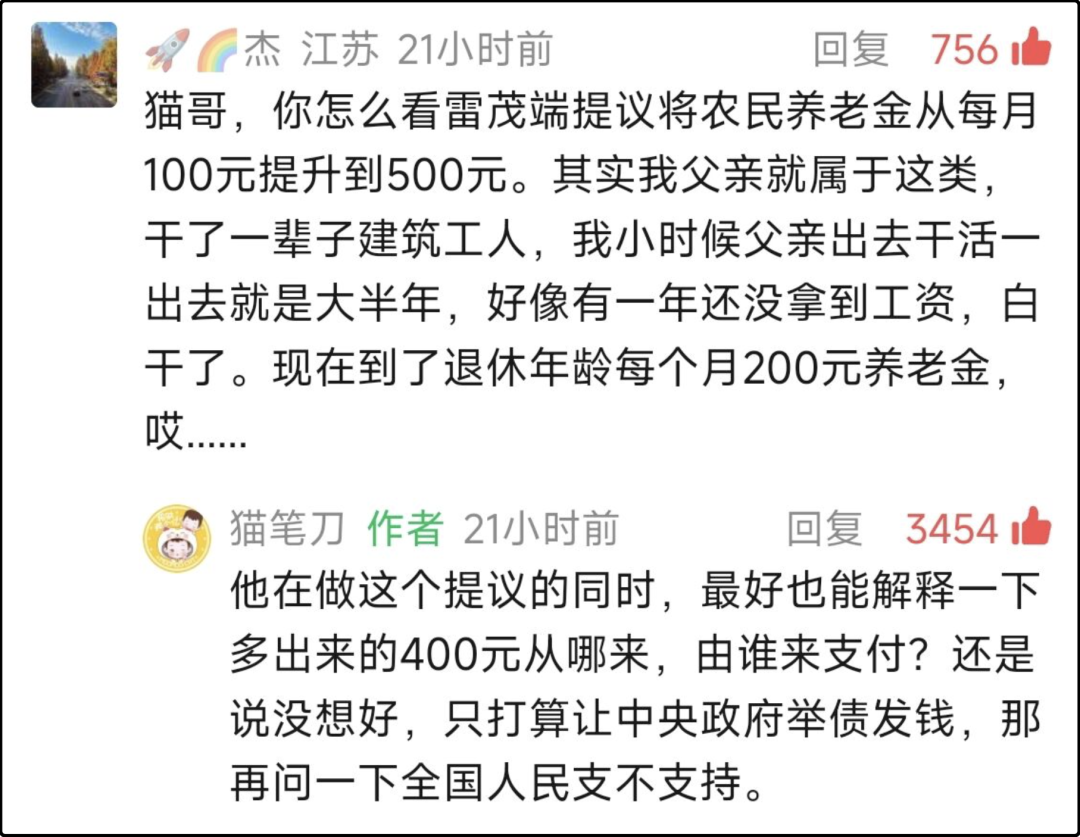
This comment received the most likes last night, and readers were also very active in the comments section.
After closing up shop, I curiously searched for some data. Currently, there are about 180 million people in our country receiving basic pension benefits. The minimum amount is 163 yuan per month, and then local governments provide subsidies based on their financial resources. In wealthy areas like Shanghai, the amount is as high as 1,500 yuan, in Beijing it is over 900 yuan, and in some cities in Jiangsu and Zhejiang it exceeds 500 yuan. However, in most inland areas, the amount is in the range of 163-250 yuan.
If the minimum standard were raised from 163 to 500, the annual additional expenditure would be around 700 billion yuan. Last year, government fiscal expenditure was 28.7 trillion yuan, meaning 700 billion yuan would account for 2.44%.
This is definitely not a small amount of money. If you don't have a sense of the amount, let me give you an example: last year, the stock stamp duty was 200 billion. If we increase the stamp duty by 3.5 times, we can collect an additional 700 billion.
Just kidding, no shareholder would agree to that. This is a common situation when discussing public welfare; people always feel morally superior when proposing to increase welfare for the poor, but fall silent when asked who will pay for it.
I know that many people subconsciously feel that the country can issue bonds, but a government deficit ratio of 4% is already a relatively high level in history. Now, every 0.1% increase requires repeated research and discussion. Suddenly adding 700 billion is like planning to starve the country. It is inappropriate to leave a mountain of debt for future generations.
Some people in the comments section suggested cutting salaries for military personnel, civil servants, and teachers; others suggested reducing the defense budget or environmental subsidies. Haha, that's hilarious! Your suggestions are quite good, but I think it would be better to increase the stamp duty by 3.5 times first.  To be serious, the low level of basic old-age pensions for residents is a historical problem that began in 2009. Before 2009, according to Chinese tradition, elderly people in rural areas were either supported by their families or relied on farming, and there was no unified national pension. Only after the government had some funds did it begin to distribute basic old-age pensions to residents in the form of fiscal subsidies, allowing them to share in the dividends of national development.
Many people compare it to urban employee pension (which has a higher amount), but these are different. Employee pension insurance was launched in the 1980s and 1990s, and it has historical accumulation, which is why there are better benefits.
Finally, I'd like to add that Lei Maorui's original proposal didn't raise the threshold to 500 for all elderly people, but only for those over 70. I calculated that the annual expenditure would be around 200 billion yuan, which is much less. However, low-income elderly people over 70 are an absolutely vulnerable group in this society, and it's difficult to significantly tilt resource allocation towards them, especially given the widespread shortage of funds in recent years. I think this matter… is difficult to resolve.
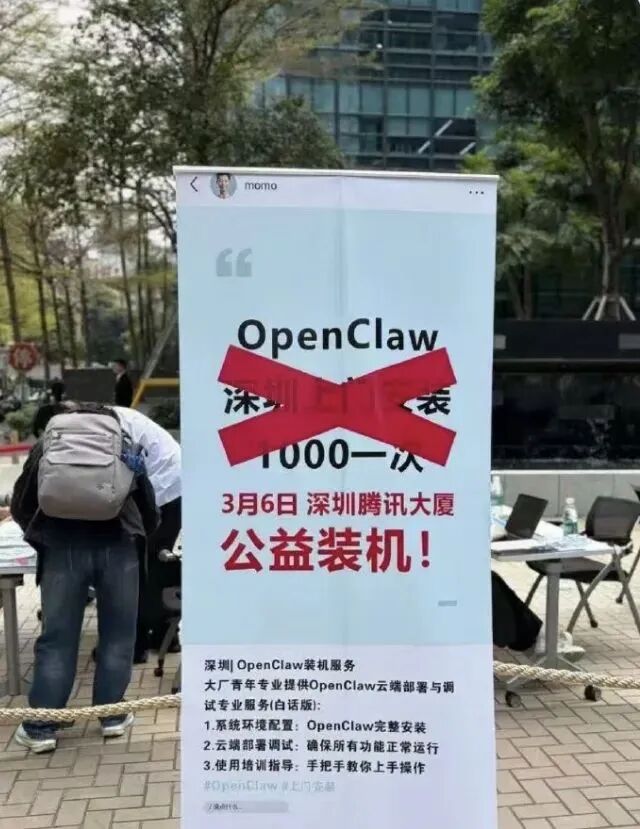
Today, something from Tencent went viral: they set up a platform downstairs at their office building, having dozens of programmers come down to install Lobster AI on users for free. Previously, there were on-site installation services that charged 1000 yuan per installation, but now Tencent Charity is offering it for free, and huge crowds are lining up at the site.
I previously mentioned Lobster AI in the nightly report; its full name is OpenClaw. It can be deployed locally on a computer, and once given permissions, it can utilize all the tools on that computer to complete tasks, such as managing emails, writing code, creating content, cleaning files, and more—it's more than just a chatbot.
It has local file records, so it has memory. The longer you use it, the smarter it becomes and the better it understands you.
It can proactively perform tasks. For example, if you tell it you have a Bitcoin position, it will proactively remind you and provide suggestions if it detects a sharp drop in the price of Bitcoin.
It's important to note that the Lobster AI's brain needs to be externally connected. Most mainstream large models on the market can be used, such as chatgpt, gemini, beanbag, qianwen, yuanbao, and minimax. However, connecting an external brain costs money. You need to buy tokens (computing power) for it. The longer it works each day, the more computing power it consumes, and the more money you will spend.
I haven't set one up myself yet, but a friend overseas has set one up, and for him, as a light user, it costs less than $20 a month. In China, I've seen monthly subscriptions range from 30-70 RMB, depending on usage. You can assess your own situation and avoid being a fomo-motivated user, thinking that just because it's popular you'll be left behind if you don't get one. New things aren't free; it's all about whether you actually need them.
I definitely wouldn't dare deploy Lobster on my investment computer; it might mishandle things and leak my important information. So, if I were to do something, it would definitely be deployed on a separate computer, essentially giving me a 24/7 AI assistant. I haven't decided what it would do yet, but it'll probably monitor market price fluctuations while I'm sleeping.
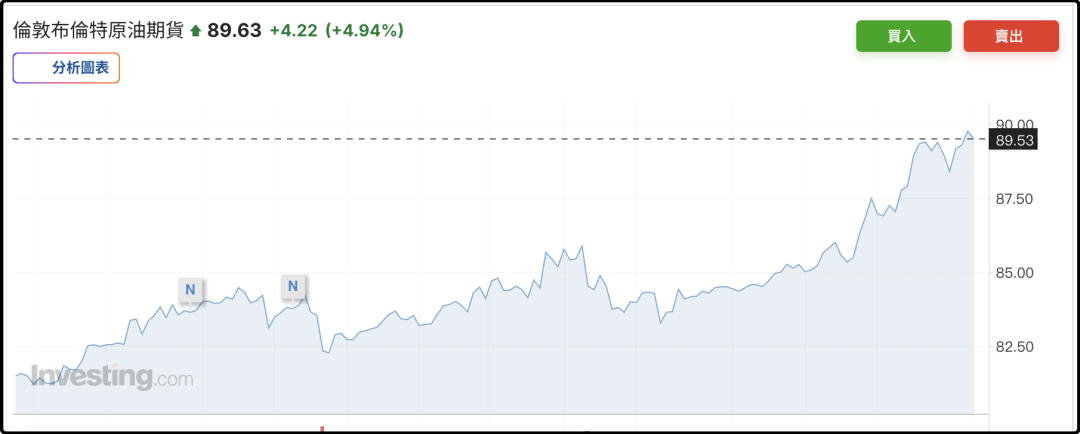
Brent crude oil surged tonight, reaching $90. If the situation in Iran does not ease and the Strait of Hormuz remains blocked, there is a good chance it could eventually hit $100.
The market is expected to fluctuate again next week, and war-related themes such as oil and gas may be picked up and speculated on again.
That's all for tonight, have a great weekend!
To be serious, the low level of basic old-age pensions for residents is a historical problem that began in 2009. Before 2009, according to Chinese tradition, elderly people in rural areas were either supported by their families or relied on farming, and there was no unified national pension. Only after the government had some funds did it begin to distribute basic old-age pensions to residents in the form of fiscal subsidies, allowing them to share in the dividends of national development.
Many people compare it to urban employee pension (which has a higher amount), but these are different. Employee pension insurance was launched in the 1980s and 1990s, and it has historical accumulation, which is why there are better benefits.
Finally, I'd like to add that Lei Maorui's original proposal didn't raise the threshold to 500 for all elderly people, but only for those over 70. I calculated that the annual expenditure would be around 200 billion yuan, which is much less. However, low-income elderly people over 70 are an absolutely vulnerable group in this society, and it's difficult to significantly tilt resource allocation towards them, especially given the widespread shortage of funds in recent years. I think this matter… is difficult to resolve.
Today, something from Tencent went viral: they set up a platform downstairs at their office building, having dozens of programmers come down to install Lobster AI on users for free. Previously, there were on-site installation services that charged 1000 yuan per installation, but now Tencent Charity is offering it for free, and huge crowds are lining up at the site.
I previously mentioned Lobster AI in the nightly report; its full name is OpenClaw. It can be deployed locally on a computer, and once given permissions, it can utilize all the tools on that computer to complete tasks, such as managing emails, writing code, creating content, cleaning files, and more—it's more than just a chatbot.
It has local file records, so it has memory. The longer you use it, the smarter it becomes and the better it understands you.
It can proactively perform tasks. For example, if you tell it you have a Bitcoin position, it will proactively remind you and provide suggestions if it detects a sharp drop in the price of Bitcoin.
It's important to note that the Lobster AI's brain needs to be externally connected. Most mainstream large models on the market can be used, such as chatgpt, gemini, beanbag, qianwen, yuanbao, and minimax. However, connecting an external brain costs money. You need to buy tokens (computing power) for it. The longer it works each day, the more computing power it consumes, and the more money you will spend.
I haven't set one up myself yet, but a friend overseas has set one up, and for him, as a light user, it costs less than $20 a month. In China, I've seen monthly subscriptions range from 30-70 RMB, depending on usage. You can assess your own situation and avoid being a fomo-motivated user, thinking that just because it's popular you'll be left behind if you don't get one. New things aren't free; it's all about whether you actually need them.
I definitely wouldn't dare deploy Lobster on my investment computer; it might mishandle things and leak my important information. So, if I were to do something, it would definitely be deployed on a separate computer, essentially giving me a 24/7 AI assistant. I haven't decided what it would do yet, but it'll probably monitor market price fluctuations while I'm sleeping.
Brent crude oil surged tonight, reaching $90. If the situation in Iran does not ease and the Strait of Hormuz remains blocked, there is a good chance it could eventually hit $100.
The market is expected to fluctuate again next week, and war-related themes such as oil and gas may be picked up and speculated on again.
That's all for tonight, have a great weekend!
Original Article: View Chinese Version