First, let me correct something from last night's comments. There were rumors that Ahmadinejad had also been killed in the bombing, but his office denied this today. He is still alive. The bombing targeted the guards' quarters, which were about 100 meters from his residence. Three of his guards were killed. He was unharmed and is currently in hiding.
Ahmadinejad was the former president of Iran. During his tenure, he adopted a hardline stance and firmly believed in the elimination of Israel. He stepped down in 2013 and was subsequently ousted from power. He attempted to run for president three times but was disqualified each time. He was also briefly detained in 2018. It is certain that he was not on Khamenei's side, but it is true that he enjoyed considerable popularity within Iran.
Let's talk about the developments in the situation in Iran over the past 24 hours.
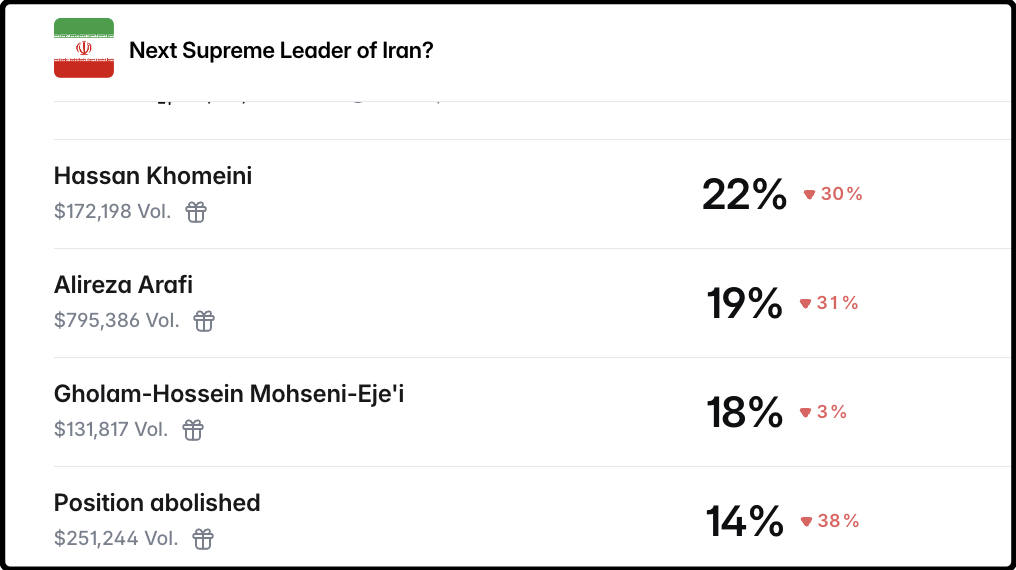
Following Khamenei's death, Iran's top leadership formed a temporary leadership council to take over national affairs. A new pool has opened on the blockchain casino, where participants can guess who will be the next leader of Iran. The four most probable candidates are as follows:
First on the list is Hassan Khomeini , Khomeini's grandson, who was the leader of Iran before Khamenei. Second is Alafi, a senior Islamic jurist and current member of the Guardian Council , holding significant religious authority. Third is Ejai, the current Chief Justice and former Minister of Intelligence, a core member of the hardline conservative faction, widely considered Khamenei's preferred successor.
There is also a 14% chance that Iran will no longer have a Supreme Leader.
I was curious why Iranian President Pezechian, who survived the bombings these past few days, wasn't included . After searching, I found out it's because he's the head of administration and can't succeed the religious leader; politics and religion are two separate paths in Iran.
Today, Iran launched a high-intensity counterattack, primarily targeting Israel and the United States, and also bombing neighboring Gulf states. Most of these countries have US military bases or tacitly allow US missiles and aircraft to fly over their airspace, so in Iran's eyes they are accomplices.
Judging from the current situation, Iran is unlikely to concede defeat in the short term. However, based on the scale of the counterattacks in the past two days, Iran's medium- and long-range missiles may be depleted in about two weeks, at which point they will no longer be able to reach Israel. But if relying on its own production capacity and relatively inexpensive defenses (drones + short-range missiles), Iran could hold out for several months.
In fact, some people have started speculating about when this round of conflict will end, with a 25% probability before March 15, a 46% probability before March 30, and a 68% probability before April 30. These are all real-time probabilities and are for investment reference only.
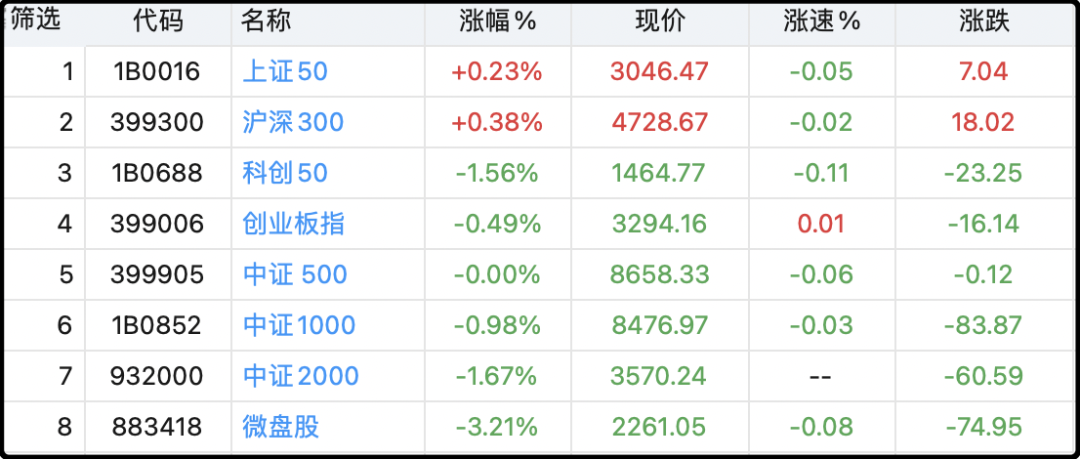
Today's A-share market was quite volatile, with a turnover of 3.02 trillion yuan, once again breaking the 3 trillion yuan mark. The median market was in a rather dire situation, falling 2.39%, a significant drop, causing strong pain for many investors. However, on the other hand, the eight major broad-based indices performed strongly. The SSE 50 and CSI 300 were still in positive territory, the CSI 500 did not fall, and the remaining indices, except for micro-cap stocks, all outperformed the median. This indicates that the heavyweight sectors of the A-share market performed well today.
The oil and gas exploration sector saw the biggest gains today, rising 12%, with PetroChina, Sinopec, and CNOOC all hitting their daily limit. Brent crude futures are currently at $80, up nearly 9% in a single day. The Strait of Hormuz is effectively blocked, preventing many oil tankers from passing. As long as the situation in Iran does not ease, Brent crude may even have further room to rise.
The precious metals sector rose 10.7%, with the latest international gold price at $5,385 and silver at $95, gradually returning to previous highs. Gold and silver already have a bull market foundation, and the situation in Iran has only added fuel to the fire in the short term.
Further down the list, military industry rose 2.4%, ports and shipping 3.2%, natural gas 2.9%, minor metals 2.3%, industrial metals 1.2%, and chemical raw materials 1.7%. The logic behind these gains was explained in last night's article. The smaller increase in chemical raw materials is due to the large market capitalization of the sector; methanol and ethylene glycol, which are related to imports from Iran, actually saw significant price increases, reaching their daily limit.
Aside from these, only the banking sector rose 0.7% today due to some funds seeking safe haven. The rest of the A-share market was mostly down, with dividend-paying sectors falling less and technology sectors falling more. The worst performer was the liquor sector, which fell 3% today, erasing all the gains from the rally at the end of January and hitting a new low.
Overall, this conflict with Iran has impacted global capital markets, with Hong Kong falling 2% today. However, undervalued core assets in mainland China have become a safe haven, not only unaffected but also attracting some investment. The situation in Iran is unlikely to improve immediately in the next two or three days. Once both sides are exhausted from fighting and have figured out each other's bottom lines, they will be able to sit down and negotiate peacefully. At that time, it's advisable to avoid sectors that have seen extra gains in the past few days, except for precious metals and non-ferrous metals, which are expected to continue rising even after a ceasefire in Iran.
1. In war, there are often conflicting accounts from both sides. For example, Iran claims that four missiles hit the USS Abraham Lincoln aircraft carrier, while the US says that all of them were intercepted, and the missiles didn't even reach within 5 kilometers. No third party can verify this.
Another thing is that three US F-15 fighter jets were shot down today. Iran said it was their air defense system that shot them down, while the US said it was caused by a mistaken attack by Kuwaiti air defense system while intercepting missiles.
Objectively speaking, the US military's account is more credible because the plane crashed in Kuwait, and all six pilots ejected safely and were rescued. If it had been shot down during an attack from Iranian territory, it would have been impossible for it to fly back to Kuwait. The nearest Iranian air defense position (Port Khomeini) is over 80 kilometers from the crash site, and its main anti-aircraft missiles have a maximum range of only 45 kilometers, making them physically inaccessible .
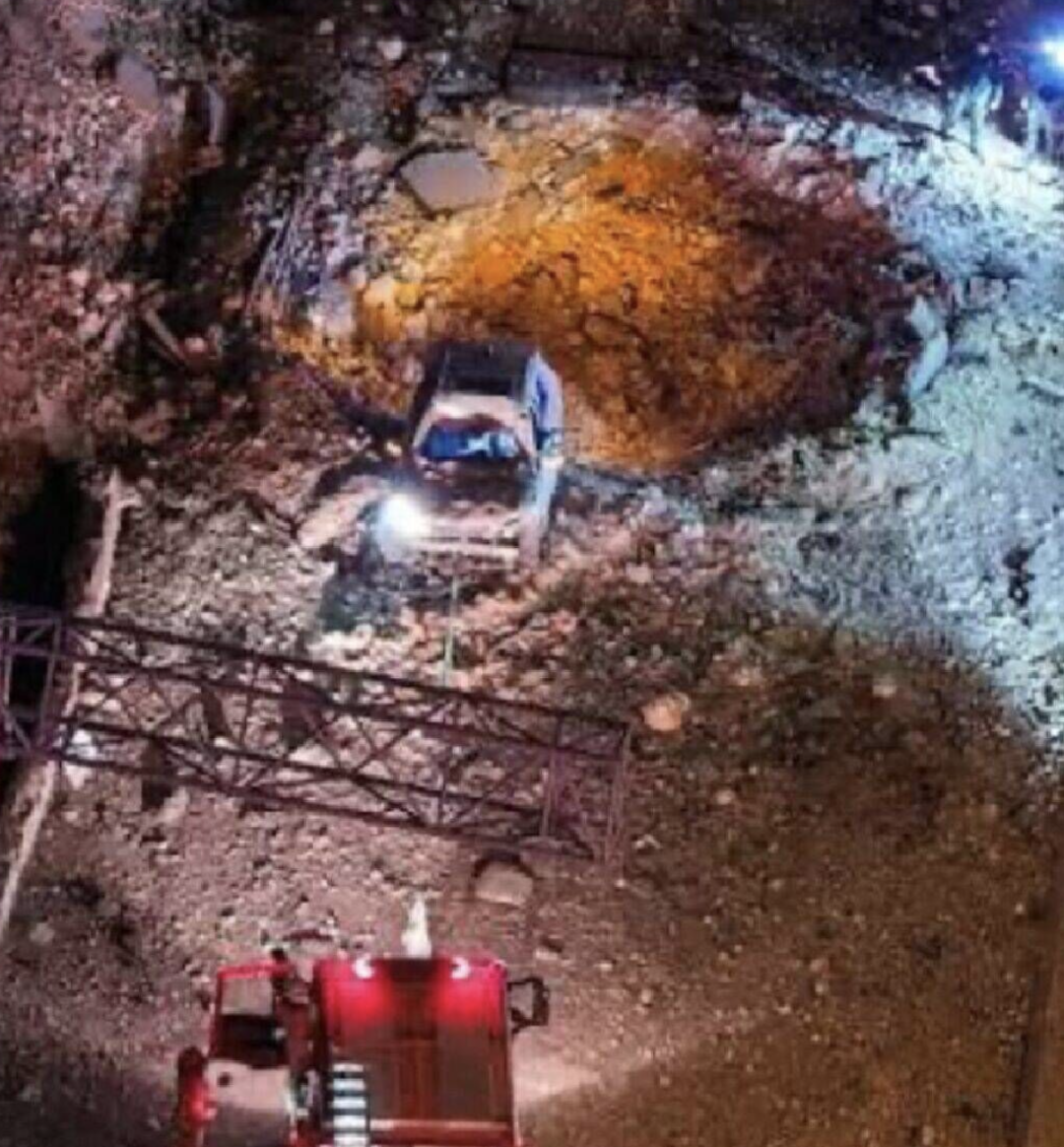
2. Today, BYD unexpectedly became an internet sensation due to a photo showing a BYD car, relatively intact, sitting on the edge of a crater created by an artillery shell. This has drawn much admiration. However, an artillery shell capable of creating such a massive crater is certainly not something a civilian vehicle could withstand; the BYD's presence in that location is purely coincidental. BYD's stock price surged 8% today; it's unclear whether this is related to the incident.
3. European natural gas prices surged 25% due to concerns that the conflict with Iran could disrupt gas supplies.
4. OPEC decided to increase production by 200,000 barrels per day starting in April. This decision is not entirely in response to the current Iranian crisis, but is based on the previous economic situation and inventory levels.
That's all for now, launch.
Original Article: View Chinese Version