Did you know that the Winter Olympics have quietly started these past few days? If it weren't for the TV in my living room at home in Linhai, where I saw my elderly relatives watching the games, I wouldn't have even noticed. The internet is now like an algorithmic cocoon, isolating many important events outside our circles of interests and hobbies from our viewpoints.
Of course, another reason is that we are not a country that is truly a winter sports nation. The dividing line for winter sports is 40 degrees north latitude. Lower latitudes have hotter climates and cannot accumulate snow. Beijing is at 39.9 degrees north latitude. Of China's 1.4 billion people, only 120 million live further north than Beijing, which is less than 10%. Therefore, Chinese people as a whole are not very enthusiastic about winter sports.
In addition, winter sports have a high economic threshold. The construction and maintenance of venues, sports equipment, coaches, and medical treatment for injuries are all very expensive. A little training and playing can easily cost tens of thousands of yuan, making them not accessible to the general public.
However, China also has an Olympic strategy, and the system concentrates limited resources on training athletes to compete for gold medals. Among winter sports, short track speed skating is the most cost-effective and efficient. Indoor venues can be built to accommodate a large number of people for training, and short track is also suitable for Asians who are smaller in stature and have a low center of gravity. Therefore, you will find that more than half of China's Winter Olympic gold medals are won in short track speed skating.
This shortcut was first discovered by the South Koreans, who, through resource investment and their own efforts, became the world's leading short track speed skating nation. We followed suit; what the South Koreans could do, we can certainly do too, and crush them.
Another characteristic of the Winter Olympics is the low number of gold medals, only 116, just one-third of the Summer Olympics' 329. For example, Gu Ailing's two golds and one silver in Chongli are equivalent to six golds and three silvers in the Summer Olympics. Doesn't that sound amazing? So even though her nationality has fluctuated, and she's made a fortune from commercial endorsements in China, I think it's deserved. Who doesn't want their country to win?
Nothing major happened in the capital markets this weekend, and precious metal prices recovered slightly. Gold closed at 4960 and silver at 77 on Friday night, both within normal ranges. Silver LOF closed at 3.099 on Friday, continuing its limit-down run, because the fund's net asset value fell even faster by -13%, and the premium not only didn't narrow but actually widened. It looks like it's heading for its sixth or seventh limit-down.
This fund is currently at the center of a media storm, with a barrage of criticism online and many people threatening to sue it. The company has also urgently set up a special task force to handle the aftermath, but filling such a hole involving hundreds of millions or tens of millions of dollars is not so easy.
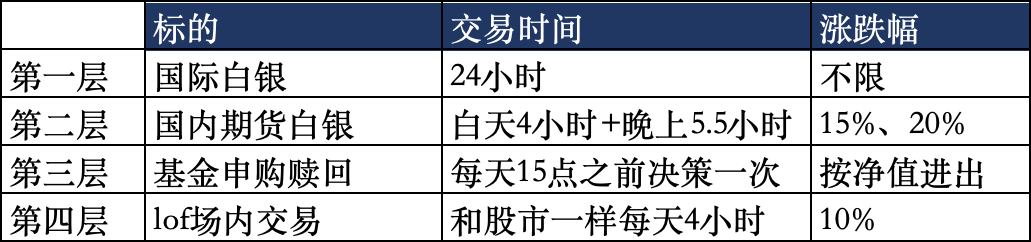
I want to say that the predicament of LOF funds is systemic. I made a table for you to see.
The same asset was traded in four different markets, with varying trading hours and rules. Normally, with low volatility, it was manageable, but then came the once-in-a-century price earthquake in silver – it would be strange if nothing went wrong. While the actions of the SDIC Fund were certainly flawed, it's unlikely any other fund company would have escaped unscathed in this situation.
Essentially, it's unreasonable to restrict the trading of an asset whose price fluctuates freely 24 hours a day to only 4 hours during the A-share market opening, with daily price limits.
At this point, I'd like to add something. The A-share market is already the world's second-largest stock market by market capitalization, but only four hours of trading per day is far too short. Most major global stock markets have longer trading hours. Moreover, these four hours aren't very friendly to European and American markets, as they're often open early in the morning or late at night. We encourage foreign investment in A-shares, so this aspect should be changed.
Hopefully, instead of shutting down products every time something goes wrong, people will simply complain about the product causing trouble. That's how the previous leveraged funds disappeared. Let's show some service and support innovative products, giving investors more investment tools to choose from.
1. Today's news indicates that Sanae Takaichi's Liberal Democratic Party (LDP) has secured 321 seats (out of a total of 465), nearly 70%, a stable majority. This number of seats means she can proceed with her "proactive fiscal policy" and "military strengthening plan" without hindrance, and push for revision of Japan's pacifist constitution in 2026.
This is important information that will profoundly impact Sino-Japanese relations in the coming years, and I feel it's gone too far.
2. The People's Bank of China (PBOC) increased its gold reserves by 40,000 ounces in December, marking the 15th consecutive month of increases. Based on the latest gold price, 40,000 ounces is worth approximately $200 million. The PBOC's gold reserves stand at 74.19 million ounces.
3. SpaceX has postponed its Mars exploration mission, originally planned for the end of 2026, but now it has been updated to March 2027. Over the weekend, a prominent figure on Wall Street mentioned a potential black swan event for gold: SpaceX might randomly discover a high-gold-content asteroid while exploring outer space, since Earth's gold is brought there by asteroid impacts, and Earth itself does not produce gold.
Randomly bumping into a gold-bearing asteroid in space—hahaha, that's a wild idea! The odds are even lower than winning 10 consecutive IPOs on the A-share market with a single account. But the probability of discovering a gold mine on Mars might be a bit higher.
4. Over the weekend, there was news in the commercial space industry that China successfully launched a reusable experimental spacecraft. Note that it's a reusable spacecraft, not a reusable rocket; it's the carrier that the rocket sent into space. The method of recovery wasn't explained, and no photos were released, likely due to state secrecy. Media speculation suggests it might resemble a drone and glide back to its designated location. I think this news is unremarkable, not particularly positive.
That's all. One thing to note about the A-share market on Friday is the significant drop in trading volume, which was only 2.15 trillion yuan. Although falling below 2 trillion yuan doesn't mean the market has stalled, the low volume makes it difficult to start a decent rally. It feels like things will probably stay this way until the Spring Festival, and it will be hard to come up with anything new.
Original Article: View Chinese Version