Back in Beijing, the temperature difference with Hong Kong is huge. It was 20 degrees Celsius there, and I was wearing just a light shirt, but here it's -5 degrees Celsius, and I'm wearing a down jacket. I've been to quite a few concerts over the years, and last night's Blackpink concert probably had the youngest audience ever. I'd estimate about three-quarters of them were women, with an average age of just over 20. The concert was like a giant nightclub, and I was so hyped up my head was spinning.
Blackpink held three consecutive shows at the Kai Tak Coliseum in Hong Kong, averaging 50,000 attendees per show, all sold out. Official tickets cost HK$1,000-2,000, but scalpers typically marked up the price by 100%. Many attendees also purchased official light sticks (light-up pink hammers) for HK$450 before entering the venue. These sticks, which cost only a few dollars to produce in Yiwu, were estimated to have sold 10,000-15,000 at the event, generating nearly HK$10 million in revenue from this alone. This is the essence of idol economics.
There's a point I'd like to elaborate on from last night's commentary: I warned those who like to engage in mean reversion trading not to participate in the commodity market, or they'll inevitably fall into a huge trap.
Many people may not understand what mean reversion trading is. This is actually a kind of conventional thinking, where many people, upon entering the trading market, subconsciously assume that indices and stock prices should be static and unchanging. In their eyes, if stock prices fall too much, they will definitely rise back, and if they rise too much, they will definitely fall back, ultimately reverting to the mean.
This kind of thinking can make small profits from frequent fluctuations in volatile markets, giving traders a good feeling. However, it leads to disastrous mistakes when faced with major, strong trends. For example, a few years ago, some people liked to buy low and sell high around the 3000-point mark, but they missed out on this round of market gains.
Actually, missing out on the gains isn't so bad; it's just a matter of being envious of others making money. However, in the commodity futures market, it's possible to short sell. Some people, having missed out on the gains, lose their minds and can't resist shorting, eventually losing everything in a crazy market.
Remember, commodity futures are almost all highly cyclical, making them inherently unsuitable for mean reversion trading. In fact, using mean reversion for stock trading is not recommended either; profits from volatility are small, while the real big money comes from trend trading. It's just that the A-share market over the past decade or so has been a cesspool, twitching back and forth around 3000 points, which has led some investors to regard this strategy as gospel.
Today, the A-share market saw a turnover of 3.25 trillion yuan. The market opened higher but closed lower, with a median decline of 1.3%, effectively pouring cold water on the overly excited investors. The major players remained active throughout the day, selling off their holdings immediately after the market opened and continuing until the afternoon close.
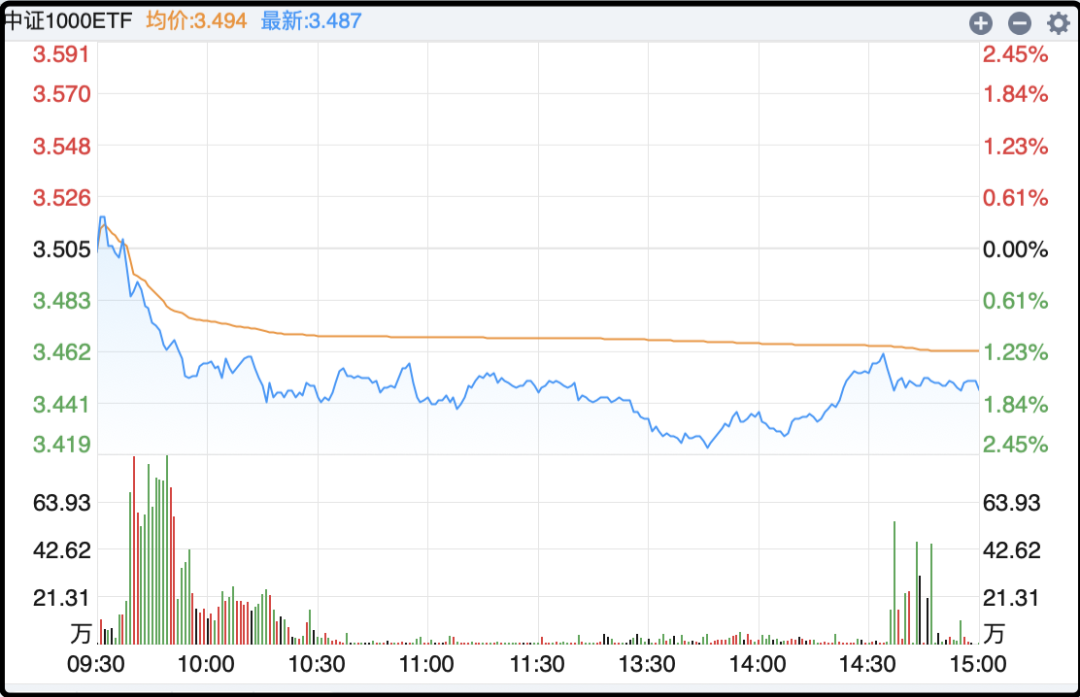
Besides heavyweight ETFs like the SSE 50 and CSI 300, this guy has also been selling off a lot of his CSI 1000 holdings these past few days. Look at the intraday chart and volume bars for 159845; it started selling as soon as the market opened, and by 10 AM it was completely destroyed. I checked the latest share count for 159845, and it still has over 30 billion units remaining, almost half of its previous high. This guy's strategy is to give away the profits meant for making money in the bull market to retail investors.
Today's market saw a shift in style, with the previously hot commercial aerospace sector down 3.5% and photovoltaic equipment opening 2.5% higher but closing down 1.5%, actually experiencing a 4% intraday drop. Funds flowed out of these concept sectors and into heavyweight stocks, making the SSE 50 and CSI 300 the only two broad-based indices to rise.
A single-day switch doesn't indicate anything; it's happened before. Unless it lasts for more than three days, it won't change market style preferences.
The only real winner in the market today was the precious metals sector, up 10.9%. Looking at that gain, you can tell the entire sector almost hit its daily limit. It's absolutely outrageous. Gold had already surpassed 5100 during the day, but as I was writing this article, it had fallen back to 5060. Silver reached a high of 110 and is now at 109. I feel like global speculative funds are rushing in; it's no longer related to fundamentals, it's purely sentiment driving the pricing.
I can't predict what the peak price will be in this round, so I won't proactively warn of the risks. Giving unsubstantiated warnings or advising people to buy gold at this time is irresponsible. At this stage, everyone is gambling based on intuition; even experts and influential figures are caught off guard. These past few days, I've received many messages asking if it's a good time to go all in on gold and silver; many people seem desperate. I don't have much to say, my only advice is that you shouldn't take positions you can't afford to lose.
1. Yanghe's stock price plummeted 9.85% today due to controversy surrounding its dividend plan, burying its shareholders. The entire liquor sector was initially dragged down, but some buying interest pulled it back up significantly, resulting in a long lower shadow on the closing price. I think the liquor sector still needs time to bottom out; the current price doesn't offer a high enough risk-reward ratio, so missing out isn't a big loss.
2. India has experienced a Nipah virus outbreak, with 5 confirmed deaths and a reportedly high mortality rate (75%). The outbreak also carries the risk of human-to-human transmission , raising concerns among global health authorities. This news spurred a surge in the biotech vaccine sector today; I noticed that Zhifei Biological Products Co., Ltd. saw a long-awaited 14% increase, clearly benefiting from this trend.
However, it's important to understand that viruses with high mortality rates are often easier to control and less likely to cause large-scale outbreaks. For example, the Ebola virus in Africa is notoriously dangerous, but it hasn't spread to other continents much because most people who contract Ebola die before even leaving Africa. We can observe the Nipah virus for a few more days, but based on experience, it's likely to subside in a few days.
I was in a rush when I got back tonight, so that's all for now.
Original Article: View Chinese Version