I was completely dumbfounded when I logged into the backend today 😳
Last night I said I'd write a movie review if you guys ordered some, so why are so many people telling me to watch "Boonie Bears"? Is this a prank? Are you serious? Why do so many people want to read a review of "Boonie Bears"? Are you all kids? I don't really care, I can go with my older brother and younger brother, consider it a family movie. It's just that I think your tastes are really weird. A bunch of stock market investors ordering "Boonie Bears Every Year"—are you guys asking for a beating from the A-share market…tsk tsk tsk
We happened to chat last night about the efficiency of different learning methods, and I have a very clear conclusion: writing is better than reading, reading is better than watching, and watching is better than listening. If you want to maintain efficient learning, it's best to actively write and read, but these two things are somewhat of a luxury for adults in modern society. Many people think that watching a few knowledge bloggers on TikTok or listening to a few podcasts is enough to persist in learning. This is not wrong in principle, but it is very inefficient, the memory is not deep, and it is easily buried and covered up.
The only constant in today's society is change. Please, Lao Deng, keep your curiosity alive and keep learning. I've been writing on my public WeChat account for 14 years, updating daily. These 14 years have been a continuous process of learning and sharing, and I've truly benefited immensely, making even more progress than when I was in school.
Today, the A-share market remained lackluster, with a turnover of 1.98 trillion yuan, finally falling below 2 trillion yuan. This trend was already visible a few days ago; investors are closing up shop in preparation for the Chinese New Year and have no interest in trading A-shares anymore. Market hotspots have generally cooled down, and volatility is decreasing. There are only two trading days left.
Every holiday season, people ask me whether to hold cash or stocks. I really don't want to look into those details. If you wouldn't dare hold a stock for even a whole Spring Festival, you shouldn't have bought it. If you're a day trader who trades very quickly, then just hold cash over the holiday.
There's only one group of people who really need to assess the risks of holding positions over the holiday: gold and silver futures investors. Nine days is just too long. Don't go on vacation and come back to find your account wiped out. If it were me, I would either hold cash or reduce my positions; I definitely wouldn't dare to hold a large position over the holiday.
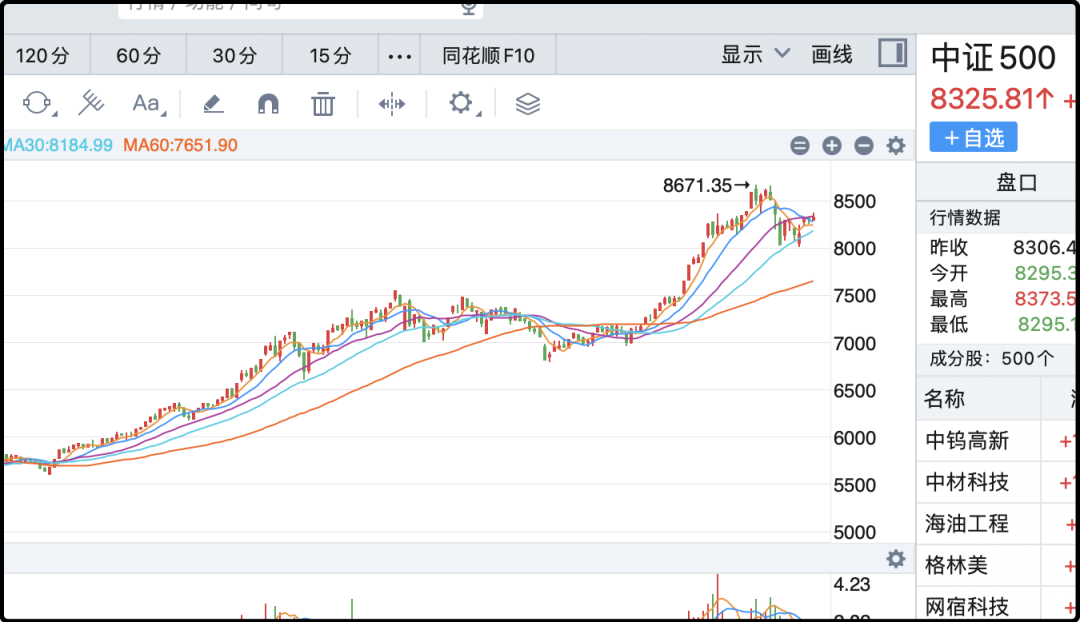
My main A-share position is in IC2606. As I mentioned before, unless the CSI 500 index rises above 10,000 points before June, I'll hold off for now. I have no trading plans for any upward or downward fluctuations of 10% from this level. I have some expectations for this year, but I'm unwilling to add to my position at this point because I believe that after this bull market ends, the subsequent bear market cycle could see the index fall back below 7,000 points. Buying at this level would only force me into a speculative mindset.
Since it's not suitable to increase holdings in this or that area, another problem many people face is what to do with their cash. I can share my own plans. First, I will pay attention to the housing market next year. If it continues to fall by 5-10% in 2026, I plan to look at affordable housing options in Beijing in the second half of the year, specifically two-bedroom apartments priced between 5 million and 6 million yuan, for investment.
I'm waiting for a possible -20% correction in US stocks next year.
I'm waiting for a big pie worth 40,000 to 50,000.
I'm waiting for 3500-4000 gold, then I can add a little more.
Many investment choices don't necessarily have to be the optimal solution. The risk of chasing the absolute lowest price is missing the buying opportunity; it's enough to be close to the target area. As for consumer stocks, while I'm not keen on buying them right now, I've been keeping them on my watchlist and monitoring them. Perhaps this tech wave is over, and then it'll be their turn to shine.
1. Today I saw several LOF funds lower their subscription limits to 1 yuan, citing high premium risk as the reason, aiming to prevent excessive arbitrage funds from entering and help the market return to rational prices. This confuses me. Doesn't a high premium require a large amount of arbitrage funds to smooth it out? Why prevent arbitrage funds from entering? This is a classic case of covering one's mouth when one's feet hurt. The reason LOF funds have high premiums in the market is because of insufficient supply. If there were enough supply, where would the premium come from?
2. Reuters reports that the Shenzhen government is drafting an 80 billion yuan bailout plan for the struggling Vanke. The plan, currently in its very early stages, includes a 20 billion yuan share placement in Vanke. The remaining 60 billion yuan comprises debt rollover from insurance funds and loans from state-owned banks.
Vanke is lucky to have partnered with Shenzhen Metro. If it had been Baoneng that took over back then, they would be buried a long way off.
3. A major event in the global financial markets these past few days was Google's issuance of 100-year bonds in the British pound bond market with an annual interest rate of 6.125%. Google borrowed the money to cope with its high annual AI competition expenses, and also because they believe that inflation over the next century will far exceed 6%, making this long-term loan at this interest rate very worthwhile.
I checked, and Google's interest rate is 1% higher than that of UK government bonds, yet it received 10 times oversubscription, indicating that investors perceive Google's credibility as comparable to that of the government. Frankly, I think this is quite crazy. I like and respect Google, but the randomness and risk of a tech company surviving for 100 years is simply too great. Disney and Coca-Cola also issued centennial bonds in 1993. These traditional industries are relatively better off, with more stable business models. Motorola's issuance in 1997 was quite tumultuous; after divesting and selling off its businesses, the remaining entity has persisted in repaying its debt to this day.
It's a pity that Google bonds can't be bought in China, otherwise I think they would be snapped up in the current asset shortage.
4. Today, the maiden flight test mission of the Long March 10 rocket and the Mengzhou spacecraft was successful. The Long March 10 is the booster, and the Mengzhou spacecraft is the manned component. This was a maximum dynamic pressure escape flight test, which tests whether the astronauts can be safely "ejected" out and saved their lives under the most violent wind pressure and the most unstable conditions of the rocket.
After the successful test, the rocket and the DreamZhu spacecraft were splashed down and recovered. The splashdown recovery involves using a rocket to decelerate the rocket and then a parachute to land it in the sea, from where it is towed back. This is a relatively mature and safe technology that we have mastered. The downside is that seawater is highly corrosive, requiring refurbishment before reuse.
I originally thought it would give a boost to the commercial space sector, but the A-shares market didn't react at all. What everyone is more looking forward to is achieving vertical recovery like SpaceX, because that would significantly reduce launch costs.
That's all for tonight, launch!
Original Article: View Chinese Version