In yesterday's article, I casually mentioned the topic of the American moon landing 50 years ago, and many readers asked me if I believed it.
I think there's no problem. The moon landing back then was real. Since you're interested, I'll just briefly mention a few pieces of evidence that I think are very convincing.
After the American moon landing in 1969, a laser reflector was deployed on the lunar surface. This was an array of over 100 quartz glass mirrors, placed on a flat area of the moon and then aligned with Earth. Once deployed, lasers emitted from Earth would be reflected back. The Soviet Union and France successfully tested this in 1970, providing the first evidence.
The second point is that the United States brought back a total of 382 kilograms of rocks from the lunar surface, while the Soviet Union's unmanned sampling drones (in three missions) only brought back 326 grams, a difference of orders of magnitude. This transport capability is also evidence. Lunar rocks have characteristics that cannot be replicated on Earth, and the US and Russia exchanged samples to verify that the other side's samples were genuine.
The third thing is the live broadcast on the day of the moon landing. The whole world was listening to the radio, and the astronauts' signals came from the direction of the moon. If it were to be faked, the fake team would also be working in that direction of the moon.
The fourth point is the number of moon landings. Between 1969 and 1972, the United States launched six spacecraft, and twelve astronauts successfully landed on the moon. If this were a fabricated political vanity project, one or two trips would have been enough. Logically, there's no need for such frequent and concentrated fabrication. This would not only be incredibly costly but also increase the risk of being exposed. Think about it; doesn't that make sense?
In order to outdo the Soviet Union, the United States invested heavily in the Apollo program, which at its peak accounted for 4.4% of the total US government budget in 1966. In the end, after achieving its goal, the US stopped the program, since the moon landing had almost no economic returns other than political gains.
In recent years, many amateur scientists have questioned the moon landing, and I've read several of them, but their level of expertise is questionable. Just imagine, during the Cold War, when the Soviet government was in a strategic standoff, any scientific team supported by the Soviet government that found evidence of fabrication would have publicly attacked the United States. Even they didn't notice the flaws, yet today netizens see it as "full of loopholes." Does this mean that Khunjerg's subordinates were all incompetent?  Today's A-share performance was passable, with a turnover of 2.48 trillion yuan. This volume is not high; during the more active period recently, it was over 3 trillion yuan. The median increase was 0.51%. What's interesting today is that the top (SSE 50, CSI 300) and the bottom (micro-cap stocks, CSI 2000) sectors both rose, while the middle and middle sectors, the ChiNext and STAR Market, were down.
The best performing sectors were coal and solar power, with one rising by 8% and the other by 5.2%.
The coal shortage is due to Indonesia's announcement of production cuts for thermal coal and export restrictions. Indonesia produced 790 million tons last year and plans to reduce production to 600 million tons by 2026, a 24% decrease. To put that into perspective, Indonesia accounts for 9-10% of global coal production, making it the third-largest coal producer after China and India.
However, China and India mine coal primarily for their own use, while Indonesia's coal is mainly exported. Indonesia accounts for 50% of global coal trade, making it the world's largest exporter. The Indonesian government felt last year's coal prices were unsatisfactory, so it is controlling supply to maintain prices. This is undoubtedly a major boon for domestic coal companies, and coal prices are expected to rise by 10-15% in the short term.
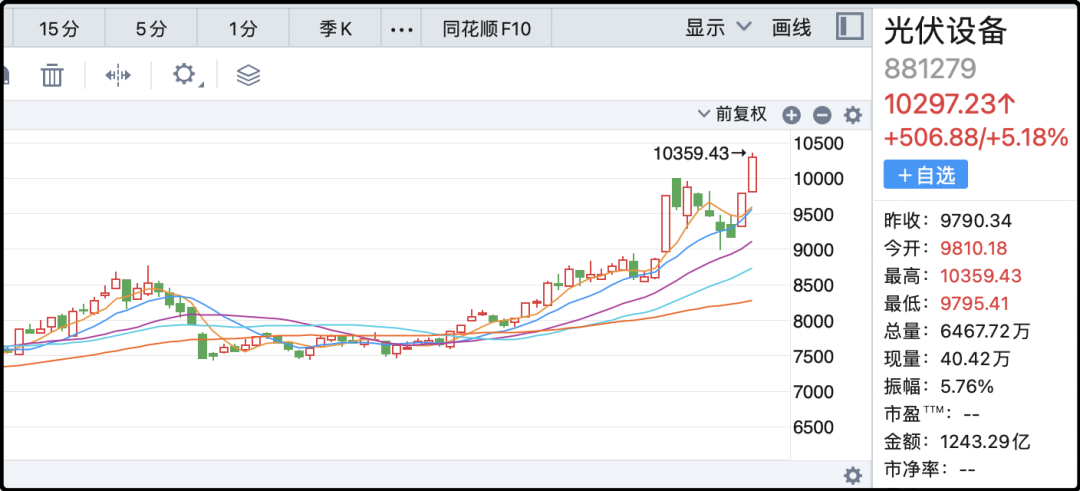
Today's surge in photovoltaic (PV) prices is related to Director Ma. He sent a team to China to visit PV companies, possibly to find suppliers for his space photovoltaic project. Domestic manufacturers have already confirmed this. Director Ma is truly the savior and benefactor of the PV industry. After more than two years of self-regulation, the industry was still struggling in a quagmire. Now, with just a few words from him and a few people taking a stroll in China, the industry is about to take off.
When domestic companies entertain foreign businesspeople, don't they offer them samples of Chinese specialties? They serve them a variety of flavors – strong, light, and strong – and then give them a gift box to take to Director Ma. If Director Ma were to post a single tweet praising Chinese baijiu, Wangdefo, it could literally boost the company's market value by hundreds of billions, no joke.
Today's A-share performance was passable, with a turnover of 2.48 trillion yuan. This volume is not high; during the more active period recently, it was over 3 trillion yuan. The median increase was 0.51%. What's interesting today is that the top (SSE 50, CSI 300) and the bottom (micro-cap stocks, CSI 2000) sectors both rose, while the middle and middle sectors, the ChiNext and STAR Market, were down.
The best performing sectors were coal and solar power, with one rising by 8% and the other by 5.2%.
The coal shortage is due to Indonesia's announcement of production cuts for thermal coal and export restrictions. Indonesia produced 790 million tons last year and plans to reduce production to 600 million tons by 2026, a 24% decrease. To put that into perspective, Indonesia accounts for 9-10% of global coal production, making it the third-largest coal producer after China and India.
However, China and India mine coal primarily for their own use, while Indonesia's coal is mainly exported. Indonesia accounts for 50% of global coal trade, making it the world's largest exporter. The Indonesian government felt last year's coal prices were unsatisfactory, so it is controlling supply to maintain prices. This is undoubtedly a major boon for domestic coal companies, and coal prices are expected to rise by 10-15% in the short term.
Today's surge in photovoltaic (PV) prices is related to Director Ma. He sent a team to China to visit PV companies, possibly to find suppliers for his space photovoltaic project. Domestic manufacturers have already confirmed this. Director Ma is truly the savior and benefactor of the PV industry. After more than two years of self-regulation, the industry was still struggling in a quagmire. Now, with just a few words from him and a few people taking a stroll in China, the industry is about to take off.
When domestic companies entertain foreign businesspeople, don't they offer them samples of Chinese specialties? They serve them a variety of flavors – strong, light, and strong – and then give them a gift box to take to Director Ma. If Director Ma were to post a single tweet praising Chinese baijiu, Wangdefo, it could literally boost the company's market value by hundreds of billions, no joke.  The tech sector saw a slight dip today, but it's not a major issue. Looking at my chart, the ChiNext index is only 3% away from its current rally high, and the CSI 500 is slightly further away, just over 4%. A single day's moderate gain should be enough. Morgan Stanley recently reported selling $84 billion (approximately 600 billion RMB), essentially liquidating their holdings from 2024 onwards, which should ease selling pressure. This aligns with my observations of the market over the past few days; selling has halted, so there's no need to be pessimistic about the market outlook.
1. Gold is currently at $5055 and silver at $91.67, both showing a clear recovery. Although still quite far from previous highs, market panic is gradually dissipating. Silver LOF funds continued to hit their daily limit down today, but trading volume is still increasing, from 100 million yesterday to 240 million today. Those who placed sell orders last night have a high probability of having sold earlier.
From a more cautious speculator's perspective, it's reasonable for a rare, only silver-focused asset like the Silver LOF to command a premium due to its short-term popularity and purchase restrictions. Currently, the premium is 52%, and if it hits the daily limit down tomorrow, it will be around 30%. I have a feeling it might not hold at the limit down price tomorrow, so you'd better not place any orders and just react after the market opens.
2. The CEO of the Hong Kong Stock Exchange stated that over 400 companies are currently queuing for listing, shifting the backlog of companies seeking to list on the A-share market from a few years ago to Hong Kong. The reason is simple: the A-share market performed poorly in recent years, leading to a significant reduction in IPOs, with a year-on-year decrease of 80%, and now often only one new stock is listed per week. Domestic companies unable to list on the A-share market but needing to raise funds have all turned to Hong Kong. However, regulators have issued a regulation, "Notice on Issues Concerning the Management of Funds Raised by Domestic Enterprises Listing Overseas," which essentially states that funds raised in Hong Kong and proceeds from share sales must be repatriated to mainland China, unless there is a genuine business need or a real overseas acquisition. Companies attempting to move funds overseas through Hong Kong listings are primarily targeted for crackdown.
That's about it. I'm heading back to Beijing from my vacation in Chongli. I'll stay another day tomorrow, and then go home for the Chinese New Year the day after. Many netizens have been urging me to go skiing, but I'm getting old, and I'm afraid of the cold and falling, so I basically stayed in the hotel for seven days. My son, on the other hand, took a week of lessons, three hours a day, and can already ski down intermediate slopes on his snowboard by himself. I'll show you a video; if you don't consider the hardships he endured beforehand, it's quite enjoyable.
The tech sector saw a slight dip today, but it's not a major issue. Looking at my chart, the ChiNext index is only 3% away from its current rally high, and the CSI 500 is slightly further away, just over 4%. A single day's moderate gain should be enough. Morgan Stanley recently reported selling $84 billion (approximately 600 billion RMB), essentially liquidating their holdings from 2024 onwards, which should ease selling pressure. This aligns with my observations of the market over the past few days; selling has halted, so there's no need to be pessimistic about the market outlook.
1. Gold is currently at $5055 and silver at $91.67, both showing a clear recovery. Although still quite far from previous highs, market panic is gradually dissipating. Silver LOF funds continued to hit their daily limit down today, but trading volume is still increasing, from 100 million yesterday to 240 million today. Those who placed sell orders last night have a high probability of having sold earlier.
From a more cautious speculator's perspective, it's reasonable for a rare, only silver-focused asset like the Silver LOF to command a premium due to its short-term popularity and purchase restrictions. Currently, the premium is 52%, and if it hits the daily limit down tomorrow, it will be around 30%. I have a feeling it might not hold at the limit down price tomorrow, so you'd better not place any orders and just react after the market opens.
2. The CEO of the Hong Kong Stock Exchange stated that over 400 companies are currently queuing for listing, shifting the backlog of companies seeking to list on the A-share market from a few years ago to Hong Kong. The reason is simple: the A-share market performed poorly in recent years, leading to a significant reduction in IPOs, with a year-on-year decrease of 80%, and now often only one new stock is listed per week. Domestic companies unable to list on the A-share market but needing to raise funds have all turned to Hong Kong. However, regulators have issued a regulation, "Notice on Issues Concerning the Management of Funds Raised by Domestic Enterprises Listing Overseas," which essentially states that funds raised in Hong Kong and proceeds from share sales must be repatriated to mainland China, unless there is a genuine business need or a real overseas acquisition. Companies attempting to move funds overseas through Hong Kong listings are primarily targeted for crackdown.
That's about it. I'm heading back to Beijing from my vacation in Chongli. I'll stay another day tomorrow, and then go home for the Chinese New Year the day after. Many netizens have been urging me to go skiing, but I'm getting old, and I'm afraid of the cold and falling, so I basically stayed in the hotel for seven days. My son, on the other hand, took a week of lessons, three hours a day, and can already ski down intermediate slopes on his snowboard by himself. I'll show you a video; if you don't consider the hardships he endured beforehand, it's quite enjoyable.
Original Article: View Chinese Version