I have friends inviting me to dinner and drinks tonight, so I'll be making pre-made dishes for everyone again. It's alright, this time I won't leave them overnight. I'll just write them out six or seven hours in advance, put them in plastic wrap, and leave them in the WeChat official account's backend. I'll heat them up in the microwave tonight and serve them to the readers.
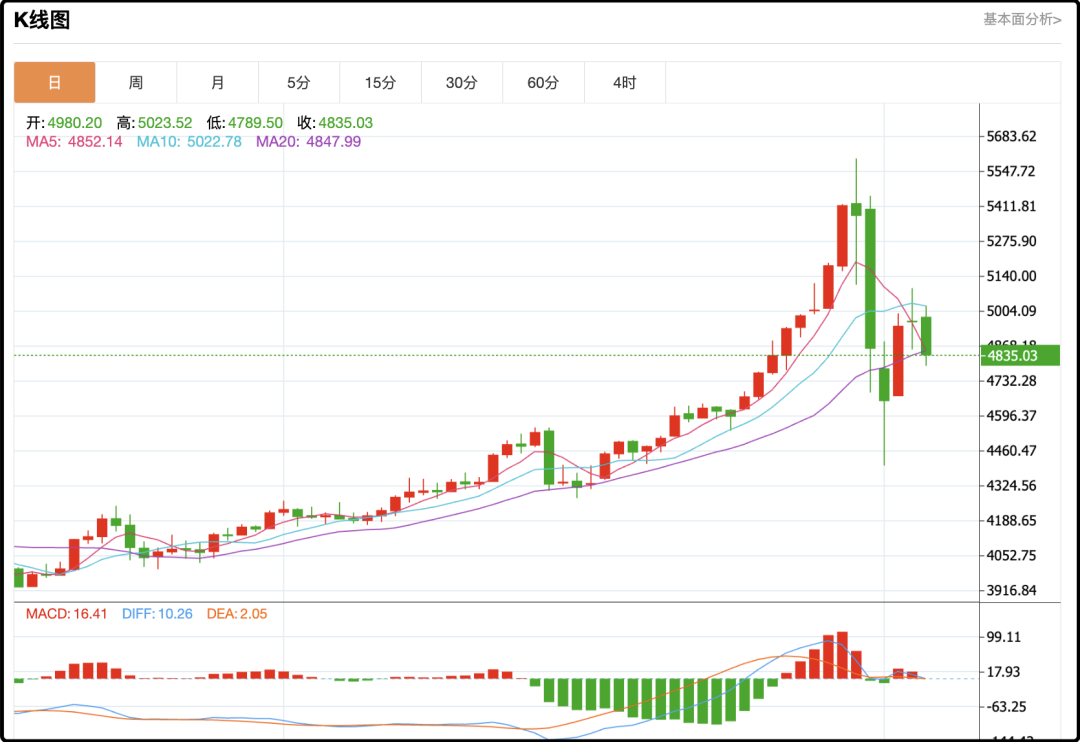
First, gold and silver prices collapsed again. Silver plummeted from 90 to 74, and gold fell from 5050 to 4800. Consequently, silver LOF funds remained locked at their daily limit down. Precious metals have just experienced the most intense price earthquake in history. Aftershocks are common after major earthquakes, and we are currently in the aftershock phase. Fluctuations in the 70-90 range for silver are normal; even conservatively speaking, a range of 60-100 wouldn't be surprising.
ETFs you buy in the Chinese market can only be traded for 4 hours a day, while futures are better, with a total of 10 hours (4 during the day + 5.5 during the night session). So if you are doing short-term trading, time difference is a big risk. It is very likely that you will be helpless when overseas markets experience sharp rises and falls, leaving you to your fate.
Investing in A-share precious metals stocks faces the same problem. These past few days, waking up in the morning is like going from heaven to hell – it's like gambling on big or small bets, no different from a casino. Once you understand the essence of the matter, you don't need to pretend to analyze company fundamentals; just control your betting positions and don't gamble until you can't afford to lose.
My gold holdings are intended for long-term allocation. I believe that a price above $4000 this year would be worthwhile because the US dollar is still in a rate-cutting cycle, and the creditworthiness of US Treasury bonds is declining. As a new anchor of wealth, gold will attract more new funds as long as the price is right. As for a price above $5000, it's not that it's unreasonable, but the risk-reward ratio is generally lower, and there's not much cost-effectiveness in buying it.
Another focus these past few days has been the continuous rebound of the consumer sector, which has emerged from its trough. The CSI Liquor Index rose five times in six days, recovering more than the 20, 30, and 60-day moving averages, indicating a trend reversal.
It's not just the liquor sector; today's leading A-share stocks, including film and television cinemas, beauty and personal care, tourism and hotels, food processing, and cultural media, all belong to the personal consumption sector. As for Hong Kong-listed Yum!, some funds have indeed withdrawn from the technology sector to engage in high-low trading based on market style.
According to statistics since New Year's Day, the CSI Liquor Index rose 5.2% and the CSI Real Estate Index rose 7.4%. These two stocks have begun to significantly outperform the CSI 300 and the market median.
So, are consumption and real estate really about to reverse course? Even if we were to draw a target from an archery target, I haven't seen any related positive news in the market. Although the National Bureau of Statistics hasn't released the figures yet, the January housing price and CPI data are unlikely to offer any surprises, and the government is unlikely to introduce any major policies before the Lunar New Year. The common explanation for the recent rebound in the consumption and real estate sectors is that people are betting on increased consumption during the upcoming Spring Festival.
Will this year's Spring Festival consumption explode? The probability is very high, due to two key advantages. First, this year's Spring Festival is exceptionally long, deliberately extended to nine days by the government to encourage more travel and spending. Second, the holiday falls later this year, from February 15th to February 23rd, coinciding with a significant warming of the southern climate, which is also conducive to people going out and spending. With these two factors, this year's Spring Festival consumption figures will definitely show a significant increase compared to last year.
However, the Spring Festival period alone is not enough. The real showdown in consumption and real estate will depend on the performance of normal data in March and April. Last year, housing prices rebounded at the beginning of the year thanks to policies, but then weakened in March and April, turned downwards, and began a retaliatory decline.
In addition, I think the reversal of consumption and real estate is highly dependent on the seesaw effect of market style. The recent surge in the small-cap sector followed by a correction is an important reason. As long as sectors such as AI, computing power, batteries, commercial aerospace, and precious metals start to rise again, the "garbage brother" combination is likely to be siphoned into the pit again.
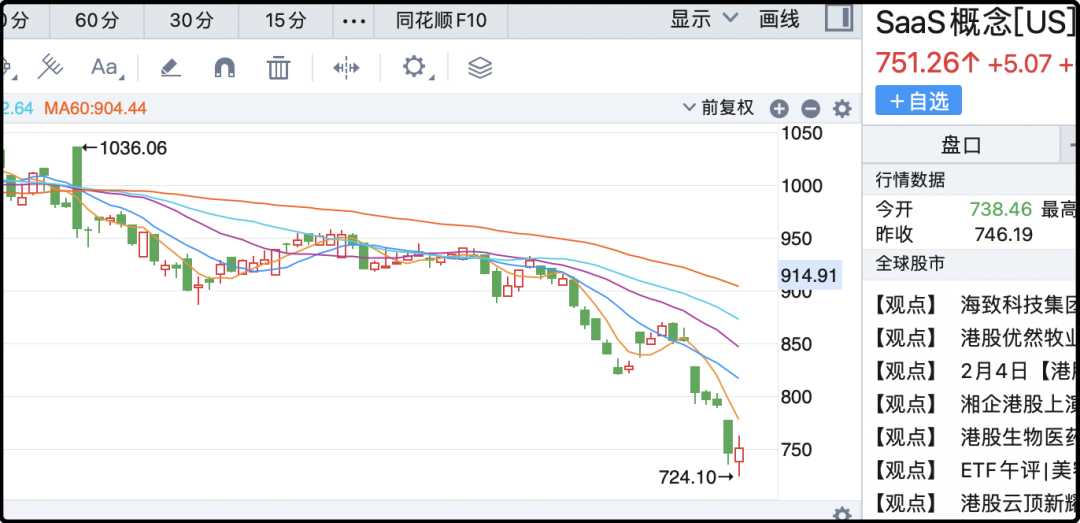
1. The recent plunge in the US stock market's software services sector is due to the realization that AI is not a remedy for software, but rather a poison. Specifically, tools like Adobe (graphic design), Salesforce (sales management), and Workday (human resource management) used to require a large workforce. For example, if your company had 100 designers, you would need 100 genuine copies of Photoshop, right? But now, with AI, the work of 100 designers might only require 20, so you only need to buy 20 genuine copies.
In particular, as intelligent agents develop further in the future, AI will replace more of the workforce, while current software services are mainly developed for human use and face the risk of being eliminated.
I took a quick look at the software sector in the A-share market, and it hasn't been affected by the US stock market yet. The candlestick chart I posted above shows the recent performance of the US software sector.
2. Bitcoin has recently experienced a sharp decline, dropping from 90,000 to 70,000. The four-year bear market cycle may have been delayed due to the intervention of traditional funds, making me suspicious that "this time is different."
The cycle appears to be still valid. Based on past patterns, each bear market retracement is typically 60-80%, with the retracement decreasing each time. Therefore, this wave is expected to reach the 50,000-60,000 range, or conservatively, the 40,000-50,000 range. For ETH, the target is 1500-1800, or conservatively 1200-1400. Bear markets usually last for more than a year, which will continuously test your courage; don't worry about missing out.
3. A few days ago, I commented on the changes to the net asset value rules of the silver LOF fund. Many readers left comments with their opinions, and after thinking about it, I realized they were right. Changing the rules is not inherently wrong, but the timing of the announcement was too late. Silver prices had already plummeted on Friday night. The fund should have held emergency discussions over Saturday and Sunday to address the issue, allowing them to announce the changes before the market opened on Monday, giving users the option to choose whether to hold or sell.
In reality, they announced the changes on Monday evening after the market closed. At that time, users who applied for redemptions during the day were unaware of the rule change. Many of them might not have redeemed if they had known the rules had changed. This process is flawed and greatly affects judgment. No wonder many people are now relentlessly pursuing lawsuits against the fund; there are indeed flaws, and this matter is unlikely to be resolved peacefully.
That's all for now. Today's market has ended, and overall it went down, but it's not too bad. The CSI 500 has still risen 10% since the beginning of the year; what more could you ask for in a month? I'll set up automatic posting and check the comments early when I get back tonight. You guys should go to bed early if you're going to be home late. 
Original Article: View Chinese Version