Last night I mentioned that Hynix's year-end bonuses might average over 3 million RMB per person this year, and the comments section exploded. Some people asked which company it was from, so I've converted the figures to RMB for easier reading. Hynix's profit this year is estimated to be between 1 and 1.3 trillion RMB. Their policy is to allocate 10% of profits to bonuses, which would be at least 100 billion RMB. Hynix has around 34,000 employees in South Korea, so dividing that by the amount, it's an average of 3 million RMB per person.
It's worth noting that Hynix has approximately 15,000 employees in China, and they won't share in this bonus. Last year, Chinese employees received bonuses equivalent to 6-8 months' salary, far less than their South Korean counterparts. This is understandable; Chinese companies hiring African employees in their African branches also pay them according to local rates.
Some people asked why Samsung went on strike. The main reason was dissatisfaction with the distribution of profits. Samsung has a "bonus cap" system, which means that employees' year-end bonuses cannot exceed 50% of their normal salary. Normally, this wouldn't be a problem, but in the past two years, the storage industry has been booming. Samsung's net profit this year is expected to be over one trillion yen, so the union organized workers to fight against the conglomerates, demanding that their income be on par with SK Hynix.
I'm really worried about the Koreans. They make so much money in one go, how can they maintain their original aspirations and work diligently? They're doomed.
Another reader asked about the expected annualized return of investing in the CSI 500. Under normal circumstances, it's around 4-5%, and with dividends, it might approach 6%. If you roll over futures, there's a discount, and no dividends, so the annualized return is roughly 10%. However, this 10% is not a linear return; it fluctuates dramatically year by year. For example, I lost 13% in 2022, broke even and made a small profit in 2023 and 2024, and then made a 40% profit in 2024.
If you entered the market at the end of 2021 and still lost money after three consecutive years, you might start to doubt whether your strategy was working and whether you should continue. Then, in 2025, the market rose by 15%, and you were afraid it would fall back down. You couldn't resist selling because you had some unrealized profit in your account. As a result, after four years, you only made less than 10%. I'm not using this as an extreme example to scare people; it's the real experience of many people I know.
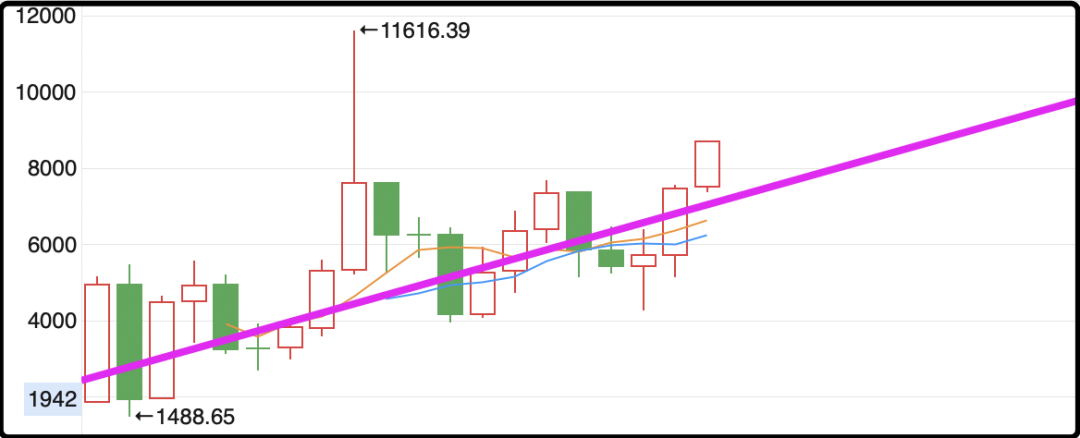 Furthermore, the CSI 500 Index has been trending upwards with fluctuations for many years, and this upward range has a central point, roughly represented by the purple line I drew. The annualized expected return I mentioned earlier is the slope of this purple line. If you buy below the purple line and sell above it, the annualized return may be higher than expected. However, since the index is currently above the purple line, the expected return for long-term investment now will be discounted.
I don't want to make empty promises; I'll be frank, and you can decide for yourselves. If you're making good money trading individual stocks, then keep going, no problem. But if you haven't made any money or outperformed the market over the years, then you should seriously consider whether you should try a different approach.
Today's market movement was mainly driven by the momentum from yesterday's surge. The rise was so rapid that there was still some energy left after a night's sleep. Components rose 4%, communications rose 3.6%, and semiconductors rose 2.7%. Sentiment is still boiling in the AI sector, and market expectations are gradually converging. Now, there are hardly any people saying anything bad about AI. At this time, pointing out the risks would only make one look like a clown who missed out. So, I've kept quiet.
Today, coal and oil & gas stocks suffered the most significant declines, both falling by more than 3%. This was due to the easing of tensions between the US and Iran, leading to a sharp drop in international oil prices. These are traditional, established stocks, and this negative news dealt them a severe blow. While older stocks didn't rise much, investor sentiment was even more precarious. Many retail investors are currently torn between whether to cut their losses and chase after hot stocks. At this time, any slight stimulus could prompt them to make the decision to sell.
Therefore, you will find that when the stock market falls, it falls in waves, but when it rebounds, it is weak and powerless. In the end, people's hearts have fallen and the team can no longer be led.
At this point, the wisest strategy is to respect the trend. Retail investors' funds are like ants; even if thousands rush in, they'll only be cannon fodder. Think about it: the national team has so much money. A few years ago, when the market was trending downwards, they bought in 500 to 600 billion yuan, but the market still couldn't stop falling. It took more than a year for it to recover.
The national team has a mission to maintain stability, while retail investors only need to be responsible for themselves. Moreover, with only a few dollars in their accounts, it's just a matter of a few seconds to buy in. So, they can wait until the trend has improved before adding fuel to the fire, making full use of their small size advantage.
1. The People's Bank of China announced its gold reserves for April, increasing them by 260,000 ounces, worth approximately 8.8 billion RMB. This increase has accelerated; January saw an increase of 40,000 ounces, February 30,000 ounces, and March 160,000 ounces, but even combined, the increase doesn't match the amount purchased in the previous month. This could be a signal that gold is consolidating around $4,500, and the possibility of it falling to $4,000 this year seems very small.
I've been putting gold futures recently, similar to Duan Yongping's operations on Pop Mart a few days ago. There are options at 4400 and 4450, with annualized interest rates of 13-17%. For example, for a contract expiring on May 22nd, if gold falls below 4400, I'll buy it at 4400; if it doesn't, I'll get the 13-17% annualized interest.
2. The main lithium carbonate contract broke through 200,000 today. However, Goldman Sachs' latest report said that lithium prices peaked in the first half of this year and will fall by 20-40% in the second half of the year to 2028. There will be a surplus of more than 20% in the second half of 2026 to 2027. Therefore, a sell rating was given.
3. The EU has introduced a policy banning public funding for energy projects (including photovoltaics and energy storage) that use Chinese inverters. Chinese inverters hold approximately 80% of the European market share, with Huawei and Sungrow Power alone accounting for 61%. The EU is using energy security as a pretext, but its real aim is to protect European companies and combine energy independence with geopolitics.
China can still sell its exports to the EU, but it won't receive subsidies, which will reduce its competitiveness. The only way out is to open factories in Europe, but that would also make it easy to encounter intellectual property disputes.
4. Iran has opened up two shipping lanes in the Strait of Hormuz, and ships have started passing through. Oil prices will drop another 4% tonight, with the latest Brent crude at $97.
That's all for today. I'm going to see the movie " Letters to Grandma " this afternoon . It's received rave reviews on Douban, with a rare 9-point rating. I watched it this afternoon and it was indeed very good; in fact, it might be the best Chinese-language film I've seen in the past year.
The background is the migration of Cantonese people to Southeast Asia. I looked up historical data and found that a total of 5 million people went there from the late Qing Dynasty to before the founding of the People's Republic of China. I had rarely paid attention to their stories before, and this film filled that gap for me. Before watching it, I thought it was a romance film, but it's not; its themes are much more sophisticated.
The script is excellent, that's its core strength. The actors' performances were also quite good. Apparently, the director cast entirely amateurs; the female lead is a senior majoring in Financial Engineering at Guangdong University of Finance and Economics, completely unrelated to acting. Financial Engineering…that's for quantitative trading majors. She was originally planning to exploit stock market investors after graduation, but looks like she'll have to switch careers to acting.
The entire film cost 14 million, so making a good movie doesn't require a lot of money. It doesn't matter if you don't have money for publicity and distribution; the work itself will speak for itself, and the audience's word of mouth will speak for itself.
Trust my taste in movies. Go see it if you have time this weekend. You can bring your elderly relatives or children too.
Furthermore, the CSI 500 Index has been trending upwards with fluctuations for many years, and this upward range has a central point, roughly represented by the purple line I drew. The annualized expected return I mentioned earlier is the slope of this purple line. If you buy below the purple line and sell above it, the annualized return may be higher than expected. However, since the index is currently above the purple line, the expected return for long-term investment now will be discounted.
I don't want to make empty promises; I'll be frank, and you can decide for yourselves. If you're making good money trading individual stocks, then keep going, no problem. But if you haven't made any money or outperformed the market over the years, then you should seriously consider whether you should try a different approach.
Today's market movement was mainly driven by the momentum from yesterday's surge. The rise was so rapid that there was still some energy left after a night's sleep. Components rose 4%, communications rose 3.6%, and semiconductors rose 2.7%. Sentiment is still boiling in the AI sector, and market expectations are gradually converging. Now, there are hardly any people saying anything bad about AI. At this time, pointing out the risks would only make one look like a clown who missed out. So, I've kept quiet.
Today, coal and oil & gas stocks suffered the most significant declines, both falling by more than 3%. This was due to the easing of tensions between the US and Iran, leading to a sharp drop in international oil prices. These are traditional, established stocks, and this negative news dealt them a severe blow. While older stocks didn't rise much, investor sentiment was even more precarious. Many retail investors are currently torn between whether to cut their losses and chase after hot stocks. At this time, any slight stimulus could prompt them to make the decision to sell.
Therefore, you will find that when the stock market falls, it falls in waves, but when it rebounds, it is weak and powerless. In the end, people's hearts have fallen and the team can no longer be led.
At this point, the wisest strategy is to respect the trend. Retail investors' funds are like ants; even if thousands rush in, they'll only be cannon fodder. Think about it: the national team has so much money. A few years ago, when the market was trending downwards, they bought in 500 to 600 billion yuan, but the market still couldn't stop falling. It took more than a year for it to recover.
The national team has a mission to maintain stability, while retail investors only need to be responsible for themselves. Moreover, with only a few dollars in their accounts, it's just a matter of a few seconds to buy in. So, they can wait until the trend has improved before adding fuel to the fire, making full use of their small size advantage.
1. The People's Bank of China announced its gold reserves for April, increasing them by 260,000 ounces, worth approximately 8.8 billion RMB. This increase has accelerated; January saw an increase of 40,000 ounces, February 30,000 ounces, and March 160,000 ounces, but even combined, the increase doesn't match the amount purchased in the previous month. This could be a signal that gold is consolidating around $4,500, and the possibility of it falling to $4,000 this year seems very small.
I've been putting gold futures recently, similar to Duan Yongping's operations on Pop Mart a few days ago. There are options at 4400 and 4450, with annualized interest rates of 13-17%. For example, for a contract expiring on May 22nd, if gold falls below 4400, I'll buy it at 4400; if it doesn't, I'll get the 13-17% annualized interest.
2. The main lithium carbonate contract broke through 200,000 today. However, Goldman Sachs' latest report said that lithium prices peaked in the first half of this year and will fall by 20-40% in the second half of the year to 2028. There will be a surplus of more than 20% in the second half of 2026 to 2027. Therefore, a sell rating was given.
3. The EU has introduced a policy banning public funding for energy projects (including photovoltaics and energy storage) that use Chinese inverters. Chinese inverters hold approximately 80% of the European market share, with Huawei and Sungrow Power alone accounting for 61%. The EU is using energy security as a pretext, but its real aim is to protect European companies and combine energy independence with geopolitics.
China can still sell its exports to the EU, but it won't receive subsidies, which will reduce its competitiveness. The only way out is to open factories in Europe, but that would also make it easy to encounter intellectual property disputes.
4. Iran has opened up two shipping lanes in the Strait of Hormuz, and ships have started passing through. Oil prices will drop another 4% tonight, with the latest Brent crude at $97.
That's all for today. I'm going to see the movie " Letters to Grandma " this afternoon . It's received rave reviews on Douban, with a rare 9-point rating. I watched it this afternoon and it was indeed very good; in fact, it might be the best Chinese-language film I've seen in the past year.
The background is the migration of Cantonese people to Southeast Asia. I looked up historical data and found that a total of 5 million people went there from the late Qing Dynasty to before the founding of the People's Republic of China. I had rarely paid attention to their stories before, and this film filled that gap for me. Before watching it, I thought it was a romance film, but it's not; its themes are much more sophisticated.
The script is excellent, that's its core strength. The actors' performances were also quite good. Apparently, the director cast entirely amateurs; the female lead is a senior majoring in Financial Engineering at Guangdong University of Finance and Economics, completely unrelated to acting. Financial Engineering…that's for quantitative trading majors. She was originally planning to exploit stock market investors after graduation, but looks like she'll have to switch careers to acting.
The entire film cost 14 million, so making a good movie doesn't require a lot of money. It doesn't matter if you don't have money for publicity and distribution; the work itself will speak for itself, and the audience's word of mouth will speak for itself.
Trust my taste in movies. Go see it if you have time this weekend. You can bring your elderly relatives or children too.
Original Article: View Chinese Version