These past few days everyone's been focused on how Hynix and Samsung are making huge profits and giving their employees massive bonuses, right? They give out 10% of their operating profit each year, with the company keeping 90%. So I've been wondering who the shareholders of Hynix and Samsung are.
After checking, I found that these two companies have something in common: 50-55% of their shares are held by foreign investors, including BlackRock, the Norwegian sovereign wealth fund, the Singapore sovereign wealth fund, Fidelity, Vanguard, and many other well-known institutions from around the world.
We often say that Samsung is controlled by the Lee family chaebol, but in reality, their family's shareholding ratio is only about 18%, which is not enough to control the company. However, most foreign institutions are financial investors, and they will not interfere with the company's management if they can make money. In addition, the South Korean pension fund holds 7% of the shares and often tacitly approves of this. Therefore, the Lee family has always been in control of Samsung.
Hynix is effectively controlled by SK Group, the third largest chaebol in South Korea, the Choi family. They hold 25% of the shares, and with the tacit support of the South Korean pension fund (7.5%), they have achieved control over the company. The 55% foreign capital is also just money without any involvement.
As an aside, SK Group is a behemoth in South Korea, controlling an energy and telecommunications empire. SKT, where Lee Sang-hyeok played for 14 years, is an esports club under the group. I was stunned to see a video of him and Yoo Jimin today; my first reaction was to check for AI prompts in the bottom left corner.  Getting back to the main point, because more than half of the shares are held by foreign capital, there's a view circulating online that South Korean companies are controlled by Europe and the US, and their profits are being squeezed out. There's some truth to this, but consider this: South Korea is a tiny country with a population of just over 50 million, yet it boasts several world-class corporations and even monopolizes high-tech core industries like memory storage.
Without the support of global capital and the binding of interests, they likely wouldn't have achieved their current status, and even if they had, they wouldn't be able to guarantee their own interests. The safest business model is for everyone to make money together. If the Lee family held 80% of Samsung's shares instead of 18%, various sanctions, technological blockades, and tariff barriers would have followed. Foreign shareholders = political protection umbrella; you can surely understand this.
Returning to the A-share market, the overall investment ratio of foreign capital is around 3.5%, which is not high. In contrast, the foreign capital ratio in the US and Japanese stock markets is 20-30%, and even in the Indian stock market, it is over 10%. This is related to the institutional design of the A-share market, which has many restrictions and inconvenient entry and exit. Furthermore, the domestic public opinion is not friendly; whenever the market is sluggish, the first scapegoat is foreign capital, with accusations of "malicious short selling," "hostile foreign capital," and "unrelenting attempts to destroy us." Many retail investors even wish to drive all foreign capital out of the A-share market.
In fact, foreign capital has been the main force actively buying A-shares for the past decade, with a cumulative inflow of about 1.85 trillion yuan.
Therefore, I think that the mentality of closing oneself off or hoarding resources is not acceptable. As Chinese companies grow bigger and bigger and their relationship with the global market becomes closer, we should welcome the participation of global capital. The deeper the ties of interests are formed, the less confrontation and conflict will occur, and the more stable peace and prosperity will be.
In the past few days, many readers have left messages asking about the World Cup broadcasting rights, worried that the negotiations might fall apart and they wouldn't be able to watch the games. FIFA initially offered $250-300 million, which was just a casual offer to raise expectations for the negotiations. They have now conceded to $120-150 million, which is not far from CCTV's expected price of $60-80 million. The probability of both sides making concessions and reaching a compromise at the last minute is 90%, and the possibility of a complete breakdown is less than 10%.
Our country has policies stipulating that CCTV is the only authorized negotiator for the World Cup and the Olympics. Local TV stations and online platforms have no right to participate, so there is no bidding or infighting. FIFA only has CCTV as a channel to bring the World Cup to China.
In the previous two seasons, CCTV bought the broadcasting rights and kept them all to itself, leaving no share for local TV stations. The rights were only granted to online platforms like Douyin and Migu, preventing internet capital from getting involved. In contrast, the NBA broadcasting rights in China were opened to bidding, and the price increased 41 times in 15 years.
Domestic media outlets have claimed that FIFA discriminates against Chinese consumers with its pricing, but I think this statement is not objective. We can compare it with other countries and regions.
Japan spent $200 million and South Korea spent $125 million. Of course, these two countries have teams participating and high public attention, but in terms of audience size and advertising market scale, we are definitely not inferior to Japan and South Korea.
Hong Kong, with a population of just over 7 million, has no teams participating, yet the broadcasting rights have already been signed for $25 million.
The US has 480 million, the UK 350 million, Germany 150 million, India 17.5 million, and Vietnam 15 million. Comparing these, what do you think is a reasonable price for China?
Even if negotiations break down in the end, there will likely be a lot of pirated alternatives online. Fans who really want to watch the games will definitely find a way. As for casual fans who just want to join in the fun, they can simply choose not to watch. The world won't fall apart without the World Cup.
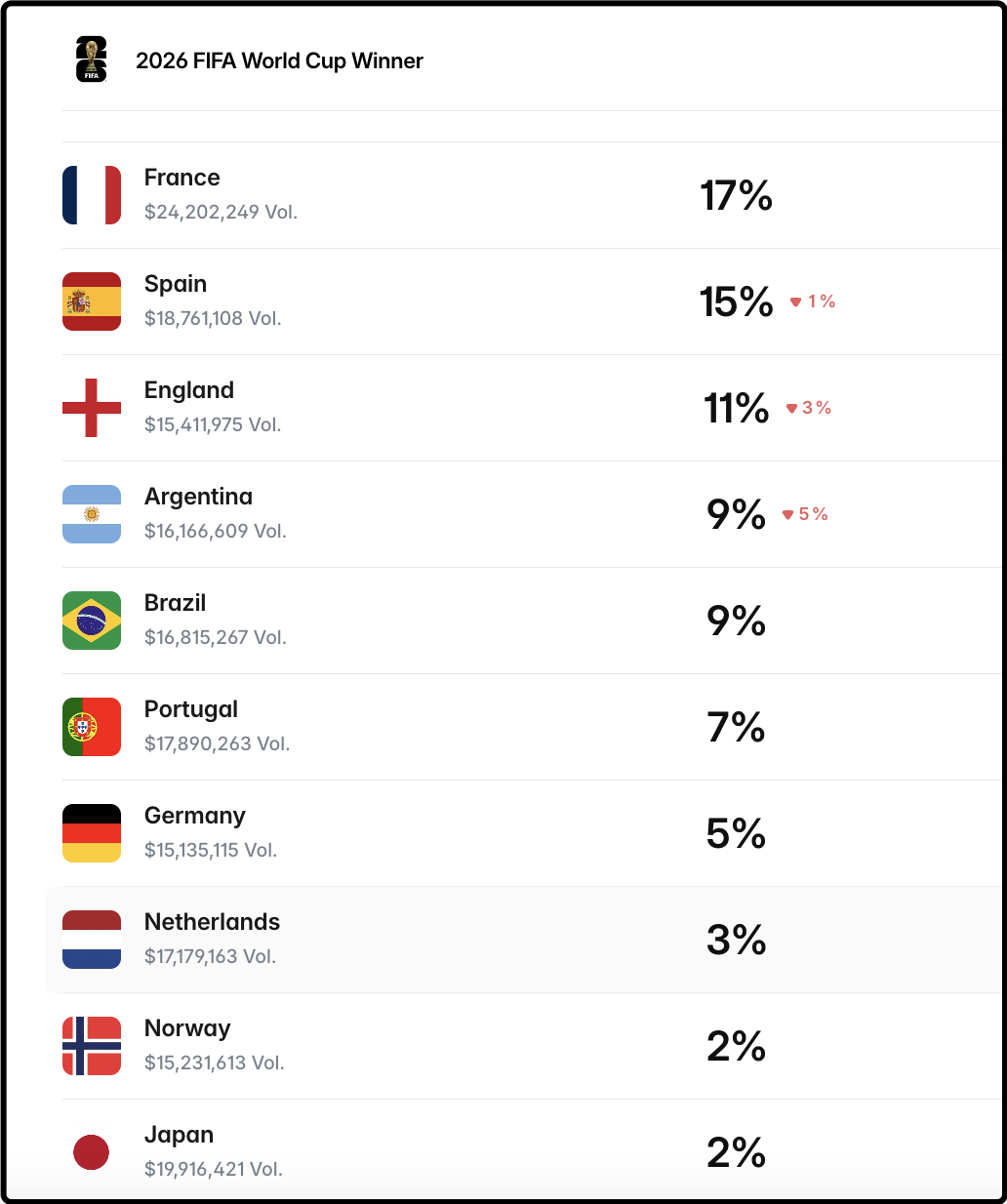
I glanced at the latest on-chain betting odds, and Japan has actually squeezed into the top ten. I'm actually hoping they can pull off a miracle and win the championship. If Japan wins, it will completely shatter racial discrimination in football, and there will be no more saying that Asians are not suitable for playing football or for contact sports. It will also ignite the competitive spirit of Chinese football. What the Japanese can do, theoretically the Chinese can also do, just like Su Bingtian running 9.83 at the Tokyo Olympics, which caused a sensation and cheers throughout Japan.
That's all for tonight. I just saw that Micron Technology opened up 10% again. May it continue to shine next week. Have a great weekend.
Getting back to the main point, because more than half of the shares are held by foreign capital, there's a view circulating online that South Korean companies are controlled by Europe and the US, and their profits are being squeezed out. There's some truth to this, but consider this: South Korea is a tiny country with a population of just over 50 million, yet it boasts several world-class corporations and even monopolizes high-tech core industries like memory storage.
Without the support of global capital and the binding of interests, they likely wouldn't have achieved their current status, and even if they had, they wouldn't be able to guarantee their own interests. The safest business model is for everyone to make money together. If the Lee family held 80% of Samsung's shares instead of 18%, various sanctions, technological blockades, and tariff barriers would have followed. Foreign shareholders = political protection umbrella; you can surely understand this.
Returning to the A-share market, the overall investment ratio of foreign capital is around 3.5%, which is not high. In contrast, the foreign capital ratio in the US and Japanese stock markets is 20-30%, and even in the Indian stock market, it is over 10%. This is related to the institutional design of the A-share market, which has many restrictions and inconvenient entry and exit. Furthermore, the domestic public opinion is not friendly; whenever the market is sluggish, the first scapegoat is foreign capital, with accusations of "malicious short selling," "hostile foreign capital," and "unrelenting attempts to destroy us." Many retail investors even wish to drive all foreign capital out of the A-share market.
In fact, foreign capital has been the main force actively buying A-shares for the past decade, with a cumulative inflow of about 1.85 trillion yuan.
Therefore, I think that the mentality of closing oneself off or hoarding resources is not acceptable. As Chinese companies grow bigger and bigger and their relationship with the global market becomes closer, we should welcome the participation of global capital. The deeper the ties of interests are formed, the less confrontation and conflict will occur, and the more stable peace and prosperity will be.
In the past few days, many readers have left messages asking about the World Cup broadcasting rights, worried that the negotiations might fall apart and they wouldn't be able to watch the games. FIFA initially offered $250-300 million, which was just a casual offer to raise expectations for the negotiations. They have now conceded to $120-150 million, which is not far from CCTV's expected price of $60-80 million. The probability of both sides making concessions and reaching a compromise at the last minute is 90%, and the possibility of a complete breakdown is less than 10%.
Our country has policies stipulating that CCTV is the only authorized negotiator for the World Cup and the Olympics. Local TV stations and online platforms have no right to participate, so there is no bidding or infighting. FIFA only has CCTV as a channel to bring the World Cup to China.
In the previous two seasons, CCTV bought the broadcasting rights and kept them all to itself, leaving no share for local TV stations. The rights were only granted to online platforms like Douyin and Migu, preventing internet capital from getting involved. In contrast, the NBA broadcasting rights in China were opened to bidding, and the price increased 41 times in 15 years.
Domestic media outlets have claimed that FIFA discriminates against Chinese consumers with its pricing, but I think this statement is not objective. We can compare it with other countries and regions.
Japan spent $200 million and South Korea spent $125 million. Of course, these two countries have teams participating and high public attention, but in terms of audience size and advertising market scale, we are definitely not inferior to Japan and South Korea.
Hong Kong, with a population of just over 7 million, has no teams participating, yet the broadcasting rights have already been signed for $25 million.
The US has 480 million, the UK 350 million, Germany 150 million, India 17.5 million, and Vietnam 15 million. Comparing these, what do you think is a reasonable price for China?
Even if negotiations break down in the end, there will likely be a lot of pirated alternatives online. Fans who really want to watch the games will definitely find a way. As for casual fans who just want to join in the fun, they can simply choose not to watch. The world won't fall apart without the World Cup.
I glanced at the latest on-chain betting odds, and Japan has actually squeezed into the top ten. I'm actually hoping they can pull off a miracle and win the championship. If Japan wins, it will completely shatter racial discrimination in football, and there will be no more saying that Asians are not suitable for playing football or for contact sports. It will also ignite the competitive spirit of Chinese football. What the Japanese can do, theoretically the Chinese can also do, just like Su Bingtian running 9.83 at the Tokyo Olympics, which caused a sensation and cheers throughout Japan.
That's all for tonight. I just saw that Micron Technology opened up 10% again. May it continue to shine next week. Have a great weekend.
Original Article: View Chinese Version