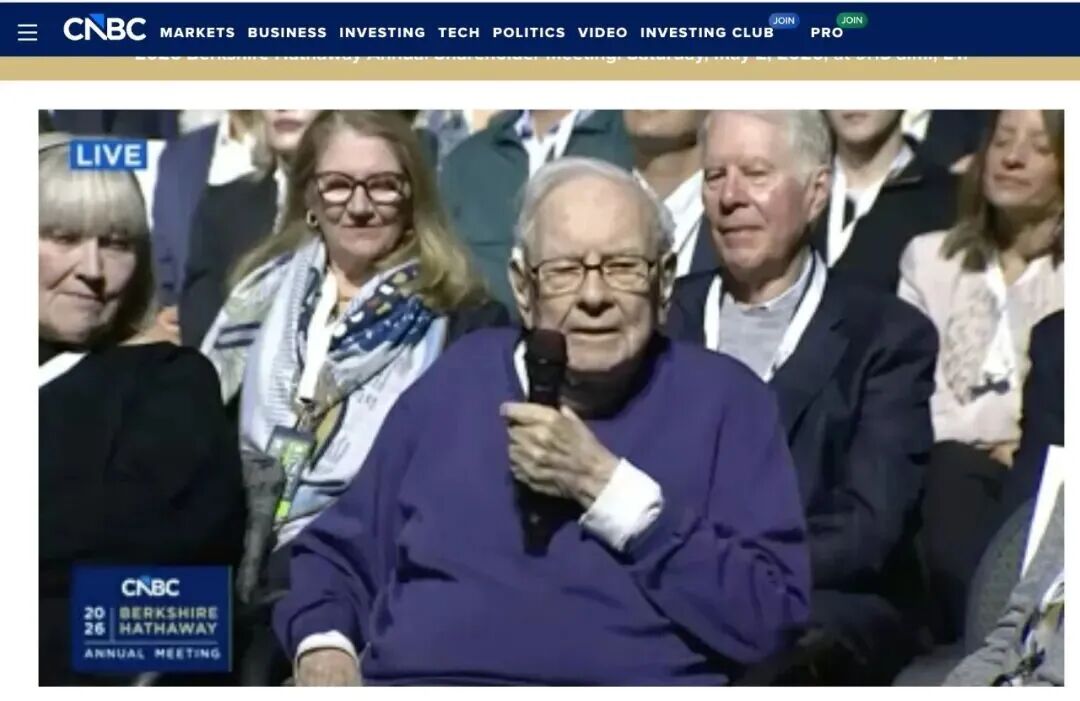
Yesterday, Berkshire Hathaway held its latest annual shareholders meeting, the first since Buffett resigned, and also the first time he wasn't presiding over the meeting from the stage. As a board member, he sat in the front row, watching Abel—his chosen successor—on the stage.
He is 95 years old this year and shows obvious signs of aging. He was supported and guided by a special person on site and could no longer move independently. However, he was still the focus of attention. For all Berkshire shareholders, he is a prophet-like spiritual totem. As long as he is still around, everyone feels inexplicably safe.
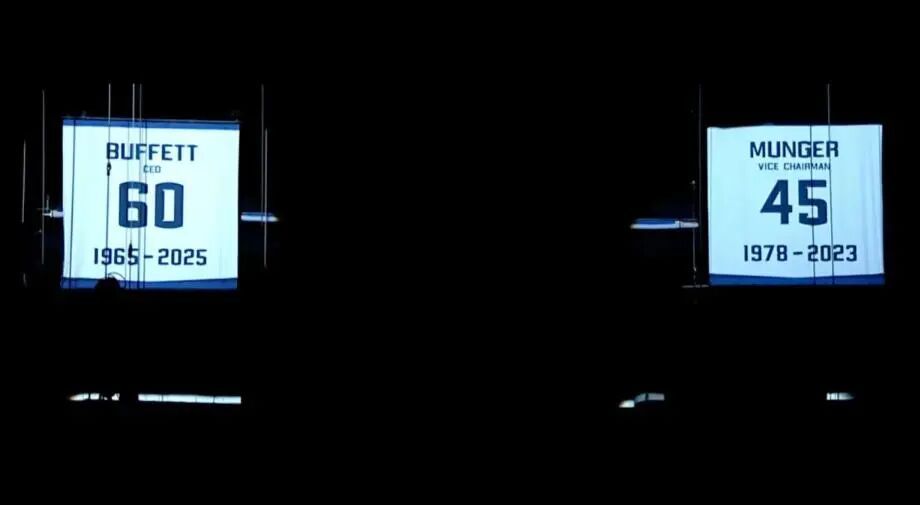
Abel officiated at the retirement ceremony for Buffett's jersey (1965-2025), with another jersey next to it belonging to Munger (1978-2023), symbolizing the passing of Berkshire Hathaway's two kings from the historical stage.
Berkshire Hathaway performed well in the first quarter after Buffett's departure, with an operating profit of $11.3 billion, mainly from real economy businesses such as insurance, railroads, and energy.
In terms of financial investments, Berkshire Hathaway sold a net $8.1 billion worth of stocks in the first quarter, marking the 14th consecutive quarter of net selling. Its latest holdings are valued at $288 billion, and it has $397.3 billion in cash on hand.
If you consider Berkshire Hathaway as a person, its current portfolio allocation is 42%, with 58% in cash. There's no doubt that Buffett, or rather the Berkshire team, is not optimistic about the current valuations of US stocks. He has explicitly stated that they are too expensive, speculative is rampant, and the US stock market is like a "church + casino," becoming increasingly crowded.
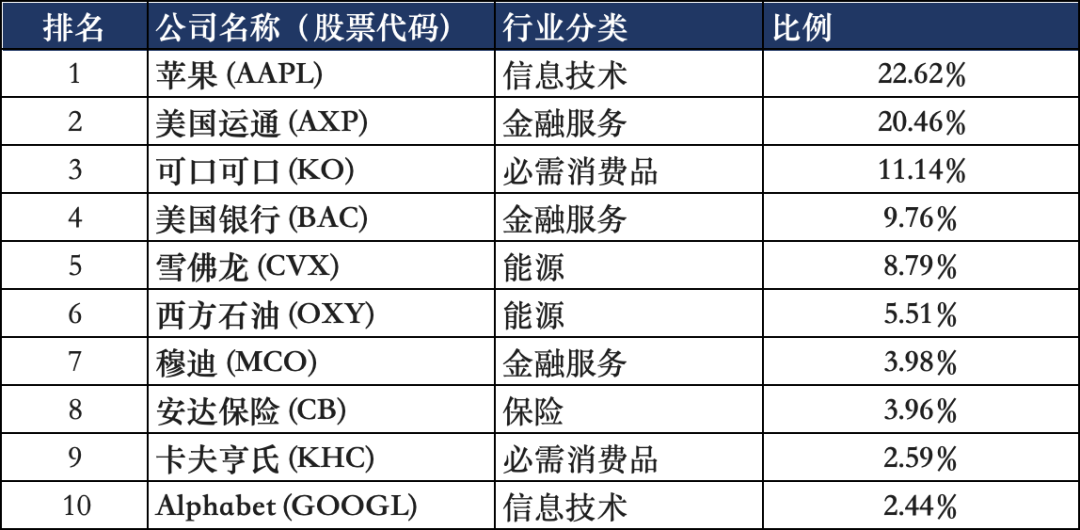
Berkshire Hathaway has barely participated in the hottest AI concept right now. In the first quarter, it disclosed its top ten holdings, with Apple still holding the largest position at 22%. The rest are mostly traditional industries, and the only AI-related stock is Google, which it has only bought a small position in.
This investment style is bound to underperform the market. Berkshire Hathaway's stock price has fallen 6% this year, while the S&P 500 has risen 6% and the Nasdaq has risen 10%, meaning Berkshire Hathaway has underperformed the market by more than 10%. But this has not shaken Buffett's resolve. He simply won't buy, and if the market continues to rise, he will continue to sell, holding cash until the US stock market crashes.
Warren Buffett is now a symbol of stubbornness in the business world, but his 60 years of success gives him the capital to be stubborn. If it were anyone else who missed out on the market with $400 billion, they would have been ridiculed by investors long ago.
The major correction in US stocks that Buffett is eagerly awaiting may not happen for some time. At 95 years old, he seems incredibly patient and not in a hurry at all. On the contrary, we stock investors in our thirties and forties are always anxious and worried about missing out on the market rally or the next big opportunity.
I take Buffett's warnings about valuations very seriously. Last year, I reduced my holdings in US stocks, but not by as much as he did. I'm looking for a balance that I can accept both rises and falls. Stock trading is about trading both ups and downs, and also about managing your own mindset.
Yesterday, a reader asked, "Which Chinese company is most like Berkshire Hathaway?"
From a purely corporate structure perspective, Berkshire Hathaway most closely resembles Ping An Insurance. Berkshire Hathaway's core business is insurance companies, using the proceeds from insurance sales to invest in stocks—a similar business structure to Ping An. However, Ping An is subject to Chinese regulatory restrictions, resulting in a lower proportion of its investment in stocks (10-20%). Its investment acumen is far inferior to Buffett's, and coupled with the significant gap between A-shares and US stocks, Ping An's stock returns are vastly different from Berkshire Hathaway's.
Another company somewhat similar is Fosun Group, which also operates on a dual-engine model of insurance and investment. Unlike Ping An, half of Fosun's insurance business is overseas, giving them more flexibility in investment restrictions. Their problem is simply poor performance; their investment returns are consistently low, with an annualized return of only 5-6%, which, after deducting funding costs, is only around 2%. Moreover, they frequently experience large losses and large gains, resulting in huge fluctuations in performance, making them very unfriendly to large investors.
There is another company that is known as the Berkshire Hathaway of the internet industry, which is the company we are currently using. Its underlying funds are not insurance, but mainly earned from its internet business. However, its investment level is recognized as the No.1 among Chinese industrial capital, with a long-term net annualized return of 13-14%, which is very close to Berkshire Hathaway's 20%.
However, in my mind, there are other companies in China that are even more like Berkshire Hathaway, namely the stocks under Li Ka-shing's control. Li Ka-shing is the most, most, most, most like Buffett in China. He focuses on industry cash flow, respects long-term value, is patient, has composure, and possesses unparalleled predictive ability. Both of them started their careers in the 1950s and have been in the business world for 70 years with virtually no losses.
So if I were to rank them, Old Li would be better than Goose, and the other two are similar in appearance but not in spirit, so they're not good enough.
Over the past two days, I've written about my experiences when I was young. Some readers have left comments saying that their children now like playing games and using their phones, and they're wondering if they should also give them room to grow, so that maybe they can follow a similar path to me.
That's too simplistic. I think parents should observe their children's behavior. If they're always in their comfort zone when playing games or using their phones, only enjoying passive stimulation without actively exploring or having their own ideas, then that's probably not a good idea.
Musk was addicted to games from a young age, but when he was 12, he wrote a small game and sold it to a magazine, earning $500.
Back then, I didn't just play games for fun. I liked to explore, analyze, and summarize, and then write down my experiences and insights from playing games and share them on the internet. This earned me opportunities for later development.
Playing games isn't the problem; it's the lack of goals, self-control, and a "consume without thinking" attitude that gradually destroys a person. This same attitude won't work for anything else either. If you're having arguments or conflicts with your child, sharing my articles from the past three days with them might be helpful.
I don't want to become the kind of person who was carefree and irresponsible in their youth but then had incredible luck and effortless success as an adult; that would be misleading. I do have some talents and skills, but I've also put in a lot of effort and perseverance. To say nothing of other things, my 14 consecutive years of daily updates on my public WeChat account proves that I am an extremely self-disciplined person.
That's all for tonight, time to go.
Original Article: View Chinese Version