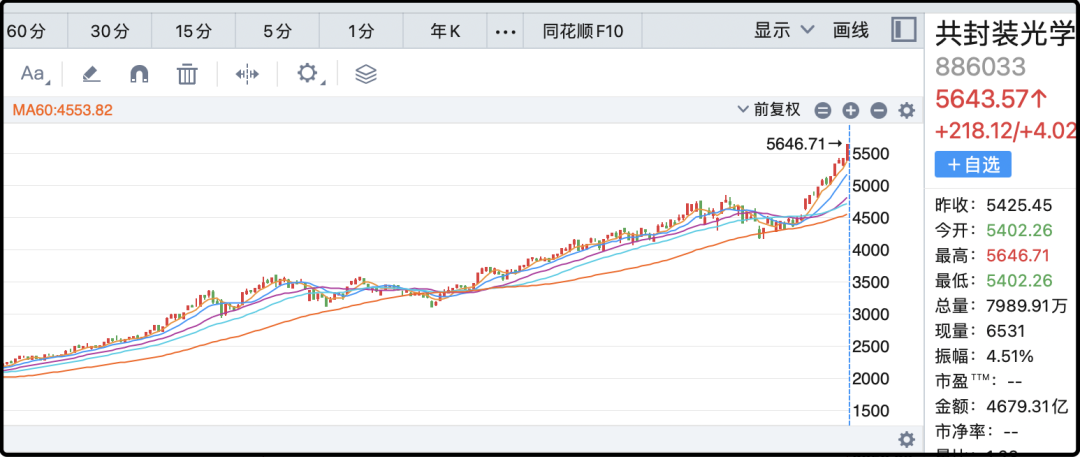
The market trend these past few days can be summarized in one sentence: silicon-based concepts are drastically outperforming carbon-based concepts. Carbon-based refers to humanity, while silicon-based refers to AI. All sectors serving AI are experiencing explosive growth, and all stocks serving humanity are suffering significant losses.
These past few days, I've been seeing related jokes all the time in the industry, like "Do you believe in optical (modules)?" and "Old Deng, you haven't been eliminated yet?" The market style is rapidly converging and concentrating, and a new round of group buying is reaching its climax.
Is the market doing well this year? Actually, it's so-so. I just checked, and as of today's closing, the median year-to-date change for A-shares in 2026 is +0.58%, only a slight increase. 48.3% of stocks are still down this year. So it's really easy to not make money this year; the key is whether your investment style is on the "bullish" side.
The communications equipment industry, mainly based on optical modules, has seen a 48% increase this year, topping the list of growth rates. This is a continuation of last year's 98% increase, effectively establishing its style dominance and exerting repeated pressure on other industries.
When I first entered the stock market, there were only about 1,000 companies listed on the A-share market. The market was like a free-for-all, with most companies rising and falling in tandem. There wasn't the sharp, segmented market that we see today. Nowadays, the overall market's rise and fall is less important. Even in a bull market that lasts all year, some sectors can fall by 10-20%, and even if the overall market doesn't rise, some sectors can double in value.
As market FOMO continues to rise, more and more people are starting to waver. In the past few days, many people have asked me in the comments whether they should chase the light-emitting module. I can't take that responsibility. I can't judge the top and the turning point. My own plan is to take broad-based indices and use the Matthew effect within the index to track the returns. It will definitely not earn as much as those who heavily invest in AI, but the CSI 500 index is +12.2% this year, plus a discount of nearly 16%, which I think is not bad.
The important thing is that I don't need to think, time the market, take sides, get caught up in dilemmas, or feel anxious when I play this way. I don't really believe in the light, nor do I question it. I won't embrace the light, but I don't resist being illuminated by it either.
Let me give new readers a simple explanation of what an optical module is.
Servers produce electrical signals, which need to be converted into optical signals for transmission via fiber optics. Once the optical fiber delivers the optical signal to its destination, it needs to be converted back into an electrical signal before it can be input to the destination server. This device that performs this electro-optical-electro-electrical conversion is called an optical module.
In layman's terms, it's like a "high-speed rail station" for computing power clusters, with information as the "passengers" and fiber optic cables as the "railway lines."
It doesn't sound like an industry with high technical barriers, so will there be a global overcapacity explosion, leading to competition and overproduction?
It's not that easy. The optical module industry is one that relentlessly pursues production capacity, cost, and yield. The top manufacturers can produce usable samples that other second-tier manufacturers can also make. However, the top manufacturers have large production capacity, high yield (95%+), and low cost. There are many technical details involved that second-tier manufacturers cannot achieve. For example, their yield is only 75-80%, which sounds high, right? But the result is that they are eliminated.
China's optical modules hold nearly 70% of the global market share, thanks to stable, large-scale production capacity, high yield rates, and low costs. However, this is different from rare earth elements; you can't use it to hold Europe and the US hostage. If you're willing to sacrifice costs, there are alternatives available abroad.
1. Trump announced an extension of the ceasefire agreement without setting a specific end date. He explained that the reason was that Iran needed time to coordinate and unify before it could come up with a negotiation plan, and he would wait for the other side's proposal. Vance was originally scheduled to go to Islamabad on the 21st, but seeing that the Iranian delegation wasn't going, he didn't go either. However, neither side wants to fight now, so both have accepted the ceasefire extension. Based on current developments, there may be localized friction between the US and Iran in the future, but the possibility of a large-scale military conflict like that in March is small.
Most importantly, global stock markets are gradually becoming less sensitive to the situation in Iran. Even though Brent crude oil has risen back to around 99, it didn't stop the stock market from rising today. I think the current game is much more civilized. One side blocks the strait, and the other blocks the bay. There are no more deaths, and it doesn't stop everyone from making money. They can keep going for as long as they want.
2. Adobe announced a new round of share buybacks totaling $25 billion. Adobe is the parent company of Photoshop and a global giant in image processing software. It has been severely impacted by AI over the past two years, with many believing that its continued development will kill off most software companies. Adobe's stock price has fallen from a high of $700 to its current price of $255, a 63% pullback.
Speaking of US companies' share buybacks, they're really aggressive. Keep in mind that Adobe's current market capitalization is only around $100 billion, and they're buying back a quarter of their shares in one go—that's quite a scale. $25 billion is equivalent to about 170 billion yuan, while the total buyback volume of the entire A-share market last year was only about 140 billion yuan. This is the most fundamental difference between the Chinese and American stock markets.
One involves pouring massive amounts of water into the pool, while the other involves rapidly expanding the pool—it expanded four or five times in 15 years—while secretly pumping water out of it. The water levels in the two pools are bound to rise and fall differently.
3. South Korea's birth rate in February increased by 13.6% year-on-year, with 22,898 new babies, the highest February figure since 2019. The composite fertility rate reached 0.93, rebounding by nearly 20% from the previous historical low of 0.75. This is certainly good news for us, proving that the birth rate is not a bottomless pit and will rebound after hitting its limit. The bad news is that even with the rebound, South Korea's rate is still more than 10% lower than ours.
4. There have been rumors in the industry recently that DeepSeek is seeking commercial funding. Initially, the valuation was rumored to be $10 billion, and the latest reports suggest that Tencent and Alibaba will invest at a valuation of $20 billion. $20 billion isn't actually that expensive; most large domestic models are currently valued between $30 billion and $60 billion.
However, after its initial meteoric rise, DeepSeek's influence in the industry has gradually declined in recent years, and it has fallen significantly behind American models. Even among the domestic models I've used, it's not considered the best. Due to its low level of commercialization, the company has seen its core team being aggressively poached by domestic competitors, which is understandable. I believe Liang Wenfeng is certainly not short of money, but so many of his engineers are not yet financially independent, and they have the right to pursue better compensation. I suspect this is why DeepSeek has finally come to this realization.
That's all for today. Finally, here's another showcase of readers' travel experiences with their parents:
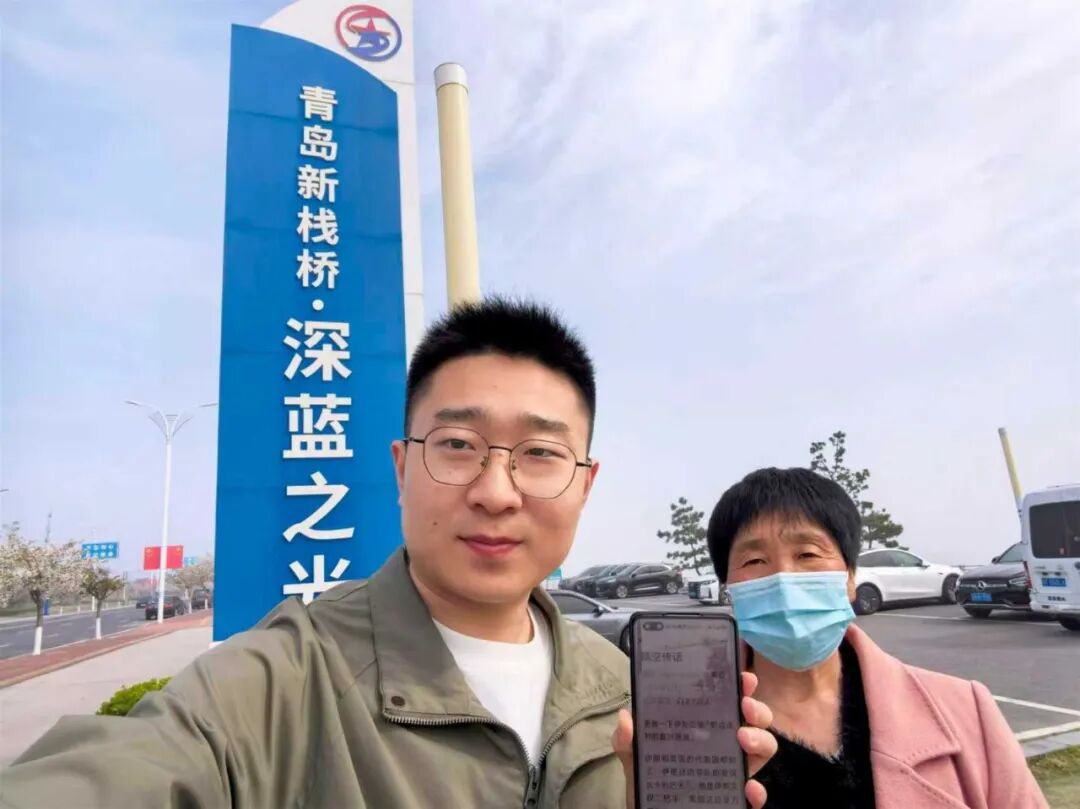 " Thanks to Brother Cat and his assistant, something I'd thought about but never quite made happen actually happened! Although my father couldn't come due to family matters, after much persuasion, my mother came with me. Overall, it was a very worthwhile and unforgettable trip! This was my mother's first time traveling 600 kilometers alone (explanation: due to my work, this was her first time visiting her workplace), and it was also a rare opportunity for us to spend time together alone. I discovered that my mother is younger than I imagined; at every scenic spot, she spent most of her time taking photos with her phone. It turns out my mother loves taking pictures so much! My phone now has more and more photos of her, and we even have our first photo together. Taking advantage of this opportunity, I also accomplished something else that I found very meaningful: taking my mother for a full medical checkup. As they get older, I spend less and less time with my parents and pay less attention to their health. I can't wait until they're old and their health deteriorates to make up for it. The biggest takeaway from this trip is that it's the right time to be filial. This is a good start, and beautiful stories will unfold. Next, I need to quickly put taking my father for a full medical checkup and the trip on my schedule! "
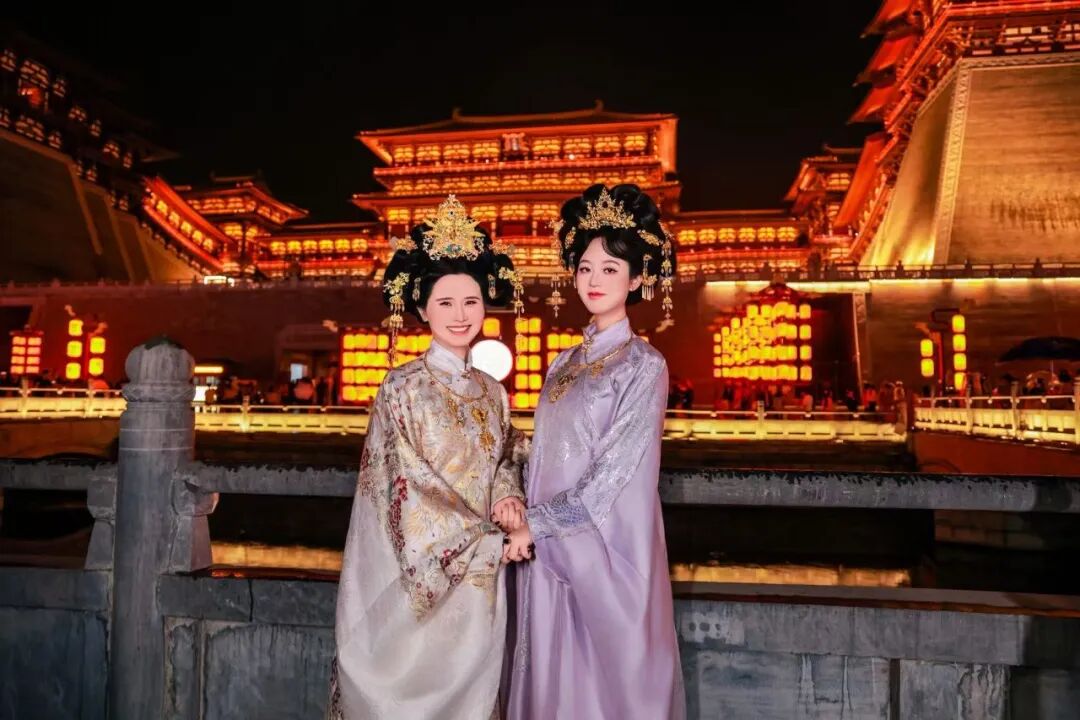 " I am very fortunate to have been selected to participate in this event."
  I went to Zhengzhou and Luoyang in Henan with my mom. We ate braised noodles and admired peonies. It was really fun! It reminded me of when my mom took me on trips when I was little. Now it's my turn to plan the itinerary. I hope that even if I'm busy with work in the future, I'll still have the opportunity to travel with my parents. Thanks again, Cat Brother !
The last reader's mother looks incredibly young.
I went to Zhengzhou and Luoyang in Henan with my mom. We ate braised noodles and admired peonies. It was really fun! It reminded me of when my mom took me on trips when I was little. Now it's my turn to plan the itinerary. I hope that even if I'm busy with work in the future, I'll still have the opportunity to travel with my parents. Thanks again, Cat Brother !
The last reader's mother looks incredibly young.  I believed her when she said she was my older sister.
Original Article: View Chinese Version