There's something I feel I need to lay out and explain clearly.
Every evening, my articles usually have about 5-6 underlined comments. I usually select "auto-display," meaning that any comments you leave will be automatically displayed without me having to filter or review them (although Tencent's system will automatically filter them). I do this to provide you with a free discussion forum, which has always been quite active, with an average of 300-400 comments per article.
I've recently noticed some issues with the underlined comment section, and I think it would be better to set some rules first.
1. Other public account authors can showcase themselves through high-quality content in the comments to attract readers' attention, but avoid simply trying to drive traffic. Directly asking for followers is not allowed.
2. If the same content is copied and pasted in multiple underlined areas, the user will be blocked.
3. You are welcome to refute my criticisms and viewpoints, but please refrain from personal attacks. The same applies to other readers; stick to the facts and remain friendly. Those who speak harshly and offensively online are not welcome.
With internet freedoms tightening, public spaces with high traffic offer limited opportunities for free speech. Please cherish and protect these spaces. True dignity lies in maintaining consistent and respectable behavior in both close and unfamiliar social circles.  I saw something today that I found very meaningful: PricewaterhouseCoopers (PwC) and the Hong Kong Securities and Futures Commission (SFC) reached a settlement agreement, agreeing to set aside HK$1 billion to compensate eligible shareholders of Evergrande for their negligence in auditing Evergrande's 2019-2020 financial statements.
PricewaterhouseCoopers paid a heavy price for the Evergrande incident. They were previously fined twice by mainland regulators, totaling 440 million yuan. Later, Hong Kong regulators also fined them 310 million yuan.
Adding this latest 1 billion, the total comes to 1.75 billion. This doesn't even include the severe damage to reputation, the closure of branch offices, the decline in business, and the revocation of licenses for practitioners. It is definitely a profound lesson.
It should be noted that previous fines were all turned over to the national treasury, but this time the 1 billion yuan settlement is specifically for compensating qualified shareholders. Qualified shareholders here refer to shareholders other than Xu Jiayin and the Evergrande Group. Although 1 billion yuan is a drop in the bucket, it is better than nothing.
I checked the historical records of fraud cases in China, and there are not many cases where auditing firms have undertaken significant compensation for losses suffered by shareholders. One of the more famous cases is Zhengzhong Zhujiang, which audited Kangmei Pharmaceutical. It was nominally required to pay 2.46 billion yuan in compensation, but in reality, the company went bankrupt and had no assets available for execution.
There are cases where compensation has actually been paid in the hundreds of millions, but not many. For example, in the Zijing Storage case, the auditing firms Zhitong and Rongcheng paid a total of 250 million yuan, which was a record-breaking amount of money lost in the industry.
One thing I've consistently done on this public account is organize class-action lawsuits for affected stock market investors. I've been doing this for seven or eight years, and we've successfully helped them recover over 47 million yuan in compensation. I will continue doing this long-term, striving to help investors get back a small goal.
I saw something today that I found very meaningful: PricewaterhouseCoopers (PwC) and the Hong Kong Securities and Futures Commission (SFC) reached a settlement agreement, agreeing to set aside HK$1 billion to compensate eligible shareholders of Evergrande for their negligence in auditing Evergrande's 2019-2020 financial statements.
PricewaterhouseCoopers paid a heavy price for the Evergrande incident. They were previously fined twice by mainland regulators, totaling 440 million yuan. Later, Hong Kong regulators also fined them 310 million yuan.
Adding this latest 1 billion, the total comes to 1.75 billion. This doesn't even include the severe damage to reputation, the closure of branch offices, the decline in business, and the revocation of licenses for practitioners. It is definitely a profound lesson.
It should be noted that previous fines were all turned over to the national treasury, but this time the 1 billion yuan settlement is specifically for compensating qualified shareholders. Qualified shareholders here refer to shareholders other than Xu Jiayin and the Evergrande Group. Although 1 billion yuan is a drop in the bucket, it is better than nothing.
I checked the historical records of fraud cases in China, and there are not many cases where auditing firms have undertaken significant compensation for losses suffered by shareholders. One of the more famous cases is Zhengzhong Zhujiang, which audited Kangmei Pharmaceutical. It was nominally required to pay 2.46 billion yuan in compensation, but in reality, the company went bankrupt and had no assets available for execution.
There are cases where compensation has actually been paid in the hundreds of millions, but not many. For example, in the Zijing Storage case, the auditing firms Zhitong and Rongcheng paid a total of 250 million yuan, which was a record-breaking amount of money lost in the industry.
One thing I've consistently done on this public account is organize class-action lawsuits for affected stock market investors. I've been doing this for seven or eight years, and we've successfully helped them recover over 47 million yuan in compensation. I will continue doing this long-term, striving to help investors get back a small goal.  It is precisely because of my long-term involvement in this matter that I know that it is very difficult to file securities rights protection lawsuits in China. It is common for lawsuits to last for three or four years. It is easy to lose money in the A-share market, but it is very difficult to get it back legitimately. The A-share market still has a long way to go in terms of protecting the rights and interests of shareholders.
First, we should learn from Hong Kong.
Today, A-shares experienced a pullback, with a trading volume of 2.8 trillion yuan, which is not low. The median decline was 1.29%, halting the recent upward trend. Precious metals and minor metals led the decline, falling by 5%. Additionally, the previously hot optical module sector also corrected by 2.6%. I think this is normal; no stock market only goes up.
Whenever a popular sector declines, consumer stocks that were lying low in the gutter will emerge to catch their breath. Today, liquor stocks bucked the trend and rose 2.1%. Those "corpses" that had been lying low quietly stirred again, adjusted themselves to a more comfortable position, and continued to play dead.
In the past few days, institutions have been discussing how the AI sector is becoming increasingly crowded, approaching a dangerous level. There have been many similar cases in history where the hype waned, leaving only a mess. However, during this period of accelerated growth, no one wants to speak out and say anything discouraging, lest they be ridiculed as an outdated figure. The stock market is typically results-oriented; as long as you make money, even a crazy process is considered correct; if you don't make money, you're left to grumble in a corner.
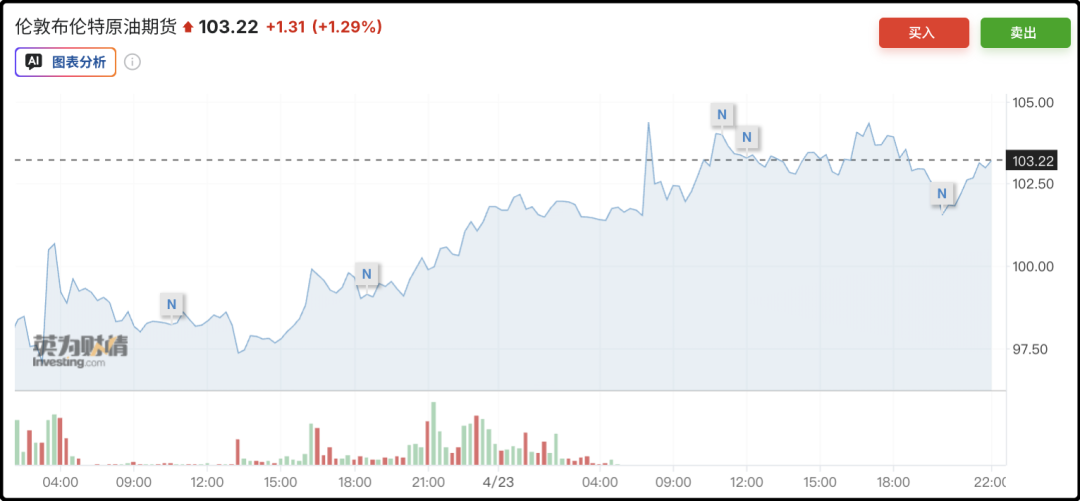
The situation between the US and Iran remains tense and deadlocked. This afternoon, sources cited Iranian officials said that there would be a breakthrough in negotiations tonight or tomorrow, but international oil prices have not reacted. Brent crude is still holding at $103. You read that right, it has slowly returned to three digits in the last few days.
Iran said today that its central bank received its first transit fee for the Strait of Hormuz. Meanwhile, Trump is directing warships to clear mines in the Strait of Hormuz. The two sides are still subtly vying for power, but a delicate balance has been reached, and a full-blown conflict is unlikely in the short term.
1. New Easun announced tonight that its operating revenue for the first quarter of 2026 reached 8.338 billion yuan, a year-on-year increase of 105.76%; net profit attributable to shareholders of the listed company was 2.78 billion yuan, a year-on-year increase of 76.80%. At first glance, it seems okay, but actually it's not so good, because it fell by 20% quarter-on-quarter. For such a super-star stock, market expectations are already at their peak, and even a slight misstep is unacceptable. Let's see how the market reacts tomorrow morning. However, it's ultimately the most favored sector, so it's easily forgiven.
2. I saw something really funny online today. There's a pool on a blockchain casino where you bet on whether the temperature in Paris will exceed 22 degrees Celsius in April. The winning condition is that a weather sensor at Charles de Gaulle Airport in France (Météo-France) records a temperature that exceeds 22 degrees Celsius at any given moment.
It is precisely because of my long-term involvement in this matter that I know that it is very difficult to file securities rights protection lawsuits in China. It is common for lawsuits to last for three or four years. It is easy to lose money in the A-share market, but it is very difficult to get it back legitimately. The A-share market still has a long way to go in terms of protecting the rights and interests of shareholders.
First, we should learn from Hong Kong.
Today, A-shares experienced a pullback, with a trading volume of 2.8 trillion yuan, which is not low. The median decline was 1.29%, halting the recent upward trend. Precious metals and minor metals led the decline, falling by 5%. Additionally, the previously hot optical module sector also corrected by 2.6%. I think this is normal; no stock market only goes up.
Whenever a popular sector declines, consumer stocks that were lying low in the gutter will emerge to catch their breath. Today, liquor stocks bucked the trend and rose 2.1%. Those "corpses" that had been lying low quietly stirred again, adjusted themselves to a more comfortable position, and continued to play dead.
In the past few days, institutions have been discussing how the AI sector is becoming increasingly crowded, approaching a dangerous level. There have been many similar cases in history where the hype waned, leaving only a mess. However, during this period of accelerated growth, no one wants to speak out and say anything discouraging, lest they be ridiculed as an outdated figure. The stock market is typically results-oriented; as long as you make money, even a crazy process is considered correct; if you don't make money, you're left to grumble in a corner.
The situation between the US and Iran remains tense and deadlocked. This afternoon, sources cited Iranian officials said that there would be a breakthrough in negotiations tonight or tomorrow, but international oil prices have not reacted. Brent crude is still holding at $103. You read that right, it has slowly returned to three digits in the last few days.
Iran said today that its central bank received its first transit fee for the Strait of Hormuz. Meanwhile, Trump is directing warships to clear mines in the Strait of Hormuz. The two sides are still subtly vying for power, but a delicate balance has been reached, and a full-blown conflict is unlikely in the short term.
1. New Easun announced tonight that its operating revenue for the first quarter of 2026 reached 8.338 billion yuan, a year-on-year increase of 105.76%; net profit attributable to shareholders of the listed company was 2.78 billion yuan, a year-on-year increase of 76.80%. At first glance, it seems okay, but actually it's not so good, because it fell by 20% quarter-on-quarter. For such a super-star stock, market expectations are already at their peak, and even a slight misstep is unacceptable. Let's see how the market reacts tomorrow morning. However, it's ultimately the most favored sector, so it's easily forgiven.
2. I saw something really funny online today. There's a pool on a blockchain casino where you bet on whether the temperature in Paris will exceed 22 degrees Celsius in April. The winning condition is that a weather sensor at Charles de Gaulle Airport in France (Météo-France) records a temperature that exceeds 22 degrees Celsius at any given moment.
France is still quite cold; it's impossible for the temperature to reach 22 degrees Celsius under normal circumstances, so the odds were very high. Someone secretly bet several thousand dollars, then went to the sensor, fiddled with a heater for a few minutes, and raised the temperature to 22 degrees Celsius, winning the bet and making $34,000. The money has already been transferred out.
The platform immediately called the police after finding out, but the person hasn't been caught yet. If they are caught, the maximum sentence would be 7 years in prison plus a fine of 300,000 euros, hahaha.
That's all for tonight, time to go.
Original Article: View Chinese Version