As a popular influencer, I often receive unrealistic requests from readers. For example, last night someone left a message asking what to buy over the next 5 years to guarantee an annualized return of 10%.
The flaw in this statement lies in the word "guarantee." Literally, it means guaranteeing the principal and interest, or at least ensuring the safety of the principal with extremely low risk. However, anyone with a basic understanding of financial markets knows that this is impossible. Currently, the yield on government bonds is less than 2%, let alone 10%. Even bonds with an annualized yield of 3% would be snapped up.
If the expected annualized return is 10%, it can only be achieved by buying risky assets. Since they are risky assets, there is no guarantee. It is possible to earn more than 10%, or it is possible to lose half of the principal after 5 years. I don't know the reader's risk tolerance, so I can't answer this question.
Among mainstream assets, US stocks have the closest annualized expected return to 10%. Buying the S&P 500 or Nasdaq 100 is achievable in the long run, but if you only focus on the 2026-2030 timeframe, it's hard to say. US stocks have risen 90% in the last three years due to the AI boom, and are currently at a relatively high level. It's important to understand that the long-term return of US stocks is around 10% annualized; the gains of the past three years are excessive, and there will inevitably be other years to recoup those gains.
Previously, China had high interest rates and high returns on wealth management products. The underlying assets were mostly real estate, and wave after wave of people who bought at the peak of the housing market contributed high returns to the capital market. Now that the housing market has cooled down, the opportunity to make easy money is gone. You either have to endure extremely low bank interest rates or try your luck in the stock market.
The media has been saying that 50 trillion yuan in fixed deposits are maturing one after another. Even if only 10% of that flows into the stock market, it would be enough to push A-shares up another 10-20%. Come on, A-shares welcome you! With courage, miracles can happen.  Trading volume in A-shares remained relatively low today, with a total of 2.25 trillion yuan, which is not much. However, despite the reduced volume, the entire market achieved a genuine broad-based rally, with both major and minor A-shares rising together, which is quite rare. The median increase was 1.35%.
When the market rises, people usually want to find reasons, because humans tend to think in terms of cause and effect. Then they might notice that Asian stock markets performed well today, with Japan up 3.9% and South Korea up 4.4%, suggesting it might be due to global stock market correlation. However, the correlation between A-shares and overseas stock markets isn't actually that strong. Otherwise, why didn't they move in tandem when overseas markets were doing so well a few years ago?
Trading volume in A-shares remained relatively low today, with a total of 2.25 trillion yuan, which is not much. However, despite the reduced volume, the entire market achieved a genuine broad-based rally, with both major and minor A-shares rising together, which is quite rare. The median increase was 1.35%.
When the market rises, people usually want to find reasons, because humans tend to think in terms of cause and effect. Then they might notice that Asian stock markets performed well today, with Japan up 3.9% and South Korea up 4.4%, suggesting it might be due to global stock market correlation. However, the correlation between A-shares and overseas stock markets isn't actually that strong. Otherwise, why didn't they move in tandem when overseas markets were doing so well a few years ago?  I think that if it goes up, it goes up, and that's a good thing. There's no need to look for reasons to explain it, especially when the trading volume is so low. A broad-based rise doesn't have much certainty. It would be awkward to have to look for reasons to explain it if it falls tomorrow.
Just grasp the general direction. The current general direction is that the A-share market is still in an overall bull market cycle. The expectations of investors for this wave of market have not yet been fully released and realized, so the probability of further upward movement in the future is definitely greater.
Taking the CSI 500 index, which I hold, as an example, it reached a high of 11,616 points in 2015. Therefore, in terms of expectation management, breaking through 10,000 points in this round of market rally is at least not an unreasonable target. I cannot guarantee that it will definitely break through 10,000 points, but if it falls below 10,000 points, I will be more cautious in reducing my holdings and selling. After all, you endured so many years of hardship in the A-share market and lingered there, just to sell at a good price when the bull market arrives.
I think that if it goes up, it goes up, and that's a good thing. There's no need to look for reasons to explain it, especially when the trading volume is so low. A broad-based rise doesn't have much certainty. It would be awkward to have to look for reasons to explain it if it falls tomorrow.
Just grasp the general direction. The current general direction is that the A-share market is still in an overall bull market cycle. The expectations of investors for this wave of market have not yet been fully released and realized, so the probability of further upward movement in the future is definitely greater.
Taking the CSI 500 index, which I hold, as an example, it reached a high of 11,616 points in 2015. Therefore, in terms of expectation management, breaking through 10,000 points in this round of market rally is at least not an unreasonable target. I cannot guarantee that it will definitely break through 10,000 points, but if it falls below 10,000 points, I will be more cautious in reducing my holdings and selling. After all, you endured so many years of hardship in the A-share market and lingered there, just to sell at a good price when the bull market arrives.
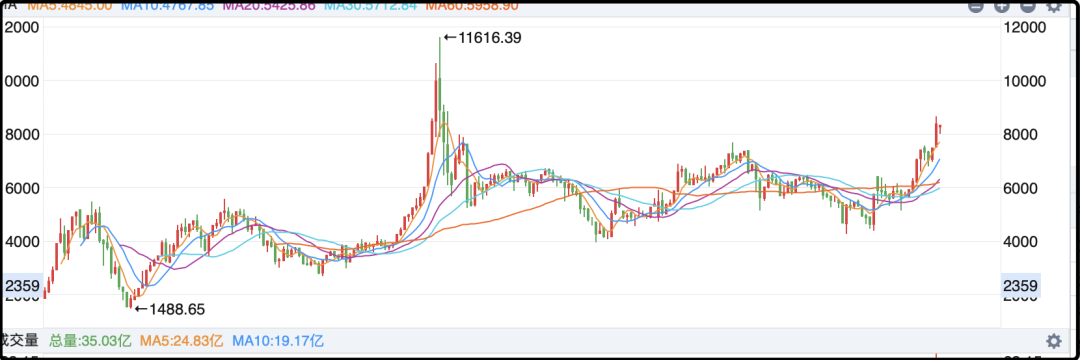 Long-time readers might remember that I reduced my holdings above 7000 points, selling one-third of my positions. Now, I'm eyeing 10000 points again, but these two scenarios don't contradict each other in terms of trading strategy. Back then, the bull market wasn't confirmed, and I reduced my holdings based on the idea of a bear market rally. Now that the bull market cycle is confirmed, I plan to sell the remaining positions based on the strategy of selling on rallies during a bull market.
Gamblers have no faith; they only know how to take advantage of the situation and avoid harm.
1. ByteDance released a brand-new AI video generation model, Seedance 2.0. Its main advantages are: firstly, the generated food videos include their own original sound; secondly, it has the ability to mimic human directors' camera movements, a capability previously unavailable in video AI. Seedance 2.0 quickly went viral on social media upon its release, stimulating a surge in A-share listed video application and multimodal sectors.
The past two years have been a window of opportunity for the AI industry to explode. We hear news of technological breakthroughs almost every month or every week. In fact, we are already in the fourth industrial revolution, but we haven't realized it yet.
2. The RMB exchange rate continues to rise, currently standing at 6.92. I've read analyses from overseas institutions suggesting this upward trend will likely stabilize around 6.8, indicating a further 1-2% appreciation potential. Last year's low was 7.3; reaching 6.8 would represent an appreciation of nearly 7%. Many people who exchanged RMB for USD in previous years to invest in wealth management products with 3-4% annualized returns have undoubtedly lost money in this current market. The positive aspect is that overseas travel is now more cost-effective, as the RMB is more valuable.
The problem is that Japan used to be the most popular destination for Chinese tourists traveling abroad, but now, as you know, Sino-Japanese relations are strained, so they can't go there anymore. As a result, more people are choosing to go to Southeast Asia or Europe.
3. Yesterday I said the Liberal Democratic Party (LDP) would win 321 seats, which was media prediction. Today, 316 seats were finally confirmed, a very high number, and the LDP can claim a landslide victory. I know that domestic netizens are seeing news reports about Sanae Takaichi's unpopularity and ongoing protests in Japan, but "the front lines don't lie." Currently, young people in Japan are not friendly towards China. Today I saw a poll in Japan where three-quarters of people believe there is no need to improve relations with China. That's why I said yesterday that Sino-Japanese relations are drifting further apart, and I don't know if there will be a period of warming in the future; perhaps there will be. My childhood and adolescence were the period when Sino-Japanese relations were closest; back then, all the cartoons shown in the 6 pm children's time slot were Japanese.
4. Silver LOF (Listed Open-Ended Fund) opened at its daily limit down today and ultimately closed up 8%. It's like it just came out of the ICU and immediately went to karaoke. However, the systemic issues I mentioned yesterday still exist. Silver is traded 24 hours a day internationally, while A-share LOF funds can only be traded for 4 hours a day. I hope those participating in speculation understand the risks of this time mismatch and don't be unable to accept losses.
That's all for now. There are still 4 days left before the New Year. I feel like everyone around me has already switched to "New Year's mode." Have people in your company started taking leave and leaving one after another? Stop making a fuss and just relax and enjoy the New Year.
Long-time readers might remember that I reduced my holdings above 7000 points, selling one-third of my positions. Now, I'm eyeing 10000 points again, but these two scenarios don't contradict each other in terms of trading strategy. Back then, the bull market wasn't confirmed, and I reduced my holdings based on the idea of a bear market rally. Now that the bull market cycle is confirmed, I plan to sell the remaining positions based on the strategy of selling on rallies during a bull market.
Gamblers have no faith; they only know how to take advantage of the situation and avoid harm.
1. ByteDance released a brand-new AI video generation model, Seedance 2.0. Its main advantages are: firstly, the generated food videos include their own original sound; secondly, it has the ability to mimic human directors' camera movements, a capability previously unavailable in video AI. Seedance 2.0 quickly went viral on social media upon its release, stimulating a surge in A-share listed video application and multimodal sectors.
The past two years have been a window of opportunity for the AI industry to explode. We hear news of technological breakthroughs almost every month or every week. In fact, we are already in the fourth industrial revolution, but we haven't realized it yet.
2. The RMB exchange rate continues to rise, currently standing at 6.92. I've read analyses from overseas institutions suggesting this upward trend will likely stabilize around 6.8, indicating a further 1-2% appreciation potential. Last year's low was 7.3; reaching 6.8 would represent an appreciation of nearly 7%. Many people who exchanged RMB for USD in previous years to invest in wealth management products with 3-4% annualized returns have undoubtedly lost money in this current market. The positive aspect is that overseas travel is now more cost-effective, as the RMB is more valuable.
The problem is that Japan used to be the most popular destination for Chinese tourists traveling abroad, but now, as you know, Sino-Japanese relations are strained, so they can't go there anymore. As a result, more people are choosing to go to Southeast Asia or Europe.
3. Yesterday I said the Liberal Democratic Party (LDP) would win 321 seats, which was media prediction. Today, 316 seats were finally confirmed, a very high number, and the LDP can claim a landslide victory. I know that domestic netizens are seeing news reports about Sanae Takaichi's unpopularity and ongoing protests in Japan, but "the front lines don't lie." Currently, young people in Japan are not friendly towards China. Today I saw a poll in Japan where three-quarters of people believe there is no need to improve relations with China. That's why I said yesterday that Sino-Japanese relations are drifting further apart, and I don't know if there will be a period of warming in the future; perhaps there will be. My childhood and adolescence were the period when Sino-Japanese relations were closest; back then, all the cartoons shown in the 6 pm children's time slot were Japanese.
4. Silver LOF (Listed Open-Ended Fund) opened at its daily limit down today and ultimately closed up 8%. It's like it just came out of the ICU and immediately went to karaoke. However, the systemic issues I mentioned yesterday still exist. Silver is traded 24 hours a day internationally, while A-share LOF funds can only be traded for 4 hours a day. I hope those participating in speculation understand the risks of this time mismatch and don't be unable to accept losses.
That's all for now. There are still 4 days left before the New Year. I feel like everyone around me has already switched to "New Year's mode." Have people in your company started taking leave and leaving one after another? Stop making a fuss and just relax and enjoy the New Year.
Original Article: View Chinese Version