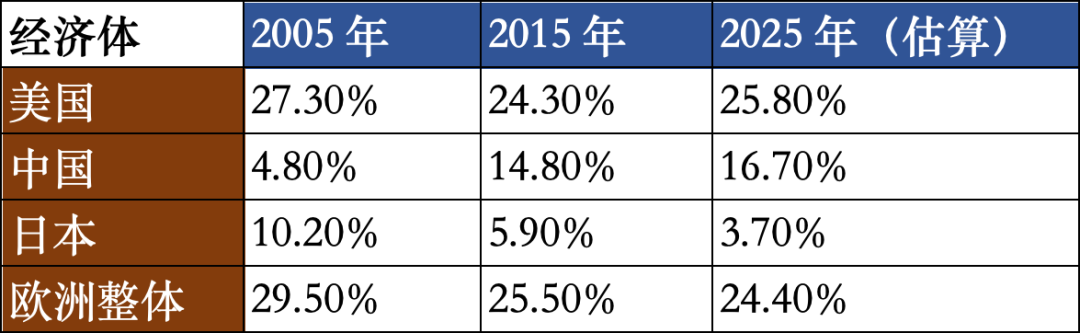
Yesterday, someone in the comments asked whether the United States has declined in the last ten years. This is a question that people ask every now and then. I said in my opinion that the United States has not declined. Considering its economy, military, and culture, it is still the world's largest economy.
We can take 2005, 2015, and 2025 as the three time points to calculate the proportion of US GDP to global GDP. In 2005, it was 27.3%, in 2015 it was 24.3%, and in 2025 it was 25.8%. The data is slightly weaker than 20 years ago and slightly stronger than 10 years ago, but it is basically at the level of one-quarter of the world's GDP, and it has been the world's number one for 132 consecutive years.
The reason why many people feel that the United States is not as powerful as it was 20 or 30 years ago may be related to the significant narrowing of the gap between China and the United States. In 2005, China's GDP growth rate was 4.8%, in 2015 it was 14.8%, and in 2025 it is projected to be 16.7%. 20 years ago, the gap between China and the United States was 5.6 times, but now it is only 50%. If we take China as a reference point, the United States seems to have become weaker. However, strength and weakness are relative.
The United States remains at the top, while China has made significant progress. So who has fallen behind in the past 20 years?
The biggest loser in terms of data is Japan, whose share dropped from 10.2% in 2005 to only 3.7% in 2025. Japan is indeed not what it used to be. In addition, Europe's overall decline is also quite significant, from 29.5% in 2005 to 24.4% in 2025, a decrease of 5 percentage points.
The share lost by Japan and Europe over the past 20 years is almost exactly equal to the share of growth by China. That's roughly the situation. GDP, as a single indicator, cannot fully reflect comprehensive national strength, but for the time being, there is no more intuitive data than it, and it is at least more convincing than "I think," "I believe," or "I feel."
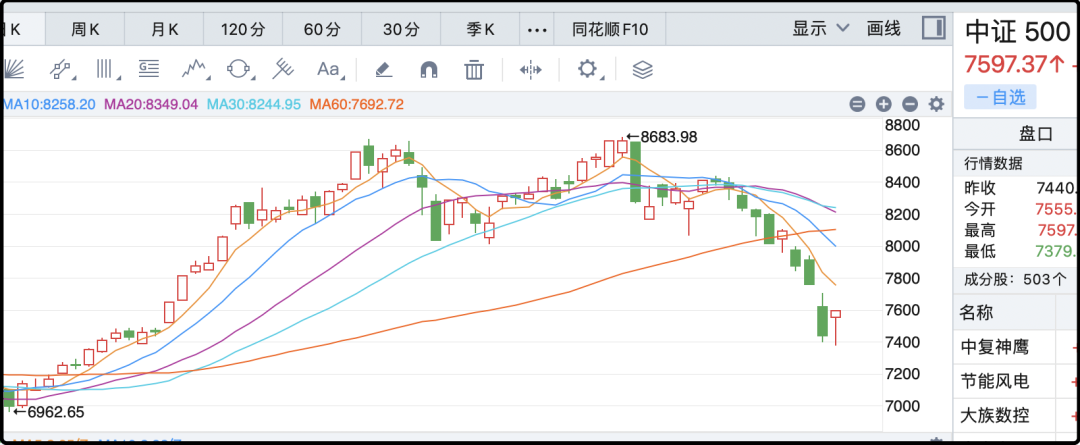
Today's A-share market was a bit volatile. The CSI 500 opened 1.5% higher, then plunged as much as 0.8%, before stabilizing around 10:30 AM and rebounding. It then rallied again around 1:30 PM, ultimately closing up 2.1%. Total turnover for both Shanghai and Shenzhen stock exchanges was 2.08 trillion yuan, which is relatively low, but the median market performance was strong, rising 3.35%, providing a significant recovery.
Because Trump announced last night that he was canceling the ultimatum and postponing the bombing plan, global capital markets saw a rebound in TACO, with the magnitude of the rebound roughly half of Monday's decline. This indicates that the market is generally cautiously optimistic, hoping to see the ceasefire negotiations move forward, but generally lacking confidence in the prospects of the negotiations.
The US has three core demands: hand over enriched uranium, halt long-range missile launches, and cease support for the Crescent of Resistance. Iran has four core demands: a guaranteed permanent ceasefire, the removal of US military bases from the Persian Gulf, war reparations, and the restoration of order in the Strait of Hormuz. Frankly, I think none of these seven points can be agreed upon, as they represent core interests that neither side is willing to concede. Compromise is only possible if one side can no longer bear the pain of war, but that's not the case now. Both sides are currently quite resilient and determined.
In the past two days, I've seen a heated debate in the underlined comments about whether Iran is developing nuclear weapons. According to the International Atomic Energy Agency's monitoring, Iran has 440 kg of 60% enriched uranium, far exceeding the 20% threshold for military-civilian integration. Given another 7-10 days, it could be enriched to 90%, achieving weapons-grade uranium enrichment. Iran has signed the Treaty on the Non-Proliferation of Nuclear Weapons and is the only non-nuclear-weapon state possessing 60% enriched uranium. They haven't yet built nuclear weapons; they're in a state of near-completion, just one step away. This has crossed a red line for the US and Israel; they cannot accept Iran possessing nuclear weapons.
Here's a little-known fact: Taiwan also secretly attempted to develop nuclear weapons in the 1970s and 80s, codenamed the Hsinchu Project. It was later discovered by the United States, which ordered it to stop, removed the nuclear fuel, dismantled the equipment, and disbanded the team. Taiwan eventually pledged to abandon nuclear weapons.
Returning to the A-share market, today's weak rebound is merely a technical oversold bounce and does not fundamentally reverse this main downward trend. The US-Iran situation has only temporarily eased; there has been no clear progress in ceasefire negotiations, and the US and Israel even continued bombing Iran today. Therefore, one should not be blindly optimistic about the subsequent market trend, as the situation could deteriorate at any time.
 I was writing this when I was shocked to hear that Zhang Xuefeng's company had officially announced his death. Zhang Xuefeng passed away in Suzhou at 3:50 PM that afternoon, the cause of death being sudden cardiac arrest. Actually, I had heard about it earlier that afternoon. When the medical records were released, he was immediately put on ECMO. I saw this device frequently during the COVID-19 pandemic; it's an artificial lung replacement device, very expensive, and only used for extremely critically ill patients. I already had a very bad feeling about it then.
I heard that Zhang Xuefeng had been consistently running long distances recently, covering a considerable amount of distance. He mentioned on his WeChat Moments that he ran over 70 kilometers in March. Now that this tragedy has occurred, I can't help but wonder if there's a causal relationship between the two events. I feel particularly sympathetic because I was diagnosed with premature atrial contractions (PACs) several years ago, experiencing nearly 10,000 beats a day. For the past few years, I've avoided strenuous exercise, and now I'm even more hesitant.
People don't just die when they get old; they can die anytime, anywhere. Every time someone dies young, this sentence comes to mind. Men in their forties are often the pillars of their families, with recently retired parents and underage children. If something happens to them, their world collapses. My main readership consists of middle-aged men, so I hope you all take good care of yourselves and stay healthy.
As for Zhang Xuefeng's career, although it has been embroiled in controversy many times, I think it has been positive for society overall. He has enabled many children from ordinary families to start paying attention to career planning and personal development at a much earlier stage, reducing the burden of information asymmetry on disadvantaged groups. What he has done is much more transparent than those who point fingers at him.
It's a pity that this is the last time he'll trend on social media in this way.
1. Xiaomi's total revenue in 2025 reached 457.3 billion yuan, a year-on-year increase of 25%; adjusted profit was 39.1 billion yuan, a year-on-year increase of 43.8%, both record highs. The automotive business became the core growth driver, delivering 411,000 vehicles throughout the year and achieving annual profitability. Fourth-quarter revenue reached a record high of 116.9 billion yuan, but net profit declined year-on-year due to cost and competition factors.
Xiaomi's performance was decent, but not a surprise; it was largely within institutional expectations. The recent weakness in Xiaomi's stock price over the past six months isn't due to poor management, but simply because the previous surge was too large, overextending its potential. I calculated that a realistic, optimistic valuation for Xiaomi was around 40 yuan, so I sold most of my holdings when it was above 50 yuan. If it subsequently falls below 30 yuan, it would be a good buying opportunity.
2. Pakistani Prime Minister: Pakistan is prepared to host talks between the United States and Iran to diplomatically mediate tensions in the Persian Gulf. Pakistan is the only Muslim country to possess nuclear weapons.
I was writing this when I was shocked to hear that Zhang Xuefeng's company had officially announced his death. Zhang Xuefeng passed away in Suzhou at 3:50 PM that afternoon, the cause of death being sudden cardiac arrest. Actually, I had heard about it earlier that afternoon. When the medical records were released, he was immediately put on ECMO. I saw this device frequently during the COVID-19 pandemic; it's an artificial lung replacement device, very expensive, and only used for extremely critically ill patients. I already had a very bad feeling about it then.
I heard that Zhang Xuefeng had been consistently running long distances recently, covering a considerable amount of distance. He mentioned on his WeChat Moments that he ran over 70 kilometers in March. Now that this tragedy has occurred, I can't help but wonder if there's a causal relationship between the two events. I feel particularly sympathetic because I was diagnosed with premature atrial contractions (PACs) several years ago, experiencing nearly 10,000 beats a day. For the past few years, I've avoided strenuous exercise, and now I'm even more hesitant.
People don't just die when they get old; they can die anytime, anywhere. Every time someone dies young, this sentence comes to mind. Men in their forties are often the pillars of their families, with recently retired parents and underage children. If something happens to them, their world collapses. My main readership consists of middle-aged men, so I hope you all take good care of yourselves and stay healthy.
As for Zhang Xuefeng's career, although it has been embroiled in controversy many times, I think it has been positive for society overall. He has enabled many children from ordinary families to start paying attention to career planning and personal development at a much earlier stage, reducing the burden of information asymmetry on disadvantaged groups. What he has done is much more transparent than those who point fingers at him.
It's a pity that this is the last time he'll trend on social media in this way.
1. Xiaomi's total revenue in 2025 reached 457.3 billion yuan, a year-on-year increase of 25%; adjusted profit was 39.1 billion yuan, a year-on-year increase of 43.8%, both record highs. The automotive business became the core growth driver, delivering 411,000 vehicles throughout the year and achieving annual profitability. Fourth-quarter revenue reached a record high of 116.9 billion yuan, but net profit declined year-on-year due to cost and competition factors.
Xiaomi's performance was decent, but not a surprise; it was largely within institutional expectations. The recent weakness in Xiaomi's stock price over the past six months isn't due to poor management, but simply because the previous surge was too large, overextending its potential. I calculated that a realistic, optimistic valuation for Xiaomi was around 40 yuan, so I sold most of my holdings when it was above 50 yuan. If it subsequently falls below 30 yuan, it would be a good buying opportunity.
2. Pakistani Prime Minister: Pakistan is prepared to host talks between the United States and Iran to diplomatically mediate tensions in the Persian Gulf. Pakistan is the only Muslim country to possess nuclear weapons.
Original Article: View Chinese Version