I was halfway through writing an article last night when I learned that Israel had just bombed Iranian energy facilities, and Iran had threatened immediate retaliation. After the news broke, I discovered the situation had escalated further.
Last night, Israel bombed the South Pars gas field, the world's largest natural gas field, accounting for about 20% of its total reserves. This gas field is very large, spanning both Qatar and Iran, with each side extracting its own portions. The Qatari side is called the Northern Gas Field.
The South Pars gas field accounts for 70-80% of Iran's natural gas production and earns $12 million in foreign exchange daily. Its bombing directly shakes the foundations of the Iranian regime. Israel carried out the bombing. Trump claimed to know nothing about it, but Israel admitted the operation received coordination and support from the US military.
Although the Iranians are stubborn, they are not stupid. They immediately retaliated by launching missiles at Saudi and Qatari energy facilities. Most of the missiles were intercepted by Patriot missiles, but one missile broke through the defenses and destroyed Qatar's largest natural gas export base.
Iran's logic is that if the US and Israel attack its energy resources, it will retaliate by attacking the energy resources of other Gulf countries, causing global energy hardship. While this approach may seem somewhat unscrupulous, objectively speaking, it's Iran's only remaining leverage. Currently, a balance of deterrence has been achieved, allowing for some restraint in mutual attacks. However, as the pain of war escalates, this restraint is slowly being breached.
Qatar, having been innocently attacked, was naturally furious, expelling Iranian diplomats and issuing a barrage of harsh words, but ultimately dared not declare war on Iran. Iran ranks third in military strength in the Middle East; aside from Turkey and Israel, the rest are relatively easy targets.
This is what happened last night: natural gas prices rose another 20%, from over 20 before the war to 65 now. Brent crude oil prices recently rose to 114; if the International Energy Agency hadn't released a huge amount of reserves beforehand, it would probably be over 150 by now.
Something happened today that puzzled many people: gold and silver prices plummeted. Gold prices fell 5% today, recently reaching the $4,500-$4,600 range. Silver fared even worse, plunging to $66, almost halving from its previous high of $117.
It's generally understood that when war breaks out, people seek refuge in gold and silver, which is true. However, this three-year bull market in gold and silver was not driven by safe-haven funds. The main narrative was the US dollar's interest rate cuts and monetary easing, coupled with the transfer of US Treasury bonds as a substitute. War was at most a short-term catalyst, not a decisive factor.
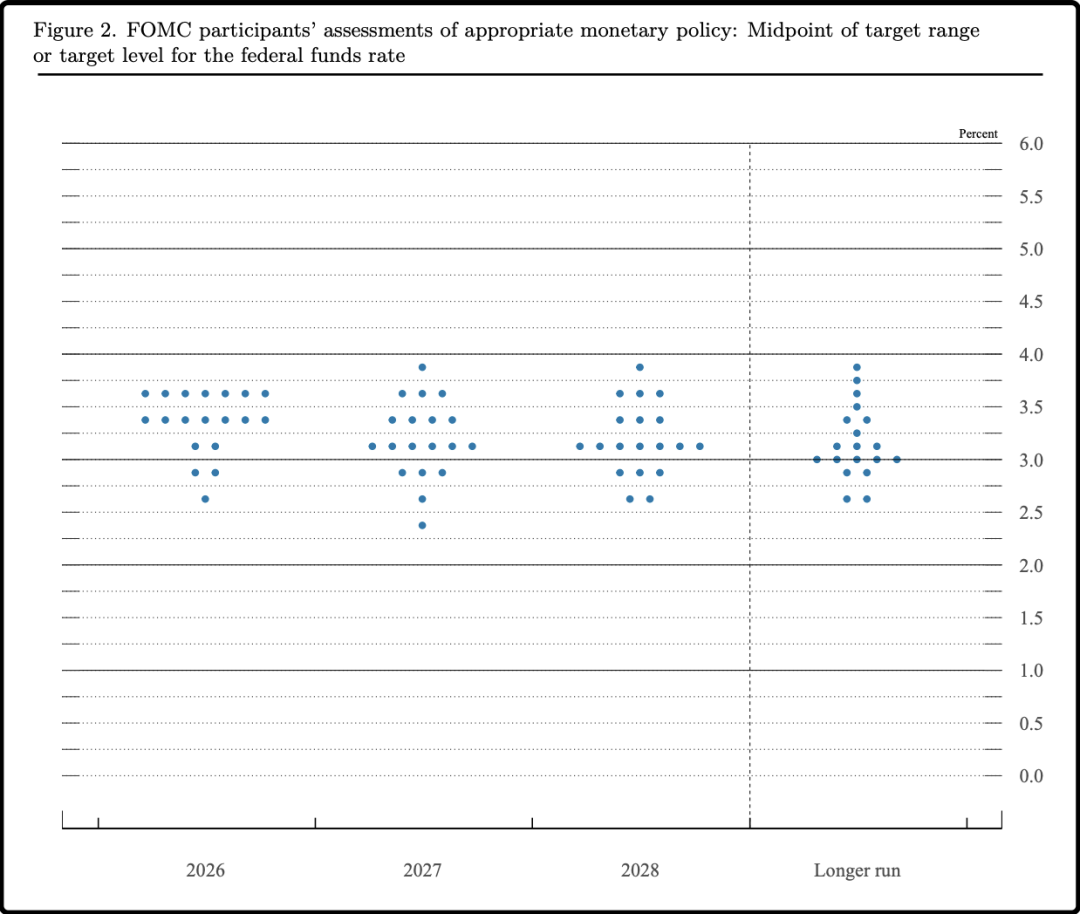
Another important event last night was the Federal Reserve's March interest rate meeting, which ultimately decided to maintain the interest rate range at 3.5-3.75%, with no rate cuts. Furthermore, due to inflationary pressures caused by the Iranian energy crisis, committee members generally adjusted their expectations for rate cuts, suggesting a potential tightening of the dollar, which will be reflected in the interest rate dot plot.
The horizontal axis represents time, the vertical axis represents interest rates, and the 19 points represent the votes of the 19 committee members. It's highly likely that interest rate cuts will be cancelled in 2026, and at most, a 0.25% cut will occur once in 2027. Some funds, seeing the hawkish signals, sold off precious metals and fled.
Yesterday someone said I should buy at 4800, but I didn't say that. In my article on February 11th, I mentioned my target for this year: gold in the 3500-4000 range, Bitcoin in the 40,000-50,000 range, and I wouldn't consider the CSI 500 above 7000 points. A 20% drop in US stocks is also a conservative estimate. It's okay if you can't buy, I already have a base position anyway.
All of the above is related to the A-share market, explaining why the precious metals sector collapsed by 6% today, ranking first in decline, with the CSI Nonferrous Metals Index plummeting by 6%, completely breaking through the upward trend. The safe-haven demand brought about by the escalating situation in Iran is far less significant than the impact of inflationary pressures leading to a contraction in the US dollar, which is why nonferrous metals have been falling recently.
Every escalation of the situation in Iran has dragged down the tech sector, with AI-related stocks completely stalled today. The best performing sectors were oil and gas (up 4.7%), natural gas (up 3.7%), coal (up 1.33%), and electricity (up 0.3%) – only these four sectors were in positive territory today.
Trump said he wanted to request a $200 billion budget to advance subsequent military operations against Iran. That's just 1.4 trillion RMB, right? The A-shares market has already readily allocated funds today. Those big rockets in the Middle East aren't for nothing, everyone! Time to top up and send gifts!  The market briefly dipped below 4000 points today, but managed to recover by the close. Some on social media are discussing whether the national team, which previously sold off its holdings, will return to stabilize the market. Judging from their bank loan history, they sold around 700 billion yuan worth of shares in the first quarter, of which at least 200 billion yuan was profitable. Currently, the national team has ample liquidity, but a drop to 4000 points is unlikely to trigger intervention. The government's money is for preventing systemic risks; they will only intervene to buy at the bottom when the market is in a state of panic and despair.
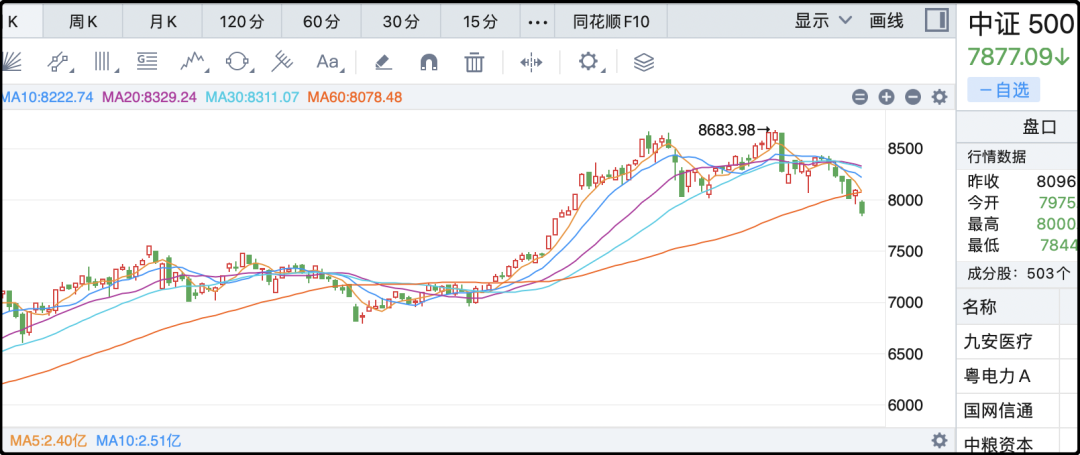
The CSI 500 has confirmed a drop below 8000 points. If you're trading on the right side of the trend, you should reduce your holdings now and buy back when it rebounds above 8000 points. However, this low-sell, high-buy trading strategy is extremely unreliable, so proceed with caution. My last reduction in holdings last year was at 7770 points, and even after today's drop, the index is still at 7877 points. I haven't even considered buying back in.
Just a reminder that tomorrow is the settlement date for the March futures contract. The discount has widened rapidly recently, making it a good time to switch to a longer-term contract. You could consider switching to June, or even locking in the September discount in advance.
Finally, let me answer yesterday's question from a reader about channels for ordinary people to invest in quantitative funds.
The most mainstream approach is to invest in quantitative private equity funds. There are many excellent domestic firms in this field. The founder of DeepSeek is a leader in the industry; he can burn money to develop AI without raising funds, which shows how profitable this can be if done well. Currently, many quantitative private equity funds require a minimum investment of 3 million yuan because qualified investors need 3 million yuan in financial assets for certification. They no longer accept small investors with 1 million yuan.
A lower barrier to entry is rolling index futures, such as IC or IM. I've talked about this a lot before. The entry threshold is 500,000 yuan, but having only 500,000 yuan is not safe. I calculated that a 20% drawdown would result in a margin call. Do you think the A-share market at the current level might experience a 20% drawdown? I think the possibility is small, but not impossible. To safely roll one contract of index futures, I think you need 700,000 yuan.
Are there any options with even lower entry barriers? That would be mutual funds, and there are some decent index-enhanced funds. If you're interested, I'll run some tests on my software when I get back and see which mutual funds are performing well. I'm short on time tonight, so I'll stop here for now.
The market briefly dipped below 4000 points today, but managed to recover by the close. Some on social media are discussing whether the national team, which previously sold off its holdings, will return to stabilize the market. Judging from their bank loan history, they sold around 700 billion yuan worth of shares in the first quarter, of which at least 200 billion yuan was profitable. Currently, the national team has ample liquidity, but a drop to 4000 points is unlikely to trigger intervention. The government's money is for preventing systemic risks; they will only intervene to buy at the bottom when the market is in a state of panic and despair.
The CSI 500 has confirmed a drop below 8000 points. If you're trading on the right side of the trend, you should reduce your holdings now and buy back when it rebounds above 8000 points. However, this low-sell, high-buy trading strategy is extremely unreliable, so proceed with caution. My last reduction in holdings last year was at 7770 points, and even after today's drop, the index is still at 7877 points. I haven't even considered buying back in.
Just a reminder that tomorrow is the settlement date for the March futures contract. The discount has widened rapidly recently, making it a good time to switch to a longer-term contract. You could consider switching to June, or even locking in the September discount in advance.
Finally, let me answer yesterday's question from a reader about channels for ordinary people to invest in quantitative funds.
The most mainstream approach is to invest in quantitative private equity funds. There are many excellent domestic firms in this field. The founder of DeepSeek is a leader in the industry; he can burn money to develop AI without raising funds, which shows how profitable this can be if done well. Currently, many quantitative private equity funds require a minimum investment of 3 million yuan because qualified investors need 3 million yuan in financial assets for certification. They no longer accept small investors with 1 million yuan.
A lower barrier to entry is rolling index futures, such as IC or IM. I've talked about this a lot before. The entry threshold is 500,000 yuan, but having only 500,000 yuan is not safe. I calculated that a 20% drawdown would result in a margin call. Do you think the A-share market at the current level might experience a 20% drawdown? I think the possibility is small, but not impossible. To safely roll one contract of index futures, I think you need 700,000 yuan.
Are there any options with even lower entry barriers? That would be mutual funds, and there are some decent index-enhanced funds. If you're interested, I'll run some tests on my software when I get back and see which mutual funds are performing well. I'm short on time tonight, so I'll stop here for now.
Original Article: View Chinese Version