Today was another day of widespread decline. In fact, after the year-end rally ended, the market entered a sideways consolidation phase at the end of January, and has been adjusting for almost two months. From a technical perspective, this is quite reasonable. Waiting for the moving averages to stabilize can make the cost distribution of shares healthier. Otherwise, if the market continues to rise at the same steep slope as at the beginning of the year, a slow bull market will turn into a fast bull market, and a fast bull market will turn into a crazy bull market. The first quarter alone would be enough to exhaust the entire year's potential, and then it would crash and cause chaos in the end.
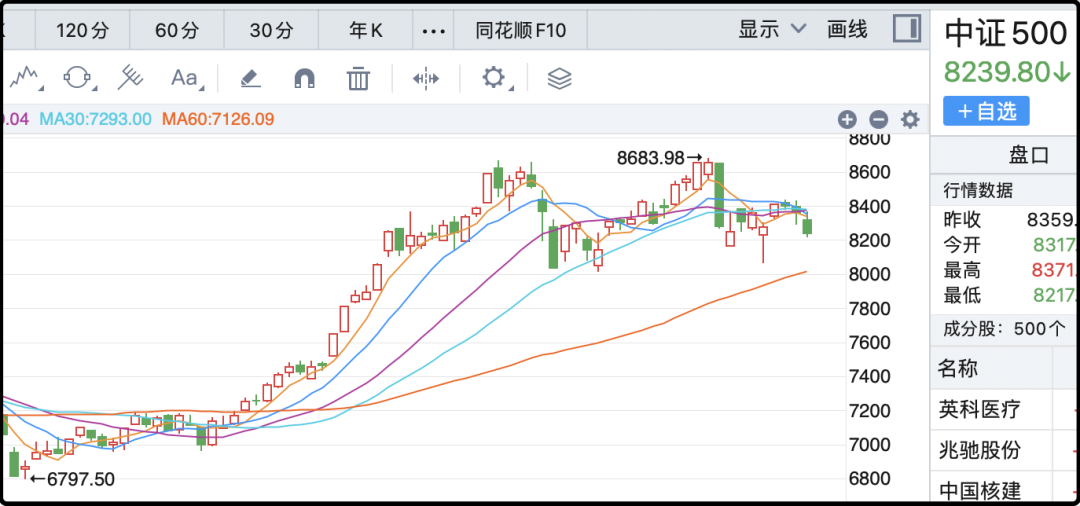 This stalemate between bulls and bears is most comfortable for assets with "time compensation". In recent months, I have observed the fluctuation of IC discount. It basically fluctuates within the monthly average range of 40-60 points. I suggest seizing the opportunity to switch to a longer-term contract when the discount widens to around 60 points, rather than waiting until the delivery date, which would put you in a more passive position.
Today, the tech sector saw a broad-based pullback. The lobster craze, which lasted less than a week, has cooled down. Those who rushed in during the first half of the week are likely holding on for a few days, waiting for the next wave of news to emerge before exiting. Another factor contributing to the tech sector's decline is the deteriorating situation in Iran, with no signs of a ceasefire in the near future. High oil prices and geopolitical instability typically drive up commodity and safe-haven assets, causing funds to temporarily flow out of the tech sector.
I saw two news items today. One is a Caixin report that Chinese and Russian merchant ships have been confirmed to be able to navigate the Strait of Hormuz. This isn't simply a matter of flying the Chinese national flag; it depends on the ship's registration in the Aircraft Identification System (AIS). The controlling shareholder/operator must be listed as "China owner," meaning the ship is owned by China. Only then can Iran be notified 24 hours in advance to request passage. The ships have crossed the Strait of Hormuz, but fuel prices remain high due to market fluctuations.
Another report, published by CNN and the New York Times, stated that the White House severely underestimated Iran's resolve to block the Strait of Hormuz when deciding to attack Iran, leading to Iran's actual action. The White House lacked contingency plans and did not anticipate the rapid and substantial rise in oil prices. The sources of this information are government personnel within the White House.
Haha, so this world is truly a makeshift operation. Even the self-proclaimed national strategist on TikTok knew that Iran had the option of blocking the Strait of Hormuz, yet the White House wasn't prepared. The report says that Trump's team thought that since Iran didn't block the Strait of Hormuz after the last bombing of nuclear facilities, they probably wouldn't this time either. Perhaps they thought Iran wouldn't incur public wrath and drag the whole world down with them. But if Iran is about to perish, who cares about such things?
Many readers have asked me why Venezuela won after a decapitation strike, while Iran became stronger and more resilient after a decapitation strike?
Simply put, Iran is not a country ruled by a single individual; its ruling group is a vast religious-military entity, commonly known as the Islamic Revolutionary Guard Corps. Khamenei is the leader of this group, with numerous key members holding power across the board, and the organization has a clear and stable hierarchical structure. Therefore, when the US and Israel eliminated the top leader, the second-ranked leader took over; when the second, third, fourth, and fifth-ranked leaders were eliminated, the sixth-ranked leader rose to power.
Unlike Maduro, who was all alone and even relied on Cuban special forces for his personal guards, after he was captured, the remaining people gave up resistance and all turned to cooperate with the United States.
To truly understand Iran, one must look at the 1979 revolution. At that time, the Pahlavi dynasty was nearing its end, social contradictions were acute, and the capital saw numerous demonstrations by millions in protest. Although Iran had an army of 400,000, the Pahlavi king was alienated and lost the support of the military, ultimately being forced into exile.
After Khomeini returned victorious, he dared not disband the 400,000-strong army directly. He adopted a policy of appeasement and appeasement, but since they were not his own people and he could not trust them regarding the distribution of power, he established the Islamic Revolutionary Guard Corps. The Iranian constitution stipulates that the purpose of this army is to protect the revolution and that it is directly loyal to the Supreme Leader.
Do you remember the nationwide protests that broke out in Iran at the beginning of the year? It was the Revolutionary Guard that suppressed them. The Iranian National Security Council said that the unrest resulted in 3,117 deaths and more than 3,700 injuries .
Iran currently has two military systems. The Iranian National Defense Forces maintain a strength of 400,000 personnel, but they are poorly equipped, poorly paid, and lack political status , thus being marginalized. The Revolutionary Guard, with approximately 200,000 personnel, receives funding, power, and resources, and is the core of the Iranian regime, as well as the group truly confronting the United States and Israel.
In conclusion, decapitation strikes in modern warfare are only effective against special regimes with highly centralized power, and cannot destroy ruling groups with large organizational structures.
Finally, I'd like to share something incredibly outrageous that happened today.
Around midnight today, a whale using an on-chain wallet exchanged $50 million worth of stablecoins for less than $40,000 worth of Aave tokens. This bizarre transaction result was attributed to the erratic pathfinding of the trading aggregator. The interface warned of slippage exceeding 99% and required manual confirmation. The whale manually confirmed the transaction, resulting in a loss of $49.96 million.
The tax address for this transaction is
This stalemate between bulls and bears is most comfortable for assets with "time compensation". In recent months, I have observed the fluctuation of IC discount. It basically fluctuates within the monthly average range of 40-60 points. I suggest seizing the opportunity to switch to a longer-term contract when the discount widens to around 60 points, rather than waiting until the delivery date, which would put you in a more passive position.
Today, the tech sector saw a broad-based pullback. The lobster craze, which lasted less than a week, has cooled down. Those who rushed in during the first half of the week are likely holding on for a few days, waiting for the next wave of news to emerge before exiting. Another factor contributing to the tech sector's decline is the deteriorating situation in Iran, with no signs of a ceasefire in the near future. High oil prices and geopolitical instability typically drive up commodity and safe-haven assets, causing funds to temporarily flow out of the tech sector.
I saw two news items today. One is a Caixin report that Chinese and Russian merchant ships have been confirmed to be able to navigate the Strait of Hormuz. This isn't simply a matter of flying the Chinese national flag; it depends on the ship's registration in the Aircraft Identification System (AIS). The controlling shareholder/operator must be listed as "China owner," meaning the ship is owned by China. Only then can Iran be notified 24 hours in advance to request passage. The ships have crossed the Strait of Hormuz, but fuel prices remain high due to market fluctuations.
Another report, published by CNN and the New York Times, stated that the White House severely underestimated Iran's resolve to block the Strait of Hormuz when deciding to attack Iran, leading to Iran's actual action. The White House lacked contingency plans and did not anticipate the rapid and substantial rise in oil prices. The sources of this information are government personnel within the White House.
Haha, so this world is truly a makeshift operation. Even the self-proclaimed national strategist on TikTok knew that Iran had the option of blocking the Strait of Hormuz, yet the White House wasn't prepared. The report says that Trump's team thought that since Iran didn't block the Strait of Hormuz after the last bombing of nuclear facilities, they probably wouldn't this time either. Perhaps they thought Iran wouldn't incur public wrath and drag the whole world down with them. But if Iran is about to perish, who cares about such things?
Many readers have asked me why Venezuela won after a decapitation strike, while Iran became stronger and more resilient after a decapitation strike?
Simply put, Iran is not a country ruled by a single individual; its ruling group is a vast religious-military entity, commonly known as the Islamic Revolutionary Guard Corps. Khamenei is the leader of this group, with numerous key members holding power across the board, and the organization has a clear and stable hierarchical structure. Therefore, when the US and Israel eliminated the top leader, the second-ranked leader took over; when the second, third, fourth, and fifth-ranked leaders were eliminated, the sixth-ranked leader rose to power.
Unlike Maduro, who was all alone and even relied on Cuban special forces for his personal guards, after he was captured, the remaining people gave up resistance and all turned to cooperate with the United States.
To truly understand Iran, one must look at the 1979 revolution. At that time, the Pahlavi dynasty was nearing its end, social contradictions were acute, and the capital saw numerous demonstrations by millions in protest. Although Iran had an army of 400,000, the Pahlavi king was alienated and lost the support of the military, ultimately being forced into exile.
After Khomeini returned victorious, he dared not disband the 400,000-strong army directly. He adopted a policy of appeasement and appeasement, but since they were not his own people and he could not trust them regarding the distribution of power, he established the Islamic Revolutionary Guard Corps. The Iranian constitution stipulates that the purpose of this army is to protect the revolution and that it is directly loyal to the Supreme Leader.
Do you remember the nationwide protests that broke out in Iran at the beginning of the year? It was the Revolutionary Guard that suppressed them. The Iranian National Security Council said that the unrest resulted in 3,117 deaths and more than 3,700 injuries .
Iran currently has two military systems. The Iranian National Defense Forces maintain a strength of 400,000 personnel, but they are poorly equipped, poorly paid, and lack political status , thus being marginalized. The Revolutionary Guard, with approximately 200,000 personnel, receives funding, power, and resources, and is the core of the Iranian regime, as well as the group truly confronting the United States and Israel.
In conclusion, decapitation strikes in modern warfare are only effective against special regimes with highly centralized power, and cannot destroy ruling groups with large organizational structures.
Finally, I'd like to share something incredibly outrageous that happened today.
Around midnight today, a whale using an on-chain wallet exchanged $50 million worth of stablecoins for less than $40,000 worth of Aave tokens. This bizarre transaction result was attributed to the erratic pathfinding of the trading aggregator. The interface warned of slippage exceeding 99% and required manual confirmation. The whale manually confirmed the transaction, resulting in a loss of $49.96 million.
The tax address for this transaction is
0x9fa9feab3c1989a33424728c23e6de07a40a26a98ff7ff5139f3492ce430801f
I suspect you didn't understand what I wrote above, so let me give you a simpler example. A wealthy man runs downstairs to the convenience store and says, "I want 50 million to buy all the Coke in your store!" The owner says, "All the Coke in our store is only worth 40,000 US dollars." The wealthy man says, "I don't care, I want 50 million US dollars to buy it all."
The boss reminded you again that you'd lose over 99% this way, and asked for your signature. The wealthy man, with a flourish of his pen, declared, "That's my decision. Continue the transaction!"
It might seem completely incomprehensible, and I don't understand it either, but that's exactly how it happened. Some might suspect that a wealthy person deliberately used the shop owner to launder money, but that doesn't seem likely, because the abnormal price caused by this transaction immediately attracted arbitrage bots, which snatched up all the money, and the shop owner (LP) didn't actually make much money.
350 million! If I could snag a bargain, I'd give it all to you guys as red envelopes, 700 yuan per person, and you could have a wonderful weekend.
Uncle's sauce.
Original Article: View Chinese Version