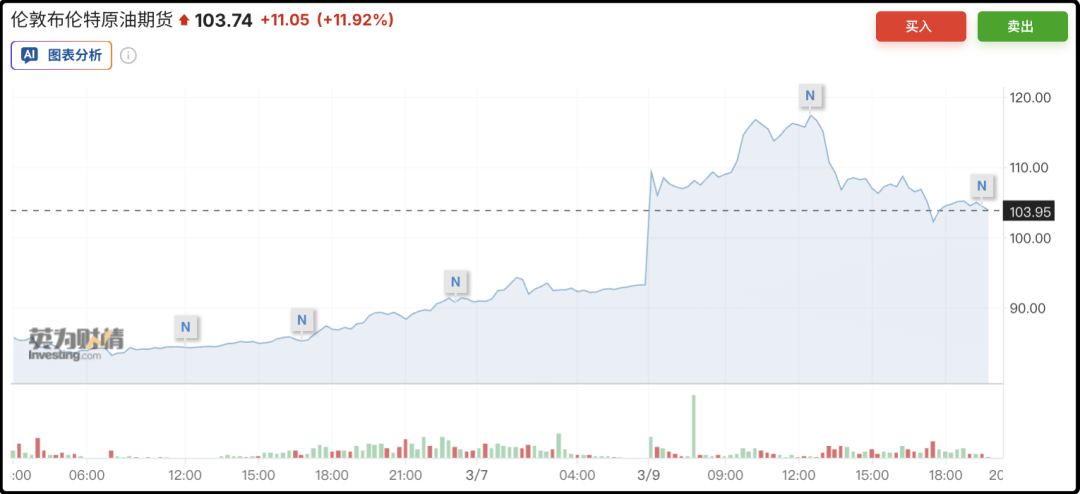
This morning, oil prices opened above 110, reaching a high of 117 around noon, a maximum intraday gain of 25%. Just a few days ago we saw silver plummet by 35% in a single day, and now we see oil surge by 25% in a single day. This world has truly gone mad.
The price fell during the session because the G7, led by the United States, contacted the IEA (International Energy Agency) and proposed that several oil-consuming countries jointly release oil reserves to stabilize oil prices. The IEA's total reserves are approximately 1.2 billion barrels, and the US proposed releasing 300-400 million barrels, roughly 30% of the total reserves.
The plan is to release 10 million barrels of oil daily for 30-40 days to fill the oil gap caused by the situation in Iran.
However, not all countries listen to the United States. OPEC (mainly Saudi Arabia and Russia) opposes releasing reserves. From the perspective of oil-producing countries, they wish for oil prices to skyrocket and make a fortune, so they will unite to cut production as retaliation.
Oil prices have temporarily fallen due to a combination of factors, with Brent crude currently at $103 and WTI crude at $100.
This explains why the oil and gas sector in the A-share market opened high but closed low today. The morning was precisely when oil price panic was at its worst and market sentiment was at its most volatile. From noon onwards, news of the G7's planned release of reserves caused oil prices to fall, and the entire sector followed suit. Anyone who rushed in at the open suffered a large negative candle and is now stuck with losses in the short term. Further developments will depend on how the situation unfolds; oil prices may not necessarily retreat from here. As long as the US-Iran stalemate continues, I believe oil prices could reach new highs.
P.S.: China is neither in the IEA nor OPEC, and its attitude this time is one of neutrality and self-preservation.
Today, A-shares initially fell before rising, forming a particularly long lower shadow. This movement is highly correlated with oil price fluctuations; the sharp rise in oil prices in the morning coincided with the largest drop in A-shares, while the afternoon saw a gradual recovery as oil prices fell. The median decline was 0.94%, which is considered a relatively small drop compared to European, American, and Asia-Pacific stock markets. In comparison, the Nikkei index fell 5.2%, the South Korean Kospi fell 6.5%, and the Taiwan Weighted Index fell 4.4%, making A-shares' performance today relatively acceptable.
I checked the data, and China's strategic reserves plus commercial reserves are about 1.2 billion barrels, which is equivalent to the entire IEA's reserves. This can cover net imports for more than 140 days. So although we are the world's largest oil importer, our ability to withstand pressure in this oil crisis is no weaker than that of Europe and the United States. As long as it doesn't drag on for more than half a year, there will be no problem.
Today, the biggest gainer in the A-share market wasn't oil, but computing power leasing, up 3.2%, mainly because the entire Chinese internet sector was swept up in a lobster AI craze over the weekend. I've introduced this to you before; it's the AI agent that the financially independent, retired coding genius wrote in his spare time at home. It was originally called Clawdbot, later renamed OpenClaw.
It can be deployed on a local computer, and as long as you grant it permissions, it can call various software to complete tasks. However, locally deployed Lobster lacks intelligence, so you need to configure it with an external brain. The external brain can be Doubao, Yuanbao, chatgpt, or gemini, but you need to pay according to the computing power consumption. In China, it costs about 30-80 yuan per month for light personal use, and 200-500 yuan per month for intensive office use.
Therefore, you'll see that major internet companies have been actively promoting Lobster AI to individual users these past few days, because once you install it, you'll also buy their computing power monthly package and pay for it long-term.
In the past few days, some articles have started creating anxiety, making it seem like you'll be left behind if you don't have Lobster AI. The real reason is just to profit from deployment and installation fees, or training fees. I learned about Lobster AI last month, but after weighing the options, I felt it wasn't necessary for me to install and deploy it at this stage.
The lobster AI craze has stimulated the market demand for personal computing power. If future versions are upgraded to be more suitable for everyday use, it's possible that everyone will have a personal AI assistant in the future, at which point the demand for computing power will be astronomical. The market potential is huge, but for now, only this much has been implemented.
1. Iran today announced its new Supreme Leader, Mojtaba Khamenei, the 56-year-old second son of the late Khamenei who died a few days ago. His close ties to the Islamic Revolutionary Guard Corps (IRGC) are significant, given that the IRGC is currently the largest vested interest group in Iran.
His succession appears to be a continuation of his father's leadership, which is not in the interests of the United States and Israel, so there is a possibility that he will continue to seek opportunities to assassinate his father.
2. Today, southbound capital saw a net inflow of HK$37.2 billion, setting a new single-day record. The largest buyers were the Tracker Fund of Hong Kong (HK$12.5 billion), Hang Seng China Fund (HK$5.3 billion), and Southern Hang Seng Fund (HK$4.1 billion). I was stunned when I saw this news; it's the exact opposite of the news from a few days ago, when there was a record single-day net outflow, with similar amounts in these same sectors. What's going on? Are large institutions rebalancing their portfolios? Surely they wouldn't be using HK$20 billion for short-term trading?  3. Gas prices will be raised tonight. 92-octane gasoline will increase by 0.55 yuan, and 95-octane gasoline will increase by 0.58 yuan. Filling up a 50-liter tank will cost nearly 30 yuan more.
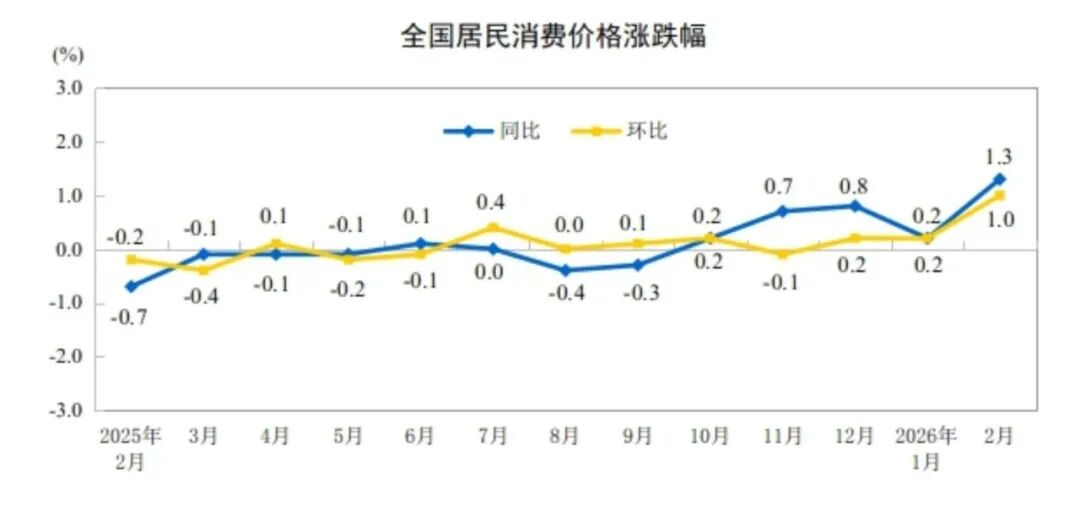
4. The latest CPI figure for February is +1.3%. I checked the data, and the last time it was above 1% was in March 2023. I initially thought that a CPI exceeding 1% would be a significant signal of escaping deflation, but after checking, it seems the reason is largely related to the mismatch between the Spring Festival and the actual CPI. Last year, the Spring Festival was in January, while this year it was in February, resulting in a particularly low CPI in January (0.2%) and a particularly high CPI in February (1.3%). Adding these two figures together and dividing by 2 gives us a level roughly equivalent to the end of last year. Therefore, we need to look at the data for March and April.
3. Gas prices will be raised tonight. 92-octane gasoline will increase by 0.55 yuan, and 95-octane gasoline will increase by 0.58 yuan. Filling up a 50-liter tank will cost nearly 30 yuan more.
4. The latest CPI figure for February is +1.3%. I checked the data, and the last time it was above 1% was in March 2023. I initially thought that a CPI exceeding 1% would be a significant signal of escaping deflation, but after checking, it seems the reason is largely related to the mismatch between the Spring Festival and the actual CPI. Last year, the Spring Festival was in January, while this year it was in February, resulting in a particularly low CPI in January (0.2%) and a particularly high CPI in February (1.3%). Adding these two figures together and dividing by 2 gives us a level roughly equivalent to the end of last year. Therefore, we need to look at the data for March and April.
 That's all. I just checked the on-chain casino's pool for March oil prices. I thought that since the highest price today was 117, the options below 120 should have already shown results. But it turns out that's not the case. Its rules don't look at the instantaneous highest price, but rather at the daily settlement price of WTI crude oil.
The settlement price of WTI crude oil is based on the weighted average price of transactions made between 2:28 and 2:30. A well-known case is that the Bank of China's "Crude Oil Treasure" product was manipulated during those two minutes, resulting in negative oil prices. Therefore, this gamble remains unpredictable; even if the price settles at over $100 today, a win is not guaranteed.
That's all. I just checked the on-chain casino's pool for March oil prices. I thought that since the highest price today was 117, the options below 120 should have already shown results. But it turns out that's not the case. Its rules don't look at the instantaneous highest price, but rather at the daily settlement price of WTI crude oil.
The settlement price of WTI crude oil is based on the weighted average price of transactions made between 2:28 and 2:30. A well-known case is that the Bank of China's "Crude Oil Treasure" product was manipulated during those two minutes, resulting in negative oil prices. Therefore, this gamble remains unpredictable; even if the price settles at over $100 today, a win is not guaranteed.
Original Article: View Chinese Version