In my article yesterday, I mentioned the Meng Wanzhou incident from a few years ago, and there were many incorrect replies in the comments. It seems that although this incident was very sensational, many netizens are not actually clear about the ins and outs. Let me briefly explain it to you.
The incident began when the US discovered that Skycom had sold €1.3 million worth of goods to Iran, including HP servers and switches, as well as Microsoft software. At the time, the US banned the sale of its own goods to Iran, and considered Skycom to be a shell company of Huawei in Iran.
This is a company-level matter and has nothing to do with Meng Wanzhou personally. The reason the US arrested her is because of something else. In 2013, when Meng Wanzhou was giving a presentation to HSBC executives , the US accused her of deliberately concealing the true relationship between Huawei and Skycom, and of suspected "bank fraud . "
Huawei and Meng Wanzhou firmly denied the accusations , providing evidence that HSBC knew about the close relationship between Huawei and Skycom beforehand and was aware that Huawei had business in Iran, so they were not deceived .
The two sides fiercely fought over this matter in court for several years, while off the court it was a diplomatic showdown between China and the United States. As you all know, the US dropped the charges and Meng Wanzhou returned to China safely.
HSBC played a dishonorable role in this incident. At the time, they were under investigation and faced hefty fines in the US for money laundering related to Mexican drug cartels. Under this pressure, they betrayed their clients. Following this, Huawei severed ties with them, resulting in the loss of numerous state-owned enterprise clients and a significant decline in their business in China. Their stock price plummeted a few years ago, but has since recovered due to the growth of other business lines.
There's also a rumor circulating online that Meng Wanzhou's troubles were caused by Iran betraying them. This is fake news, originating from a Reuters report that was misinterpreted by some domestic "experts." Iran has no reason to betray its partners to its enemy, and given their poor relationship with the US, betraying ten Huaweis wouldn't make a difference.
After I finished writing the above paragraph myself, I had it reviewed by Bean Secretary, who is the most conscientious AI, out of a desire for rigor. She helped me revise three wordings, but the factual content remained unchanged.
Today, a record-breaking data point emerged: the net outflow from the southbound trading channel reached -27.7 billion yuan, setting a new single-day high. Looking at the details, the Tracker Fund of Hong Kong (Hang Seng Index ETF) saw a net sell-off of 13.6 billion yuan, the Hang Seng China Enterprises Index saw a net sell-off of 6.1 billion yuan, and the Southern Hang Seng Tech Index saw a net sell-off of 3.9 billion yuan. These three are all index-related sectors. The largest individual stock sell-off was Alibaba, at -2 billion yuan. Adding these together roughly accounts for today's total net outflow.
Without a doubt, this level of sudden sell-off, especially in index products, couldn't have been done by retail investors; it could only be institutional activity. The Hang Seng Index has experienced dramatic ups and downs over the past six years, falling from 31,000 to 15,000, and then rebounding to 28,000. It's likely that funds that bought at the lows are now taking profits.
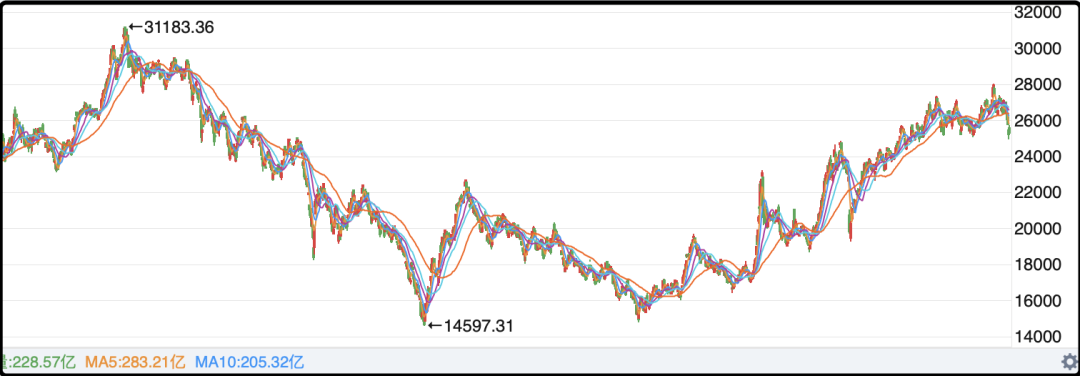 The image above is a large one. Actually, the recent trend on the far right shows the Hang Seng Index has been down for four consecutive days, indicating a potential downward breakout from the consolidation range.
I estimate that many people will feel frustrated when they see this news. The Hang Seng Tech sector was already performing poorly, and the institutions within it are even sabotaging it and running away. But this is the norm in the Chinese capital market. A few years ago, when the A-share market was below 3000 points, there were people dumping shares and running away. If you didn't have some composure back then, you would really think that the A-share market was doomed.
Objectively speaking, the Hang Seng Index is not overvalued, with a PE ratio of around 12 and a PB ratio of 1.22, which is considered cheap compared to any major global stock market. The Hang Seng Internet Index currently has a PE ratio of 21, and no other technology sector in the mainstream market has a lower valuation.
A few years ago, before the CSI 500 index rose, I often used its low valuation to convince myself to hold on. Many unsettling stories shook my resolve, but thankfully I weathered the storm. I'm actually patient enough to weather this Hang Seng quagmire, but unlike stock index futures, it doesn't offer the time to recover. The annual dividends are subject to a 20% tax, so I'm not considering adding to my position for now. I also don't want to exit when market sentiment is pessimistic; selling now would likely lead to regret in a few years.
The A-share market rebounded across the board today, with a median increase of 1.02%, more than enough to recover the losses incurred last Wednesday. We'll leave the losses from Monday and Tuesday aside for now. Other global markets also stabilized, gradually digesting the impact of the situation in Iran.
Sectors that benefited in the past few days, such as oil, gas, shipping, chemicals, and precious metals, are all on the list of biggest losers today. However, this doesn't mean they're finished; it's just a short-term emotional pullback. The situation in Iran hasn't improved at all. Both sides are still bombing each other, and the Strait of Hormuz remains closed to navigation.
Today I saw several Iranian departments speak out, some saying there was no blockade, some saying they only intercepted US, Israeli, and European ships, some saying they would manage the waterways during wartime, and others saying they would not allow passage. This might be a consequence of the US's successful decapitation strike; without unified command, the lower-level vessels are now acting independently. This state of disarray is quite frightening. On the real-time navigation charts, I saw that most merchant ships are still stuck on both sides of the Strait of Hormuz, afraid to risk passing through.
Brent crude oil is currently priced at $83, remaining at a high level, while gold is at $5120 and silver at $83, having declined slightly.
Recently, power grid equipment prices have been performing well, even hitting new highs against the market trend. The national power grid investment is expected to reach $12 trillion over the next five years. This is a clear indication that regardless of the direction AI develops, the demand for electricity will remain constant. Moreover, given the situation with Iran, there is a growing consensus that China needs to accelerate the replacement of fossil fuels with electricity to achieve energy security.
1. The US military sank an Iranian frigate in the Indian Ocean today. There were approximately 180 people on board. The frigate was attacked by a US submarine's torpedoes. Sri Lanka intervened and rescued more than 30 Iranian soldiers; the rest are either confirmed dead or missing. I'm curious why the Iranian warship was in that location. I looked it up and found it was participating in military exercises in India recently. The war hadn't broken out when it went, and it was attacked on its way back.
Even if they returned home, the outcome would be the same. With air superiority completely lost, warships are like sitting ducks, and the Iranian navy is almost wiped out. Just putting myself in the shoes of an Iranian naval soldier is too painful. They can't retreat in the face of battle, but they could be killed at any moment, possibly by bombs from the sky or torpedoes from the sea, and they can't even determine the target of the battle.
2. The government has confirmed this year's GDP growth target of 4.5-5%. Based on the experience of the past two years, achieving this target should not be a problem. Actually, I'm more concerned about the government's stated goal of ending deflation this year and striving to raise the CPI to 2%. If this goal is achieved, housing prices, consumption, and even the advertising industry will see significant improvement, presenting an opportunity for a turnaround.
However, the 2% CPI figure does not include this, as last year's target was also 2%.
3. Zhang Yiming topped the Hurun Rich List as China's richest man with over 550 billion yuan. Actually, he's been the richest for a while; ByteDance's lack of a public listing has prevented the full realization of his true wealth, which is likely much higher than 550 billion yuan. Among the newly rich, two are relatively young: Liu Jingkang and his wife from InStone, and Yan Junjie from Minimax. This is a good thing, indicating that China's wealth class is still fluid, and the window for upward mobility is not closed, but it must be in emerging industries.
4. The South Korean stock market rebounded by 9% today.
The image above is a large one. Actually, the recent trend on the far right shows the Hang Seng Index has been down for four consecutive days, indicating a potential downward breakout from the consolidation range.
I estimate that many people will feel frustrated when they see this news. The Hang Seng Tech sector was already performing poorly, and the institutions within it are even sabotaging it and running away. But this is the norm in the Chinese capital market. A few years ago, when the A-share market was below 3000 points, there were people dumping shares and running away. If you didn't have some composure back then, you would really think that the A-share market was doomed.
Objectively speaking, the Hang Seng Index is not overvalued, with a PE ratio of around 12 and a PB ratio of 1.22, which is considered cheap compared to any major global stock market. The Hang Seng Internet Index currently has a PE ratio of 21, and no other technology sector in the mainstream market has a lower valuation.
A few years ago, before the CSI 500 index rose, I often used its low valuation to convince myself to hold on. Many unsettling stories shook my resolve, but thankfully I weathered the storm. I'm actually patient enough to weather this Hang Seng quagmire, but unlike stock index futures, it doesn't offer the time to recover. The annual dividends are subject to a 20% tax, so I'm not considering adding to my position for now. I also don't want to exit when market sentiment is pessimistic; selling now would likely lead to regret in a few years.
The A-share market rebounded across the board today, with a median increase of 1.02%, more than enough to recover the losses incurred last Wednesday. We'll leave the losses from Monday and Tuesday aside for now. Other global markets also stabilized, gradually digesting the impact of the situation in Iran.
Sectors that benefited in the past few days, such as oil, gas, shipping, chemicals, and precious metals, are all on the list of biggest losers today. However, this doesn't mean they're finished; it's just a short-term emotional pullback. The situation in Iran hasn't improved at all. Both sides are still bombing each other, and the Strait of Hormuz remains closed to navigation.
Today I saw several Iranian departments speak out, some saying there was no blockade, some saying they only intercepted US, Israeli, and European ships, some saying they would manage the waterways during wartime, and others saying they would not allow passage. This might be a consequence of the US's successful decapitation strike; without unified command, the lower-level vessels are now acting independently. This state of disarray is quite frightening. On the real-time navigation charts, I saw that most merchant ships are still stuck on both sides of the Strait of Hormuz, afraid to risk passing through.
Brent crude oil is currently priced at $83, remaining at a high level, while gold is at $5120 and silver at $83, having declined slightly.
Recently, power grid equipment prices have been performing well, even hitting new highs against the market trend. The national power grid investment is expected to reach $12 trillion over the next five years. This is a clear indication that regardless of the direction AI develops, the demand for electricity will remain constant. Moreover, given the situation with Iran, there is a growing consensus that China needs to accelerate the replacement of fossil fuels with electricity to achieve energy security.
1. The US military sank an Iranian frigate in the Indian Ocean today. There were approximately 180 people on board. The frigate was attacked by a US submarine's torpedoes. Sri Lanka intervened and rescued more than 30 Iranian soldiers; the rest are either confirmed dead or missing. I'm curious why the Iranian warship was in that location. I looked it up and found it was participating in military exercises in India recently. The war hadn't broken out when it went, and it was attacked on its way back.
Even if they returned home, the outcome would be the same. With air superiority completely lost, warships are like sitting ducks, and the Iranian navy is almost wiped out. Just putting myself in the shoes of an Iranian naval soldier is too painful. They can't retreat in the face of battle, but they could be killed at any moment, possibly by bombs from the sky or torpedoes from the sea, and they can't even determine the target of the battle.
2. The government has confirmed this year's GDP growth target of 4.5-5%. Based on the experience of the past two years, achieving this target should not be a problem. Actually, I'm more concerned about the government's stated goal of ending deflation this year and striving to raise the CPI to 2%. If this goal is achieved, housing prices, consumption, and even the advertising industry will see significant improvement, presenting an opportunity for a turnaround.
However, the 2% CPI figure does not include this, as last year's target was also 2%.
3. Zhang Yiming topped the Hurun Rich List as China's richest man with over 550 billion yuan. Actually, he's been the richest for a while; ByteDance's lack of a public listing has prevented the full realization of his true wealth, which is likely much higher than 550 billion yuan. Among the newly rich, two are relatively young: Liu Jingkang and his wife from InStone, and Yan Junjie from Minimax. This is a good thing, indicating that China's wealth class is still fluid, and the window for upward mobility is not closed, but it must be in emerging industries.
4. The South Korean stock market rebounded by 9% today.
Original Article: View Chinese Version