Yesterday I wrote about Deng Ai's story, and many readers left comments asking about his situation after he destroyed the Shu Kingdom at the age of 67. Unfortunately, his entire family was killed immediately afterward.
At that time, the main force of Wei's conquest of Shu was led by Zhong Hui, with Wei Guan as the supervising officer. When they attacked Jianmen Pass, they were intercepted by Jiang Wei's troops and could not take it for a long time. Deng Ai led a detachment, bypassed the pass, and secretly crossed Yinping to attack the rear of Shu Han, forcing Liu Shan to surrender.
After making great contributions, Deng Ai became arrogant and appointed officials in Shu without authorization. He even wrote to Sima Zhao, suggesting that they take the opportunity to go south and destroy Eastern Wu as well. These were not things that a soldier of his rank should do.
Zhong Hui and Wei Guan, who had long disliked Deng Ai, falsely accused him of rebellion, arrested him, and sent him back to Wei. But in reality, it was Zhong Hui who truly wanted to rebel. He was instigated by Jiang Wei, who had feigned surrender, to plot a rebellion and establish his own state. However, the plot was exposed, and Wei Guan led his army to kill Zhong Hui and Jiang Wei.
Wei Guan was worried that Deng Ai would report him to Sima Zhao, so he sent someone who had a grudge against Deng Ai to chase after him and kill him.
This is the famous "Zhong Hui Rebellion" in the history of the Three Kingdoms. Deng Ai was clearly wrongfully killed, but the Wei court at the time charged him with treason and exterminated his entire clan. Although his end was tragic, history still gave him a high evaluation, and he is one of the eight famous generals of the Three Kingdoms who were selected for the Temple of Martial Arts.
After returning to China, Wei Guan was not only not punished, but was also promoted. However, his retribution came more than 20 years later when, as Jia Nanfeng's political enemy, his entire family died.
So I would like to ask you all, if you had to choose between the two, would you rather live a quiet and peaceful life, or make a great career and then die unjustly?
Today I saw a news item that surprised me: three companies under Li Ka-shing simultaneously announced the sale of 100% of the equity of UK Power Networks (UKPN), the largest electricity grid asset in the UK , to French utility giant Engie for £10.5 billion (approximately HK$110 billion).
I checked and found that this asset was purchased from another French company in 2010 for £5.8 billion. Over the past 15 years, it has accumulated dividends of £4.4 billion, and can now be sold for £10.5 billion. (10.5 + 4.4) / 5.8 = 257%. The annualized simple interest rate over the past 14 years is 10.5%, and the annualized compound interest rate is 6.5%, which is quite a good return.
Old Li is a prudent and profitable businessman; he's not exaggerating when he says he's never lost money in his life. As for the reason for this asset sale, external analysis suggests it's mainly due to concerns about geopolitical risks. UKPN distributes a quarter of the UK's electricity, and investment scrutiny is likely to be tightened in the future. If they don't sell now, they might not be able to sell in the future.
As for the £10.5 billion raised from the sale, it may be invested in other new energy industries under Li Ka-shing's control, or it may be used to improve his balance sheet, or it may be used for share buybacks or dividends. That's why the stocks of all of Li Ka-shing's companies surged today.
Some people may not know which stocks Li Ka-shing owns. Here is a list: CK Asset Holdings (HK1113), CK Infrastructure Holdings (HK1038), Power Assets Holdings (HK0006), CK Hutchison Holdings (HK0001), and HK Electric Holdings (HK2638).
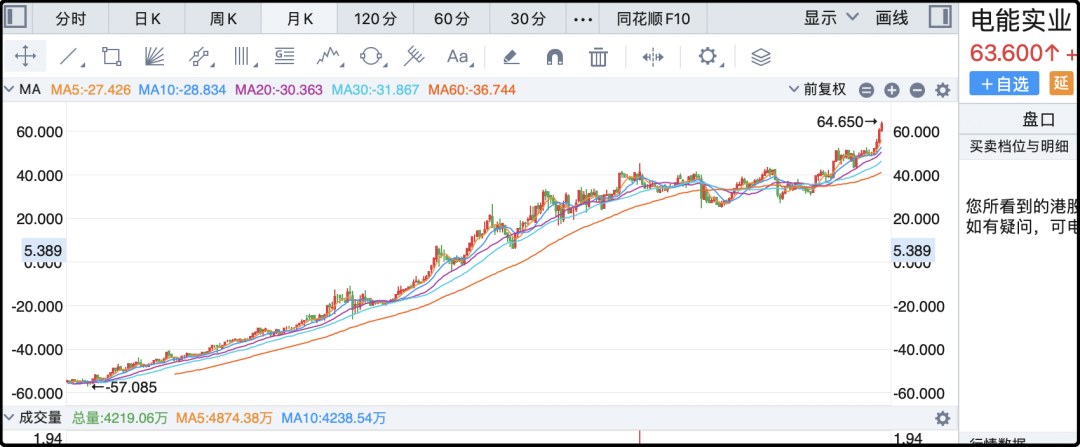
Because of previous public opinion controversies, many netizens dislike Li Ka-shing. However, as a stock investor, you certainly wouldn't dislike Li Ka-shing's companies, because every stock he owns is quite good. My long-held holding is Power Assets Holdings Limited; its monthly candlestick chart over the past 25 years looks like this:
Today, A-share trading volume reached 2.54 trillion yuan, continuing a moderate increase. Among the eight broad-based indices, four rose and four fell, with a median of -0.11%, essentially unchanged. In terms of sectors, components, semiconductors, and a bunch of power grid equipment led the gains, but the increases weren't significant. As for the bottom of the list, film and entertainment, real estate, insurance, and liquor stocks remained the same—their lackluster performance. Yesterday's "Shanghai Seven Measures" stimulus only provided a one-day boost; the effects wore off after a good night's sleep.
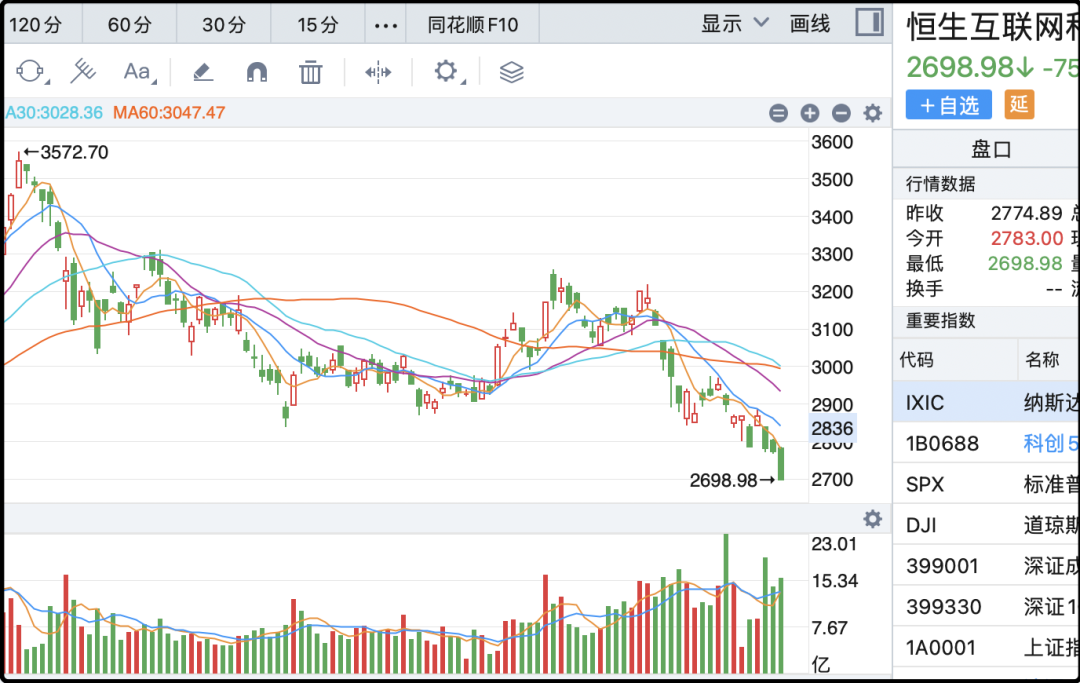
However, the Hang Seng Internet Index was the most criticized index in the stock market community today, falling 2.3% intraday. Worse still, it has already fallen 9.3% cumulatively by 2026, which is truly disastrous. Rising is as difficult as picking up soil with a needle, while falling is as easy as water pushing sand. Actually, the RMB exchange rate has been rising these past few days, with the latest offshore rate reaching 6.83, yet the Hang Seng Internet Index is still falling, meaning shareholders are losing money twice – once from the share price and once from the exchange rate.
Many people are analyzing the reasons for the decline in Hang Seng Internet Index. Besides the competitive pressure from ByteDance and the 150 billion yuan burn in the food delivery war, there may be other factors that led to institutional selling. Otherwise, it wouldn't have been so bad.
Anyone who has a large stake in Hang Seng Internet in Hong Kong stocks and a large stake in liquor in A-shares, as long as they don't commit murder or arson, they've atoned for all their sins in this life, and they'll be reborn as a rich and handsome man in their next life.
I didn't sell my 513330 when I made a small profit, and now I'm stuck with it again. But I don't plan to add to my position, so I'll just leave it there for now. The biggest problem in China's internet industry is involution; I'm not going to get bogged down in that. If I have money, I'll prioritize companies with lower costs and less competition.
1. Zimbabwe has announced an immediate and indefinite suspension of all exports of crude ore and lithium concentrate, including goods already in transit . Their aim is to boost the local mineral processing industry, keeping more added value domestically and creating jobs. From now on, only companies with mining licenses and approved beneficiation plants will be allowed to apply for exports.
Zimbabwe is Africa's largest lithium exporter, and by 2025, 19% of China's lithium imports will come from there. This event will likely stimulate a short-term rise in lithium prices, benefiting the domestic lithium sector. Currently, with the rise of global nationalism, the risks of investing in overseas mining are rapidly increasing, and many governments are advocating for resource nationalization to appease their citizens.
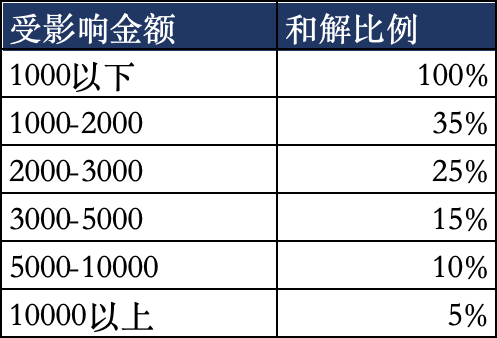
2. The settlement ratio for Guotou Silver transactions above 1000 yuan has been announced, as shown in the table. There's not much to say about this; once large investors are no longer under the "protection" of retail investors, the value of stabilization measures will shrink significantly, and they will lose their bargaining power. A 5% loss for transactions above 10000 yuan is better than nothing.
3. Hong Kong Exchanges and Clearing Limited (HKEX) projected a net profit of HK$17.7 billion in 2025, a 36% year-on-year increase. This is a stock I have held for a long time and have repeatedly recommended publicly. HKEX shares are highly scarce, making them your only investment option within an exchange. With the deterioration of US-China relations, many companies will be forced to list on HKEX in the future, ensuring the company's strong performance.
4. The South Korean stock market has been soaring recently. Stimulated by the chip and memory chip boom, Samsung and SK Hynix have seen explosive growth. The South Korean index has already risen by nearly 50% by 2026. It is said that one-third of South Koreans are now passionately investing in stocks.
5. The major shareholder of Dongcai University (actually a person's name) actually donated 20 million shares to his alma mater, Shanghai Jiao Tong University, worth approximately 450 million RMB. This was during Jiao Tong University's 130th anniversary celebration, when many influential alumni made substantial donations. Donations like these are usually converted into cash very quickly.
That's all for tonight, launch.
Original Article: View Chinese Version