I've left Taizhou. I had a very fulfilling winter vacation. First, my wife and I went to Hong Kong to see BLACKPINK's concert. Then, the whole family went skiing in Chongli. Next, we went back to Linhai to have a big feast during the Chinese New Year. Finally, I stayed at my mother-in-law's house in Suzhou for a few days before returning to Beijing before the start of the new semester.
Last night, when I was encouraging readers, I casually mentioned an example of a famous figure from the Three Kingdoms period. Many readers asked in the comments who it was. Actually, if you copy that passage and show it to AI, it will tell you it's Deng Ai. He lost his father at a young age, migrated during the war, and made a living by herding cattle—a truly impoverished background. As an adult, he worked as a grassroots official in agriculture and water conservancy, quietly serving until his forties. He also had a serious stutter, which often made him the target of ridicule from his superiors and colleagues.
The turning point came when he went to the capital at the age of 43 to report to Sima Yi, who found him to be competent and insightful, and promoted him. However, several years passed between Sima Yi's power being usurped and the coup at Gaoping Tombs, and Deng Ai finally obtained a position to lead troops independently at the age of 52.
No one expected that the old farmer official, who could barely speak, was actually a top military genius in the Three Kingdoms period. He won every battle in his military career, completely suppressing Jiang Wei. In the end, he boldly crossed Yinping, circled around and attacked Shu from behind, and personally ended the tripartite division of the Three Kingdoms. He was 67 years old that year.
Deng Ai has a classic line in Romance of the Three Kingdoms: "Being born into poverty is not a disgrace; being able to bend and stretch is what makes a true man."
So, you who are currently working like a slave in the workplace might actually possess an amazing talent in some area, you just haven't realized it yet. This isn't just motivational fluff; there are many people in history who achieved great things later in life. Keep an open mind, learn more, and try more things. Maybe one day you'll find the right path and take off in three to five years.
Today, A-shares continued their strong start after the Lunar New Year holiday, with a turnover of 2.4 trillion yuan. Trading volume further stabilized and increased, and all eight broad-based indices were in positive territory, with the CSI 500 leading the gains at 1.6%. The market median rose by 0.65%, weaker than the index performance, indicating that today's gains were mainly driven by heavyweight stocks.
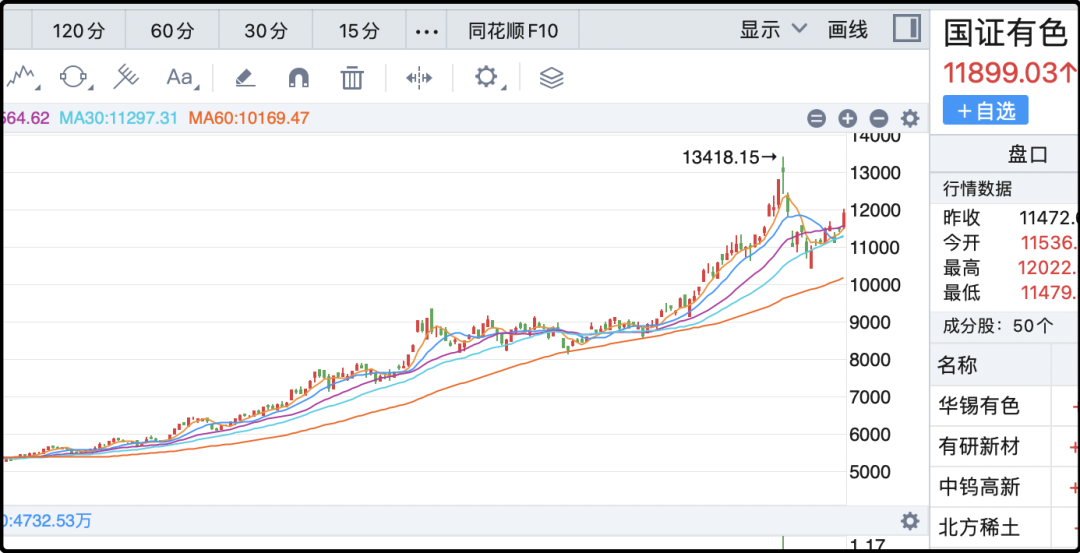
In terms of sectors, non-ferrous metals remain the best performer. The US dollar continues to weaken, and the exchange rate against the yuan has fallen below 6.87, seemingly heading towards the 6.8 level. Global commodities are rising, with silver recently rebounding to $90. Citibank is bullish on copper prices, predicting they will reach $14,000 within three months (currently at $13,100), and JPMorgan Chase is bullish on gold, predicting it will reach $6,300 by the end of the year. These are the latest views; in short, almost no institutions are bearish on commodities now.
However, the best performing sectors in the A-share market today weren't gold, silver, or copper, but rather minor metals, energy metals, industrial metals, and new materials metals—various branches within the metals sector. In short, any mining-related stocks in my portfolio have performed well recently. The non-ferrous metals market has been bullish throughout 2025, and it looks like it will continue its upward trend into 2026. Many people are holding onto their large profits and can't hold onto them; this is where composure will be tested.
It's worth mentioning that real estate prices rose by a rare 2.5% today, directly due to Shanghai's new "Seven-Day Policy." I won't copy and paste the details, but in summary, it relaxed purchase restrictions, increased the maximum amount of housing provident fund loans, and temporarily exempted certain groups from property tax. These are all minor adjustments; the major brands had already exhausted their resources in the past few years.
I checked the Trend Animals mini-program, and Shanghai housing prices stopped falling and rebounded in February. Of course, the rebound was not significant, with most districts seeing increases of less than 0.5%, but at least they stopped falling. I'm guessing that next month's data from 70 cities will show more than 10 cities with month-on-month increases exceeding 100, but this doesn't necessarily mean that this round of housing prices has bottomed out. Last year, there was also a rebound for three months at the beginning of the year, followed by a more severe correction.
(Click the image to enter the Shanghai city page of the mini-program)

1. A hot topic circulating in the market today is that Changchun High & New Technology Industries Group's GenSci141 ointment has received clinical trial approval from the National Medical Products Administration. This ointment, when applied to a child's penis, can stimulate penile development and enlargement. As a result, jokes about "penis-enhancing drugs" began to spread on social media, fueling market sentiment and finally leading to a surge around 2:30 PM, hitting the daily limit.
I know what you're thinking. This medicine won't work on children over 300 months old; it's only for undeveloped children. And it's not suitable for all children. It's only for children whose penises are unusually small due to illness; applying this medicine can help them grow to the "normal minimum length." Do you understand? This isn't a miracle drug for penis enlargement. Its target population isn't very large, but it has a certain market potential, with a sales volume of 3-5 billion RMB over its lifespan.
In the short term, it might be possible to capitalize on sentiment, but relying on this drug to turn things around is probably unlikely.
2. There's another big event tonight: Gree's major shareholder announced it will reduce its stake by 2% through block trades within the next three months, citing the need to repay bank loans. Gree's major shareholder is Hillhouse Capital, which divested its state-owned shares in 2019 at a cost of 46.17 yuan per share, for a total transaction value of 41.6 billion yuan.
Over the years, Gree has distributed a total dividend of 14.56 yuan, so the cost per share is 31.6 yuan. The current price is 38.49 yuan, resulting in a paper profit of 6.9 yuan per share. However, the 40 billion yuan acquisition by Hillhouse Capital was mainly financed by loans, and the interest costs over the years have been very high. I estimate that overall, it's a slight loss or just breaking even. Hillhouse bought at a high price and didn't make much money. Now they're withdrawing, which I think is neutral, not a major negative factor. Perhaps Gree needs to outlast Dong Mingzhu and Hillhouse Capital to have a bright future.
3. South Korea's birth rate has rebounded for two consecutive years, indicating it has successfully bottomed out as a leading indicator. South Korea's total fertility rate had been declining, reaching a low of 0.72, before rebounding to 0.75 two years ago and 0.8 last year. This means that each woman of childbearing age gives birth to an average of 0.8 children in her lifetime. While this figure is still low, at least it won't decline indefinitely. China's total fertility rate is around 1.09, and it has been declining year by year, potentially falling below 1. However, if South Korea can rebound from this low point, it would be good news for us.
The internationally recognized normal population replacement rate is 2.1, and anything below 1.3 is considered an extremely low fertility rate.
That's about it for tonight. I wrote this as I rushed home after getting off the high-speed train, and I posted it without checking it. Let's launch!
Original Article: View Chinese Version