Last night, many readers asked in the article whether drones are still useful in urban warfare. Those who have this question probably don't follow the situation of the Russia-Ukraine conflict very often. Currently, urban warfare is almost completely dominated by drones.
These netizens still think of drones as just high-altitude surveillance drones that occasionally drop bombs, but in reality, current FPV (flying drone) drones are already very powerful. Under the control of professional pilots, they are fast and agile, able to shuttle between buildings, and can enter and exit windows, ventilation ducts, and broken walls to carry out indoor attacks.
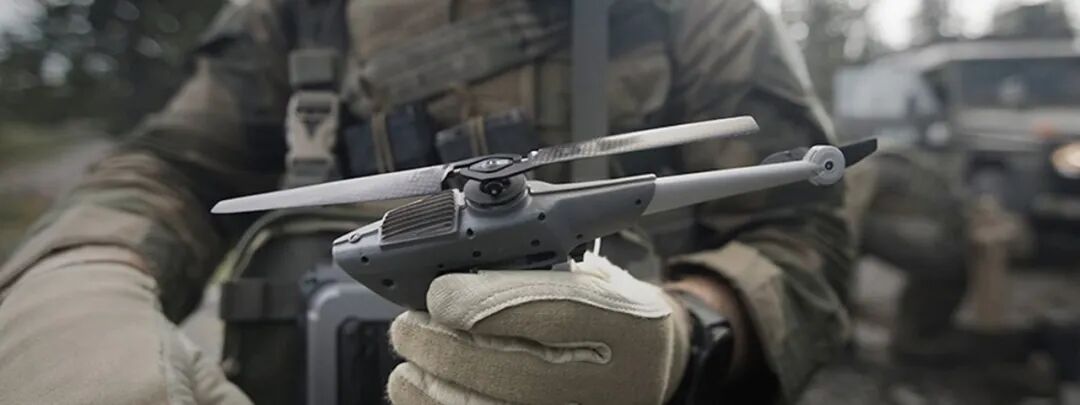
The building sweeping operation no longer requires live soldiers; there are specialized small reconnaissance drones, about the size of a palm, that fly very quietly and are inaudible unless you get close. By operating these small reconnaissance drones, they check each building and each room, and once enemies are spotted, they locate them and send artillery or FPV vehicles to kill them. If no one is found, they call in friendly soldiers to take the position.
In the current urban warfare between Russia and Ukraine, soldiers are hiding like rats, while dozens of drones search the skies. Humanity has considered countermeasures, such as signal jammers that could disable drones within a small area. Then the attacking side developed fiber optic drones—very thin beams of light, as thick as a human hair—suspended on the drone, effectively turning it into a wired system, rendering signal jamming ineffective.
On such a battlefield, humanoid robots or robot dogs have virtually no room to maneuver; they'll be instantly killed if they show their faces, unless the cost of robot dogs also drops to a few hundred US dollars, making a one-for-one trade a viable option.
In summary, drones dominate the battlefield because they are cheap, portable, deployable anytime and anywhere, small and difficult to detect, flexible, and capable of providing three-dimensional coverage. Although weapons have been developed to counter them, they are either expensive, difficult to deploy, or lack mobility, making it difficult to completely suppress drones.
Of course, this is not bad news, because China's drone manufacturing capabilities and technological level are among the best in the world.
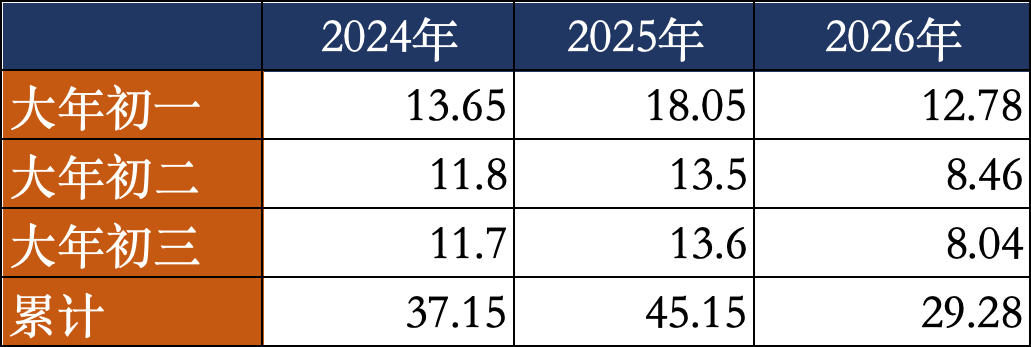
I have a vision for future wars: each side sends out a robot army to fight remotely. The side whose robots are defeated concedes the loss, without sending soldiers to their deaths. By the way, please don't screenshot this, otherwise, if one day silicon-based guys rule the earth and someone reports me for this, I'll be in grave danger.  The box office figures for the first three days of this year are in, totaling 2.928 billion yuan. This figure is not ideal, being 1.5 billion yuan less than the same period last year. Even excluding the phenomenal success of "Ne Zha 2," it's still more than 700 million yuan less than in 2024. I've made a table so you can see the difference at a glance.
The decline in box office revenue has little to do with ticket prices, which have fluctuated slightly around 50 yuan for the past three years. The key reason is a decrease in the number of moviegoers. As for why the number of viewers suddenly dropped by 20-30%, I can't say for sure, but it's probably because the films this year were of mediocre quality and the audience wasn't buying into them. Those who positioned themselves in the cinema sector before the holiday should prepare to be punished afterward.
Speaking of which, the Chinese film industry also suffers from overcapacity. I'll tell you a statistic that will probably shock you. In 2010, according to official statistics, there were approximately 6,200 screens in China. By the end of 2025, this number had skyrocketed to 93,187, a 15-fold increase in 15 years. On the other hand, the number of moviegoers in China reached a record high of 1.73 billion in 2019, but has since declined year by year due to the impact of short videos and other forms of entertainment, currently hovering around 1.2 billion annually.
On one hand, the number of screens has surged, while on the other hand, the number of moviegoers has declined, leading to a sharp drop in attendance and annual revenue per screen, causing many cinemas to suffer losses. A reader previously asked why Wanda Cinemas' stock price hasn't increased. How can it increase in this situation? All businesses in China tend to fall into a highly competitive environment, with the entire industry losing money, and then production capacity exiting this phase. Chinese cinemas are currently at their lowest point.
As for catering consumption, it seems to be doing alright. In the first three days of the holiday, 78 key pedestrian streets/business districts saw a 4.5% year-on-year increase in visitor traffic, a 4.8% year-on-year increase in revenue, and a 10.7% increase in sales for key catering enterprises. These figures are acceptable.
Another noteworthy recent development is the slow progress of US-Iran negotiations. Foreign media reports indicate that Iran is only willing to relinquish its nuclear weapons, but not its civilian nuclear industry and missile production, nor will it abandon its support for foreign armed groups. This is gradually exhausting Trump's patience, leading him to believe that Iran is merely stalling for time.
The United States is accelerating the deployment of its naval and air forces to the Middle East, including two carrier strike groups, two-thirds of its active-duty early warning aircraft, and a large number of bombers. International oil prices jumped another 4% yesterday, with Brent crude reaching $72, a six-month high.
Gold rose slightly back to $5040, while silver approached $80.
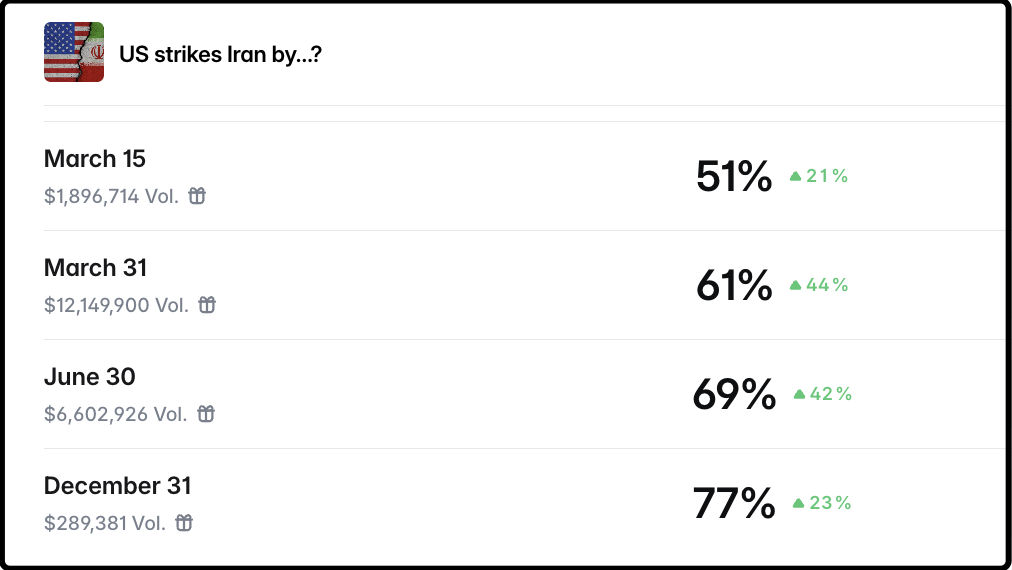
On-chain casinos report an increased probability of a US military strike against Iran: 27% if it happens before the end of February, 51% if it happens before March 15, and 61% if it happens before the end of March.
If Trump takes action in the next few days, those who bought commodities before the holiday will make a fortune. From this perspective, I estimate many people hope Iran will remain firm. War inevitably leads to death, but neither the US nor Israel intends to intervene on the ground; air strikes will be the primary method. Their intelligence is quite accurate, and their targets will mainly be military facilities and power plants, hoping to minimize civilian casualties.
The above is a pre-made meal I wrote in the afternoon. Every year on the fourth day of the Lunar New Year, I invite relatives and friends from my extended family for a gathering. Because my maternal grandmother's family is very large in the area, there are quite a few people who come, totaling 5 tables. In the future, as the next generation grows, there may be 6-7 tables. This is a particularly happy day for me, so I definitely drank too much. When I got home that night, I went straight to sleep, but my mom woke me up at 10 pm to go to work.
This is how Chinese New Year should be! How about you guys, are you enjoying your drinks?
The box office figures for the first three days of this year are in, totaling 2.928 billion yuan. This figure is not ideal, being 1.5 billion yuan less than the same period last year. Even excluding the phenomenal success of "Ne Zha 2," it's still more than 700 million yuan less than in 2024. I've made a table so you can see the difference at a glance.
The decline in box office revenue has little to do with ticket prices, which have fluctuated slightly around 50 yuan for the past three years. The key reason is a decrease in the number of moviegoers. As for why the number of viewers suddenly dropped by 20-30%, I can't say for sure, but it's probably because the films this year were of mediocre quality and the audience wasn't buying into them. Those who positioned themselves in the cinema sector before the holiday should prepare to be punished afterward.
Speaking of which, the Chinese film industry also suffers from overcapacity. I'll tell you a statistic that will probably shock you. In 2010, according to official statistics, there were approximately 6,200 screens in China. By the end of 2025, this number had skyrocketed to 93,187, a 15-fold increase in 15 years. On the other hand, the number of moviegoers in China reached a record high of 1.73 billion in 2019, but has since declined year by year due to the impact of short videos and other forms of entertainment, currently hovering around 1.2 billion annually.
On one hand, the number of screens has surged, while on the other hand, the number of moviegoers has declined, leading to a sharp drop in attendance and annual revenue per screen, causing many cinemas to suffer losses. A reader previously asked why Wanda Cinemas' stock price hasn't increased. How can it increase in this situation? All businesses in China tend to fall into a highly competitive environment, with the entire industry losing money, and then production capacity exiting this phase. Chinese cinemas are currently at their lowest point.
As for catering consumption, it seems to be doing alright. In the first three days of the holiday, 78 key pedestrian streets/business districts saw a 4.5% year-on-year increase in visitor traffic, a 4.8% year-on-year increase in revenue, and a 10.7% increase in sales for key catering enterprises. These figures are acceptable.
Another noteworthy recent development is the slow progress of US-Iran negotiations. Foreign media reports indicate that Iran is only willing to relinquish its nuclear weapons, but not its civilian nuclear industry and missile production, nor will it abandon its support for foreign armed groups. This is gradually exhausting Trump's patience, leading him to believe that Iran is merely stalling for time.
The United States is accelerating the deployment of its naval and air forces to the Middle East, including two carrier strike groups, two-thirds of its active-duty early warning aircraft, and a large number of bombers. International oil prices jumped another 4% yesterday, with Brent crude reaching $72, a six-month high.
Gold rose slightly back to $5040, while silver approached $80.
On-chain casinos report an increased probability of a US military strike against Iran: 27% if it happens before the end of February, 51% if it happens before March 15, and 61% if it happens before the end of March.
If Trump takes action in the next few days, those who bought commodities before the holiday will make a fortune. From this perspective, I estimate many people hope Iran will remain firm. War inevitably leads to death, but neither the US nor Israel intends to intervene on the ground; air strikes will be the primary method. Their intelligence is quite accurate, and their targets will mainly be military facilities and power plants, hoping to minimize civilian casualties.
The above is a pre-made meal I wrote in the afternoon. Every year on the fourth day of the Lunar New Year, I invite relatives and friends from my extended family for a gathering. Because my maternal grandmother's family is very large in the area, there are quite a few people who come, totaling 5 tables. In the future, as the next generation grows, there may be 6-7 tables. This is a particularly happy day for me, so I definitely drank too much. When I got home that night, I went straight to sleep, but my mom woke me up at 10 pm to go to work.
This is how Chinese New Year should be! How about you guys, are you enjoying your drinks? 
Original Article: View Chinese Version