After the article was published last night, many readers left comments saying that if my mother hadn't returned to Taizhou, there would be another me in a parallel universe, born in Shangyu, and I would be considered a Shaoxing native. This might be better than being born in Taizhou, because Shaoxing's overall economy and per capita income are better.
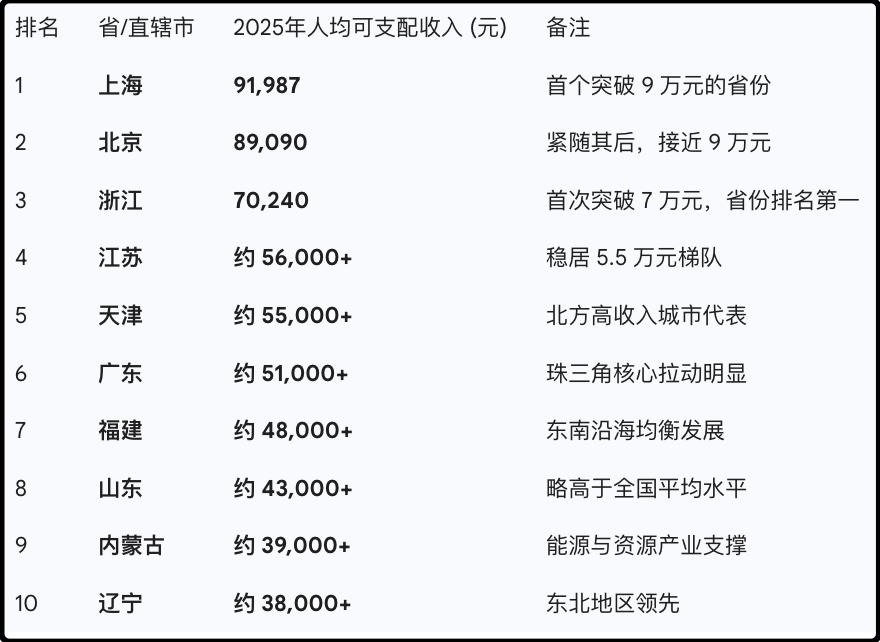
Maybe so. Being born in Zhejiang is generally a good thing; the province has no weaknesses, and everything is decent. Aside from Beijing and Shanghai, which are significantly better off, Zhejiang has consistently had the highest per capita disposable income for many years.
I've done a comparison before. Zhejiang Province and South Korea are very similar in size and population. Zhejiang's per capita income is 60% of South Korea's. However, because of the advantages of cheap public services and low-cost goods in mainland China, the overall living standards of Zhejiang people are comparable to those of South Korea. Zhejiang has already stepped into the threshold of a developed country.
A reader previously asked why Jiangsu, Guangdong, and Shandong have higher GDPs, but lower per capita incomes than Zhejiang. This is because the industries in these three provinces are mostly driven by foreign investment or state-owned enterprises. Although their industrial output is high, the profits are often taken by foreign investors and the headquarters of state-owned enterprises, leaving mainly labor compensation for the local residents.
What makes Zhejiang special is its high proportion of private enterprises. Although its GDP is not as high as that of Jiangsu, Guangdong, and Shandong, most of its profits remain locally. I checked the data, and there are about 3.8 million private enterprises and about 7.5 million individual businesses in Zhejiang, totaling 11.3 million.
Zhejiang has a total population of only 66.7 million, which means that one in every six people is a "boss" and one in every 17 people is a "business owner". This rate of having business owners is the highest in the country.
It was in this environment of widespread entrepreneurship that so many people eagerly jumped into business. My father quit his secure job at the Agricultural Bank of China in 1991 to start his own business. If this had happened in a northern province, his family probably would have discouraged him long ago, but he did it anyway because he saw relatives and friends making money in business, and he thought he could too. It's a pity he messed it up; otherwise, I might be the young master of a listed company now, or at the very least, a rich second-generation heir, hahaha.
Taizhou is considered average in Zhejiang, and Linhai is considered average in Taizhou, but this county-level city of Linhai has 10 listed companies: Huahai Pharmaceutical, Yongtai Technology, Weixing Shares, Weixing Pipe Industry, Wansheng Shares, Aoxiang Pharmaceutical, Zhejiang Yongqiang, Zhejiang Zhengte, Liansheng Chemical, and Benli Technology.
Have any of you bought any of these?  The Lunar New Year is just around the corner, and in addition to family gatherings for meals, another custom in our area is to visit the graves of our ancestors.
My grandmother passed away in 1999, my maternal grandfather in 2004, my maternal paternal grandmother in 2014, and my paternal grandfather in 2023. Except for my paternal grandfather, who passed away during the period when the pandemic restrictions were lifted, the other three have been gone for quite some time. Several times when I kowtow, I have silently wondered whether, if there is another world, they will live in the cemetery waiting for us to come and pay our respects every year, or whether they will simply be reincarnated.
If it were me, I would definitely reincarnate. After all, children only come once or twice a year, so it's better to end this life and start a new one. Those who died a decade or so ago were better off, as the birth rate was higher than the death rate; you died here and someone else was born there. Now, with the low birth rate, the birth rate is lower than the death rate, so if you die, you have to get a number and wait in line.
China's population has only recently begun to decline, so you'll only have to wait a few months at most. If you die after 2040, you'll likely have to wait 15-20 years; if you die after 2060, you'll likely have to wait 40-50 years. You might even see your own children waiting in line at the back of the queue.
The Lunar New Year is just around the corner, and in addition to family gatherings for meals, another custom in our area is to visit the graves of our ancestors.
My grandmother passed away in 1999, my maternal grandfather in 2004, my maternal paternal grandmother in 2014, and my paternal grandfather in 2023. Except for my paternal grandfather, who passed away during the period when the pandemic restrictions were lifted, the other three have been gone for quite some time. Several times when I kowtow, I have silently wondered whether, if there is another world, they will live in the cemetery waiting for us to come and pay our respects every year, or whether they will simply be reincarnated.
If it were me, I would definitely reincarnate. After all, children only come once or twice a year, so it's better to end this life and start a new one. Those who died a decade or so ago were better off, as the birth rate was higher than the death rate; you died here and someone else was born there. Now, with the low birth rate, the birth rate is lower than the death rate, so if you die, you have to get a number and wait in line.
China's population has only recently begun to decline, so you'll only have to wait a few months at most. If you die after 2040, you'll likely have to wait 15-20 years; if you die after 2060, you'll likely have to wait 40-50 years. You might even see your own children waiting in line at the back of the queue.  If you're in a hurry, you can consider getting a number in India or Africa. Actually, India is alright; decades from now, India will likely be no worse than China is now. However, be cautious about getting a number in Africa, as you might have to come back to queue up again soon after you get off.
My wife brought our two sons to Taizhou yesterday to celebrate the Chinese New Year.
My eldest son sleeps in the same bed with me. He said he's scared to sleep with me because when I hold him, I can't help but fall asleep first, while he's still awake. What if a ghost comes and takes him away without me even knowing?
I frowned and said, "You're a 10-year-old boy, are you still afraid of ghosts?"
He nodded repeatedly, "I'm scared."
I thought about it and decided to try a different approach to comfort him. If people die and become ghosts, then ghosts don't necessarily harm people. For example, if I, Dad, died and became a ghost, I wouldn't harm my own son. Would you be afraid of me becoming a ghost?
He thought for a moment and said he wasn't afraid of his father turning into a ghost, but there were so many ghosts that he didn't know which one was his father, so he was still afraid.
I pursed my lips, wondering how to answer him.
He suddenly came up with an idea: "Dad, if you become a ghost, before you come to see me, just knock over the water bottle I usually drink from on the table, and I'll know it's you."
I paused for a moment, then nodded and said it was settled. This was the secret code that my son and I had agreed upon.
If you're in a hurry, you can consider getting a number in India or Africa. Actually, India is alright; decades from now, India will likely be no worse than China is now. However, be cautious about getting a number in Africa, as you might have to come back to queue up again soon after you get off.
My wife brought our two sons to Taizhou yesterday to celebrate the Chinese New Year.
My eldest son sleeps in the same bed with me. He said he's scared to sleep with me because when I hold him, I can't help but fall asleep first, while he's still awake. What if a ghost comes and takes him away without me even knowing?
I frowned and said, "You're a 10-year-old boy, are you still afraid of ghosts?"
He nodded repeatedly, "I'm scared."
I thought about it and decided to try a different approach to comfort him. If people die and become ghosts, then ghosts don't necessarily harm people. For example, if I, Dad, died and became a ghost, I wouldn't harm my own son. Would you be afraid of me becoming a ghost?
He thought for a moment and said he wasn't afraid of his father turning into a ghost, but there were so many ghosts that he didn't know which one was his father, so he was still afraid.
I pursed my lips, wondering how to answer him.
He suddenly came up with an idea: "Dad, if you become a ghost, before you come to see me, just knock over the water bottle I usually drink from on the table, and I'll know it's you."
I paused for a moment, then nodded and said it was settled. This was the secret code that my son and I had agreed upon.
Original Article: View Chinese Version