I came across a question from a female reader that was quite representative.
She's a 27-year-old nurse from a second-tier city. Before the Lunar New Year, she met a man on a blind date who used to work but started investing in stocks full-time last year. He had turned about 200,000 yuan of his savings into over 2 million yuan in three or four years. She was worried about the unstable income after starting a family with him and asked me if he was reliable.
Most retail investors, due to their trading habits such as constantly cutting profits, never make more than 100% of their money even after more than a decade of trading. This young man's ability to make 10 times his initial investment in three or four years shows that he has a good market sense and has already grasped the winning trading pattern.
But there are still three things to clarify:
1. Did you use leverage in the process of growing from 200,000 to 2 million? If it was all earned with your principal, then it's very valuable. If you used leverage, then the value will be reduced. Leverage can make you money or make you lose money; it's a double-edged sword.
2. What was the maximum drawdown during the process of increasing from over 200,000 to over 2 million? A drawdown that is too small (below 20%) is not a good sign. It's possible that the investor took advantage of a favorable market trend and was riding high, and it's not yet clear whether they have the ability to control risk and withstand pressure in adverse situations. The A-share market has nearly doubled in the past year and a half, and many investors are now feeling very good about themselves.
Considering his profitability, he must be involved in highly volatile stocks on a daily basis, so I think a maximum drawdown of 20-40% is quite normal.
3. If, after achieving substantial profits, 20% of the funds are set aside as a family risk reserve—for example, withdrawing 1 million when profits reach 5 million, and then withdrawing 200,000 for every additional 1 million earned—would he agree to such a plan? This reveals a stock investor's risk management strategy. A gambler who invests entirely in speculation and is unwilling to build a safety margin has inherent character flaws.
In general, the woman's stable job paired with the man's professional investment seems like a good match. If they really hit the jackpot, the man's future income growth will be explosive, directly elevating the entire family's asset class. However, there are also many problems. First, professional stock investors have almost no social connections and low social density, which may lead to a somewhat withdrawn personality, naivety, and a lack of emotional support over time. Second, their state of mind is affected by market conditions. During market downturns and repeated trading setbacks, their high stress levels may cause them to vent negative emotions at home. Finally, professional stock investors are generally not very interesting and tend to be cautious with their spending, as every penny they spend is driven by profit and loss considerations.
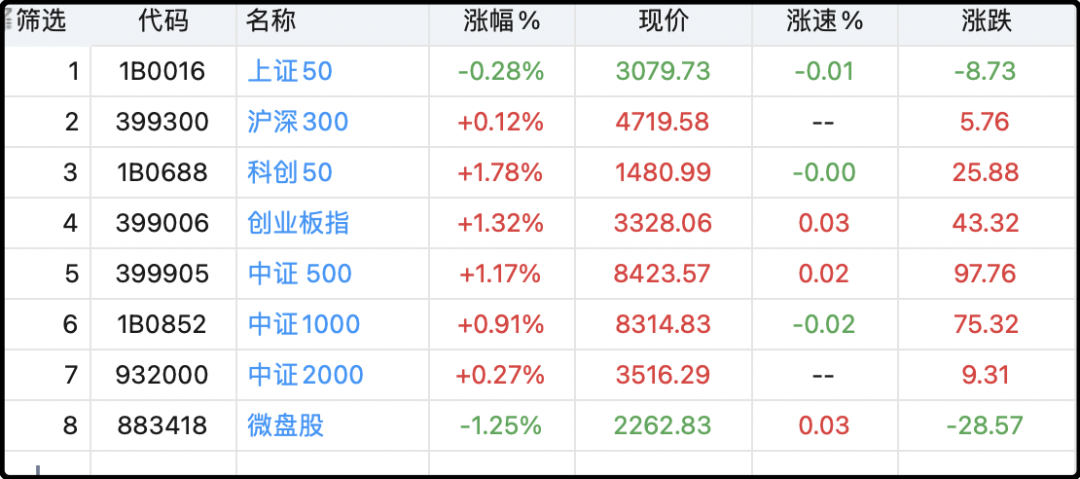
The above seems to be written for the female reader who asked the question, but it's actually also for male readers who are moving towards a career in investing. Over the past ten years or so, I feel like I've lived a rather abnormal life; my schedule is chaotic, and I lack exercise. Fortunately, I still maintain connections with society by writing on my public account, and my mindset is relatively healthy.  Today, A-share trading volume rebounded slightly to 2.13 trillion yuan, but it wasn't much, indicating the market didn't seem to be planning anything significant before the Spring Festival. The eight broad-based indices exhibited a rare pattern of a cold start followed by a hot finish, suggesting that funds are flowing back into previously popular sectors. Under the Matthew effect, most investors' holdings are unlikely to outperform the ChiNext and CSI 500 indices.
 The biggest losers these past two days have been film and entertainment. It was up 11% the day before yesterday, then fell 5.3% yesterday and 5.4% today, completely recovering its losses. The leading stock, Hengdian Film & Television, even hit its daily limit down twice. This is a classic case of me predicting your prediction, starting the hype a month in advance, and then unloading and settling accounts before the release. I've said before that I hate this kind of game because of the information asymmetry; I won't give others the opportunity to fight me with guns and arrows.
Today's biggest losers were all in the consumer sector, including travel, liquor, retail, aquaculture, and beauty. Funds in these sectors weren't even willing to wait for the post-holiday positive news to materialize; they rushed to sell before the holiday. This doesn't mean they're pessimistic about Spring Festival consumption data; it's purely a game of infighting. In this kind of game of trying to steal money from each other's pockets, it's first come, first served.
That's pretty much it before the holiday. Tomorrow's the last trading day, so I'll take a break. It feels like there's still something to do after the holiday. I have high hopes for this year. The A-share market finally broke 4000 points; it's unlikely it will fizzle out before even reaching 4200. To those brothers still debating whether to hold stocks or cash over the holiday, I can only say you need to broaden your perspective. Only those who can afford to lose can truly win.
The biggest losers these past two days have been film and entertainment. It was up 11% the day before yesterday, then fell 5.3% yesterday and 5.4% today, completely recovering its losses. The leading stock, Hengdian Film & Television, even hit its daily limit down twice. This is a classic case of me predicting your prediction, starting the hype a month in advance, and then unloading and settling accounts before the release. I've said before that I hate this kind of game because of the information asymmetry; I won't give others the opportunity to fight me with guns and arrows.
Today's biggest losers were all in the consumer sector, including travel, liquor, retail, aquaculture, and beauty. Funds in these sectors weren't even willing to wait for the post-holiday positive news to materialize; they rushed to sell before the holiday. This doesn't mean they're pessimistic about Spring Festival consumption data; it's purely a game of infighting. In this kind of game of trying to steal money from each other's pockets, it's first come, first served.
That's pretty much it before the holiday. Tomorrow's the last trading day, so I'll take a break. It feels like there's still something to do after the holiday. I have high hopes for this year. The A-share market finally broke 4000 points; it's unlikely it will fizzle out before even reaching 4200. To those brothers still debating whether to hold stocks or cash over the holiday, I can only say you need to broaden your perspective. Only those who can afford to lose can truly win.  I had a high school reunion tonight, so I wrote a little before leaving home. I was a bit sleepy after drinking, so I lay down and dozed off for a while. But I woke up around 10 o'clock. My mom said she would wake me up to update if I slept a little longer.
Look, this is the professional spirit of a daily blogger. The alarm clock rings at 10 PM every day; a sense of responsibility jols them up to work. I won't be checking the news today; it doesn't seem like anything serious, and my uncle is in a similar situation.
Speaking of my trip back to Linhai, I drank every single day, every single night. If everyone in this society were as self-disciplined as I am, the liquor and consumer market would have been much better long ago.
I had a high school reunion tonight, so I wrote a little before leaving home. I was a bit sleepy after drinking, so I lay down and dozed off for a while. But I woke up around 10 o'clock. My mom said she would wake me up to update if I slept a little longer.
Look, this is the professional spirit of a daily blogger. The alarm clock rings at 10 PM every day; a sense of responsibility jols them up to work. I won't be checking the news today; it doesn't seem like anything serious, and my uncle is in a similar situation.
Speaking of my trip back to Linhai, I drank every single day, every single night. If everyone in this society were as self-disciplined as I am, the liquor and consumer market would have been much better long ago. 
Original Article: View Chinese Version